Lời giải Tiếng Anh 11 Unit 9 Global Success: Social Issues chi tiết
 IELTS LangGo
  16/09/2026



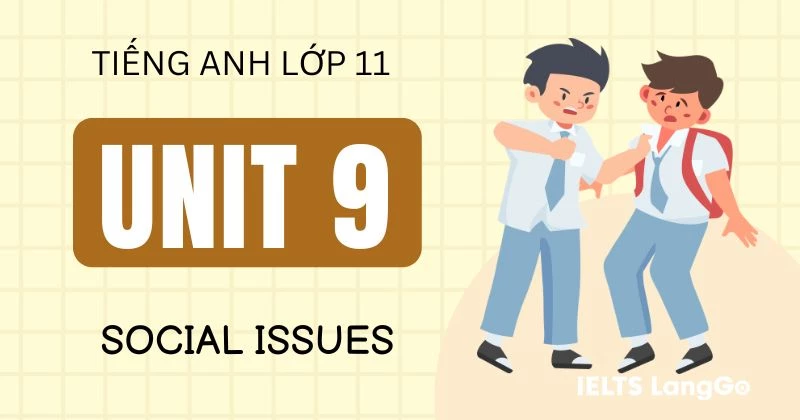
Unit 9 Tiếng Anh lớp 11 sách Global Success với chủ đề Social Issues (Các vấn đề xã hội) giúp học sinh tìm hiểu về những vấn đề xã hội ảnh hưởng đến thanh thiếu niên ngày nay, đặc biệt là áp lực bạn bè (peer pressure), bắt nạt học đường (bullying) và bắt nạt trực tuyến (cyberbullying).
Bài viết tổng hợp đầy đủ đáp án và gợi ý trả lời cho tất cả các hoạt động trong unit, giúp các bạn học sinh lớp 11 củng cố kiến thức và đạt kết quả cao trong học tập.
>>> Xem thêm: Lời giải Tiếng Anh 11 Global Success 10 Unit
I. Getting Started
1. Listen and read
Mở đầu Unit 9 là cuộc trò chuyện giữa Mark, Mai và Nam trong một buổi họp câu lạc bộ nâng cao nhận thức xã hội. Nhóm bạn cùng thảo luận về chủ đề nào nên được đưa vào chiến dịch truyền thông của câu lạc bộ, từ các vấn đề chung của thành phố đến những vấn đề trực tiếp tác động đến lứa tuổi học sinh.
2. Who suggests the following ideas? Tick (✓) the correct box.
| Mark | Mai | Nam | |
| 1. Issues that have an effect on many people in the city | ✓ | ||
| 2. Problems that have a direct impact on teens | ✓ | ||
| 3. An issue that teens face in their everyday life | ✓ |
3. Find five social issues in 1. Use the pictures and hints below to help you.

Đáp án:
1 - crime
2 - overpopulation
3 - bullying
4 - peer pressure
5 - body shaming
4. Complete the summary with words from 1.
Nam believes that there are major teen problems today (1) although many people don't feel comfortable talking about them. Mai agrees with him. Mark thinks they should focus on a problem teens struggle with every day. (2) However, they'll try to use Mai's ideas for another project. Finally, Nam suggests focusing their campaign on bullying (3) because this issue is very common among teenagers these days.
>>> Xem chi tiết: Tiếng Anh 11 Unit 9 Getting Started
II. Language
Phần Language Unit 9 tập trung vào ba mảng kiến thức chính: phát âm ngữ điệu trong câu hỏi lựa chọn, từ vựng về các vấn đề xã hội và ngữ pháp về các từ/cụm từ liên kết. Đây là nền tảng giúp học sinh sử dụng tiếng Anh chính xác và tự nhiên hơn khi nói và viết về chủ đề xã hội.
Pronunciation: Intonation in Choice Questions
Bài 1. Listen and repeat. Pay attention to the intonation. Practise saying the questions in pairs.
1. Should we focus our campaign on a general social issue ↗ or one affecting mainly teens ↘?
2. Is the top problem facing teens today peer pressure ↗, body shaming ↗, or bullying ↘?
Bài 2. Mark the intonation in these questions. Then listen and check. Practise saying them in pairs.
1. Is peer pressure good ↗ or bad ↘?
2. Is this a social ↗ or environmental issue ↘?
3. Should our campaign focus on crime ↗, overpopulation ↗, or climate change ↘?
4. Do you talk to your parents ↗, share problems with your friends ↗, or ask your teachers for advice ↘?
Vocabulary: Social Issues
Bài 1. Find five words in the word search and write them next to the correct definition. Use the glossary (page 130) to help you.
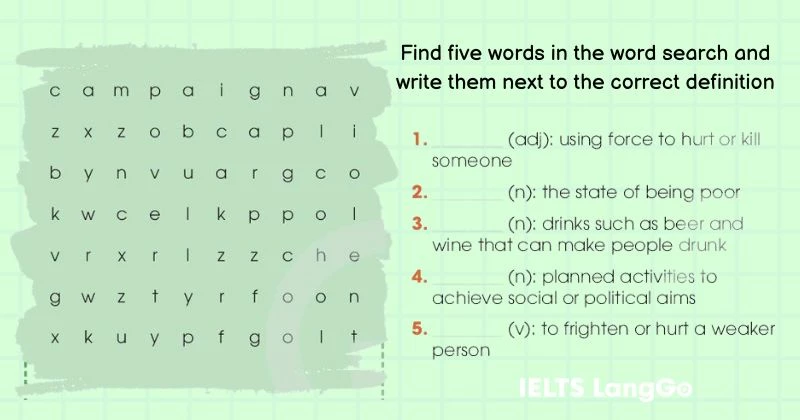
1 - violent
2 - poverty
3 - alcohol
4 - campaign
5 - bully
Bài 2. Complete the sentences using the correct forms of the words in 1.
1. People mustn't drive after drinking alcohol. It's dangerous!
2. The boy does not want to go to school because he is afraid of being bullied.
3. Many children live in poverty. They often stop going to school so that they can work.
4. Many parents complain about the number of violent TV programmes for children.
5. We are going to start a campaign to raise awareness of animal rights.
>>> Xem thêm: Trọn bộ Từ vựng Unit 9 lớp 11 Global Success chủ đề Social Issues
Grammar: Linking Words and Phrases
Bài 1. Connect these sentences, using linking words or phrases.
1. Some people cannot control their anger when drinking alcohol. As a result / Therefore / As a consequence, they become violent.
2. Body shaming is a very common issue. However, many people are not aware of it.
3. Alcohol can affect people's mind and behaviour. Besides / Moreover / In addition, they can cause other health problems.
4. The government has promised to solve our environmental issues. However, little has been achieved so far.
Bài 2. Work in pairs. Add more sentences to each item. Use different linking words and/or phrases.
Gợi ý trả lời:
1. Some children play too many violent computer games. As a result, they can also become violent. Besides, it's unhealthy for them to play video games for hours. Therefore, parents should monitor their children's screen time carefully.
2. Many people live in poverty. As a consequence, they cannot afford basic necessities like food and shelter. In addition, they may not have access to proper healthcare. Therefore, the government should implement effective poverty reduction programmes.
3. Awareness campaigns help to draw people's attention to social issues. Besides, these campaigns can encourage people to take action and make positive changes. Therefore, organizing awareness campaigns is an effective way to address social problems.
>>> Xem chi tiết: Tiếng Anh 11 Unit 9 Language
III. Reading
Bài đọc Unit 9 tập trung vào chủ đề áp lực bạn bè (peer pressure) - một vấn đề quen thuộc với hầu hết học sinh trung học - giúp học sinh nhận biết biểu hiện của áp lực bạn bè, hiểu tác hại của nó và biết cách đối phó phù hợp.
1. Work in pairs. Discuss the question.
Have your friends ever made you do something you do not like? If yes, give an example.
Gợi ý trả lời:
Yes, last year my friends tried to convince me to skip class to go to a gaming center. They said everyone was doing it, and I would be the odd one out if I didn't join them. I felt uncomfortable because I knew it was wrong, but I didn't want to lose my friends. However, I decided to say no because I valued my education. Some friends made fun of me at first, but eventually they respected my decision.
2. Read the article. Match the highlighted words and phrases with their meanings.
1 - d: hang out = to spend a lot of time in a place
2 - c: pressure = the act of trying to force someone to do something by arguing, persuading, etc.
3 - b: depression = the state of feeling very sad and without hope for the future
4 - a: self-confidence = a belief in your own ability to do things well
3. Read the article again. Which paragraph contains the following information? Write A, B, or C.
1. The definition of 'peer pressure' → A
2. How peer pressure can cause social issues → B
3. Dealing with peer pressure → C
4. The possible problems facing teens if they do not follow their peers → A
4. Read the article again and choose the correct answers A, B, or C.
1. What is the similarity between Thanh and Van?
→ C. Their parents do not approve of their behaviour.
2. Which is NOT mentioned in the article as a consequence of peer pressure?
→ A. Encouraging someone to fight.
3. What was reported about the effects of peer pressure on teenagers in the US?
→ C. More than two-thirds of teen smokers started the habit under the influence of their friends.
4. According to the article, what is one way of dealing with peer pressure?
→ B. Not always saying yes to your friends.
5. Work in pairs. Discuss the following question.
Have you, or has someone you know, experienced any of the problems mentioned in this article?
Gợi ý trả lời:
Sample 1:
Yes, I experienced peer pressure last year when my friends wanted me to spend more time playing online games instead of studying. They said I was missing out on all the fun and that studying too much was boring. I felt torn between wanting to fit in and doing well at school. My grades started to drop, and I became distant from my family. Fortunately, my parents noticed and talked to me about it. I realized I needed to find a balance and choose friends who support my goals. Now I still play games but in moderation, and I've found friends who value education too.
Sample 2:
Yes, my classmate experienced peer pressure last year. Her friends often went to expensive coffee shops and bought branded clothes. She felt pressured to do the same to fit in, even though her family couldn't afford it. She started asking her parents for more pocket money and felt bad when they couldn't give her enough. This affected her relationship with her family and made her feel depressed. Later, she realized that true friends accept you for who you are, not what you wear or where you go. She found new friends who think the same way and is much happier now.
>>> Xem chi tiết: Tiếng Anh 11 Unit 9 Reading
IV. Speaking
Phần Speaking Unit 9 giúp học sinh chia sẻ và thảo luận về những trải nghiệm thực tế liên quan đến áp lực bạn bè, đồng thời luyện tập cách phản hồi phù hợp trong các tình huống bị gây áp lực.
1. Order the examples of peer pressure below from 1 (most powerful) to 6 (least powerful).
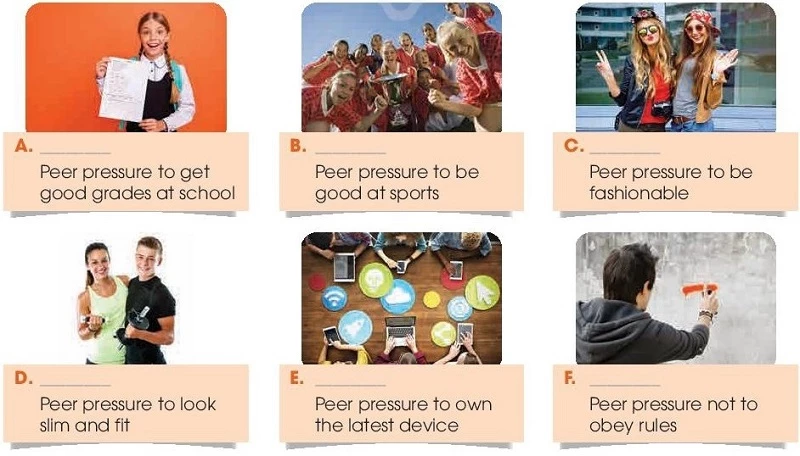
Đây là bài tập mang tính chủ quan, học sinh có thể sắp xếp theo quan điểm cá nhân. Dưới đây là một gợi ý tham khảo:
1 - A
2 - F
3 - D
4 - E
5 - C
6 - B
2. Work in pairs. Talk about your experiences of peer pressure. Use the following guiding questions.
Gợi ý trả lời:
Student A: Which example of peer pressure affects you most?
Student B: I think peer pressure to get good grades at school affects me the most. In my class, there's a lot of competition, and I always feel like I need to study harder to keep up with my friends. Sometimes it's overwhelming because I want to do well not just for myself, but also to maintain my reputation among my peers.
Student A: I understand. That can be really stressful. Which one affects you the least?
Student B: The pressure to be fashionable affects me the least. I'm comfortable with my own style and I don't really care much about following trends. I believe being yourself is more important than trying to fit in with what's considered "cool" at the moment.
Student A: That's a positive attitude! Which examples do you think are positive peer pressure?
Student B: I believe peer pressure to get good grades and to be good at sports can be positive. When my friends study hard, it motivates me to work harder too. Similarly, when friends encourage each other to stay active and healthy through sports, that's definitely a good thing. It's all about having the right mindset and not letting it become unhealthy competition.
3. Work in groups. Read the situations below and think of some possible responses. Provide reasons for each answer.
Gợi ý trả lời:
Tình huống 1: Your friend wants to skip a test, so he/she asks you to pretend that you are his/her parent(s) and write a letter to his/her teacher asking permission to be absent from school.
Response: "I can't do that. It's dishonest and could get both of us in trouble. Why don't we study together instead? I can help you prepare for the test."
→ Reason: Giúp bạn gian lận là sai. Nếu bị phát hiện, cả hai có thể bị đình chỉ. Tình bạn thực sự là giúp nhau thành công một cách trung thực, không phải tạo điều kiện cho sự không trung thực.
Tình huống 2: Your friend has just got the latest smartphone. He/She makes fun of your old smartphone and says that you should buy a new one.
Response: "My phone works fine for what I need. A phone is just a tool and I'd rather save money for more important things like my education. l, not a status symbol."
→ Reason: Tiết kiệm tiền cho việc học tập quan trọng hơn việc theo xu hướng. Điện thoại vẫn hoạt động tốt thì không cần thay.
Tình huống 3: Your friend is getting good grades in English. He/She wants you to join his/her study group so that you can also improve your English.
Response: "That's really kind of you! I'd love to join. Studying together could really help me improve my grammar and vocabulary. When does your group meet?"
→ Reason: Đây là áp lực tích cực. Học nhóm với bạn giỏi giúp cải thiện kết quả học tập thông qua chia sẻ kiến thức và tạo động lực học tập.
Tình huống 4: Your friend is skipping classes frequently. He/She says that every teen does it sometimes, and you should do it as well.
Response: "Just because others do it doesn't make it right. We are here to learn and skipping classes will affect my grades. I'm also worried that you might fall behind."
→ Reason: Bỏ học là vi phạm nội quy và bỏ lỡ bài học quan trọng. Điều này ảnh hưởng xấu đến điểm số và có thể bị kỷ luật.
4. Report your answers to the whole class. Vote for the most interesting responses.
Học sinh trình bày câu trả lời trước lớp và bình chọn cho những phản hồi thú vị và thuyết phục nhất.
>>> Xem chi tiết: Tiếng Anh 11 Unit 9 Speaking
V. Listening
Phần Listening Unit 9 giúp học sinh nhận biết các hình thức bắt nạt khác nhau và luyện tập kỹ năng nghe lấy thông tin cụ thể qua một cuộc trò chuyện giữa hai học sinh về chủ đề bullying.
1. Choose the word or phrase with the closest meaning to the underlined one.
1 - B
2 - B
3 - B
2. Listen to a conversation between two students and match the pictures with the type of bullying.

1 - d. physical bullying
2 - b. verbal bullying
3 - a. social bullying
4 - c. cyberbullying
3. Listen again. Circle the correct answers.
1. Technology has made bullying more common.
2. Mai's friend was bullied by others on social media.
3. One of the most common forms of cyberbullying is body shaming.
4. In their next meeting, they are most likely to talk about how bullying can be stopped.
4. Work in groups. Discuss the following question.
What types of bullying have you experienced or seen happening to people around you?
Gợi ý trả lời:
I have seen all four types of bullying at my school and online.
Physical bullying sometimes happens in the schoolyard. I've seen some older students pushing or hitting younger students to take their money or belongings. This makes the victims very scared to go to school.
Verbal bullying is very common. Some students call others bad names or make fun of their appearance. For example, my classmate was often teased about wearing glasses. He felt very sad and didn't want to talk to anyone.
Social bullying also happens a lot. Some groups of students deliberately ignore certain classmates and don't let them join group activities. They also spread rumors about others. One girl in my class became very lonely because nobody wanted to be her friend.
Cyberbullying is becoming more serious. My friend was a victim of body shaming on social media. Some people posted mean comments about her weight. She felt very upset and deleted her account. Another classmate received threatening messages from anonymous accounts.
I think all types of bullying are serious and can hurt people deeply. We should speak up when we see bullying and help the victims feel safe.
>>> Xem chi tiết: Tiếng Anh 11 Unit 9 Listening
VI. Writing
Phần Writing Unit 9 hướng dẫn học sinh viết một đề xuất (proposal) cho chiến dịch trường học chống bắt nạt trực tuyến (cyberbullying). Đây là dạng văn bản thực dụng quan trọng, yêu cầu học sinh trình bày ý tưởng rõ ràng, logic và thuyết phục.
1. You are planning a school campaign against cyberbullying. Work in groups to discuss these questions.
Gợi ý trả lời:
1. When and where should the campaign take place? How long should it last?
The campaign should take place at school during the second semester, from March to May. It should last for three months. We can hold activities in the school hall for big events and in classrooms for smaller group discussions. This gives us enough time to organize different activities and help students understand the issue better.
2. Who should participate in it? (You can choose more than one and add your ideas.)
✓ A. Everyone who is interested. (Tất cả những ai quan tâm.)
✓ B. Victims of cyberbullying.
✓ C. Parents.
✓ D. Teachers.
✓ E. School counselors
All these groups should participate because each plays an important role. Students need to learn about cyberbullying, victims can share their experiences if they want to, parents need to understand how to help their children, teachers can guide students and spot problems, and school counselors can provide professional support.
3. What activities should the campaign include? (You can choose more than one and add your ideas.)
✓ A. Giving talks about cyberbullying.
✓ B. Providing students with resources where they can find information on cyberbullying and how to deal with it.
✓ C. Inviting students to share experiences of cyberbullying.
✓ D. Informing students of the school anti-bullying policies.
✓ E. Showing cyberbullying videos to promote discussion about the issue.
✓ F. Organizing poster competitions and workshops on digital safety.
These activities should work together to educate students. Expert talks provide knowledge, resources give students places to find help, sharing sessions create understanding, policy information shows consequences, videos make the issue real, and creative activities keep students engaged.
4. What should be the main goals of the campaign?
The main goals should be:
- To raise awareness about cyberbullying and its effects
- To teach students how to stay safe online
- To create a supportive environment where students feel safe to report problems
- To reduce cyberbullying incidents at school
2. Write a proposal for the campaign (150–180 words) to your head teacher. Use the ideas in 1 and the outline with useful expressions below to help you.
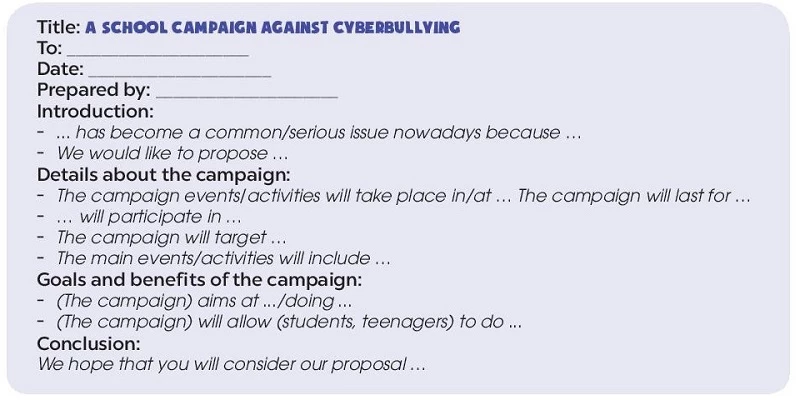
>>> Xem bài mẫu chi tiết: Tiếng Anh 11 Unit 9 Writing
VII. Communication and Culture / CLIL
Everyday English – Expressing Disappointment and Sympathy
Phần Everyday English Unit 9 giới thiệu các cách diễn đạt sự thất vọng và sự đồng cảm trong giao tiếp hàng ngày.
1. Listen and complete the conversation with the expressions in the box. Then practise it in pairs.
(1) C. What a pity
(2) B. I'm sorry to hear that
(3) A. I can sympathise
2. Work in pairs. Use the model in 1 to make similar conversations for these situations. One of you is Student A, the other is Student B. Use the expressions to help you.
| Student A can't go on a school trip because his/her little brother/sister is ill and he/she has to take care of him/her. Student B expresses disappointment and sympathy. |
Mẫu hội thoại:
B: Hi! Are you ready for our school trip tomorrow? I'm so excited!
A: I'm afraid I can't go with you. My little sister is very ill, and I have to stay home to take care of her.
B: What a pity! I was really looking forward to spending the day with you.
A: I know. I'm really disappointed too, but I have to take care of my sister.
B: I'm so sorry to hear that your sister is ill. I hope she gets better soon.
A: Thank you for understanding. Maybe I can join the next trip.
B: Of course! Take good care of your sister.
| Student B can't finish a community project on time because he/she is too stressed preparing for his/her exams. Student A expresses disappointment and sympathy. |
Mẫu hội thoại:
A: Hey, how's our community project going? We need to submit it by Friday.
B: I'm really sorry, but I don't think I can finish my part on time. I've been extremely stressed preparing for my final exams.
A: Oh no, that's too bad! I was counting on you to complete that section. How disappointing!
B: I know, and I feel terrible about it. The pressure has been overwhelming, and I haven't been sleeping well.
A: I'm sorry to hear that you're under so much stress. I can sympathise - exam preparation can be really tough. Your health and education are important too.
B: Thank you for understanding. Is there any way I can help after my exams are over?
A: Don't worry. Let me see if I can manage it. You focus on your exams first, and we'll figure something out.
B: I really appreciate your sympathy and flexibility. I'll make it up to you somehow.
CLIL - Social Problems Facing Teens in the US Today
1. Read the text and match each percentage in the chart with ONE social problem mentioned in the text.
| 70% | Anxiety and depression |
| 55% | Bullying |
| 40% | Poverty |
| 15% | Cyberbullying |
2. Work in pairs. Discuss the following questions.
Are the problems mentioned in the text similar to those facing Vietnamese teens? Are there any other problems among teenagers in Viet Nam?
>>> Xem gợi ý trả lời chi tiết: Tiếng Anh 11 Unit 9 Communication and Culture
VIII. Looking Back
Phần Looking Back giúp học sinh ôn tập và củng cố toàn bộ kiến thức đã học trong Unit 9, bao gồm phát âm ngữ điệu trong câu hỏi lựa chọn, từ vựng về các vấn đề xã hội và ngữ pháp về từ/cụm từ liên kết.
Pronunciation
Mark the intonation in these questions, using ↗ (rising intonation) or ↘ (falling intonation). Listen and check. Then practise saying them.
1. Should we report bullying to teachers ↗ or speak to our parents first ↘?
2. Is this social awareness campaign about poverty ↗ or crime ↘?
3. Have you ever experienced any physical ↗, verbal ↗, or social bullying ↘?
4. Do you worry about peer pressure ↗, body shaming ↗, or bullying ↘?
Vocabulary
Solve the crossword. Use the words you have learnt in this unit.
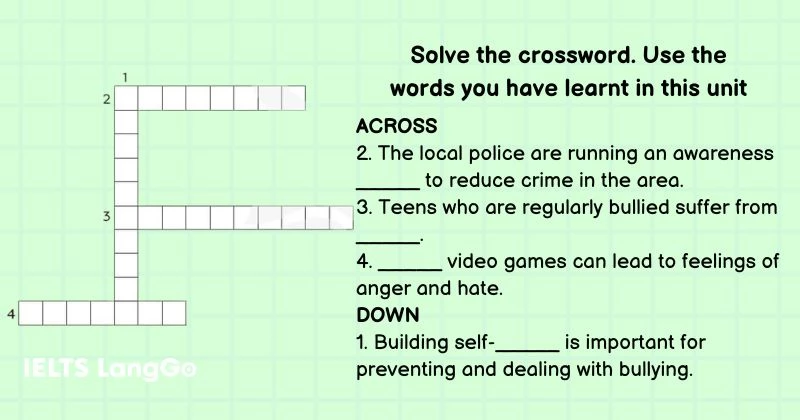
ACROSS:
2. The local police are running an awareness ______ to reduce crime in the area. → campaign
3. Teens who are regularly bullied suffer from ______. → depression
4. ______ video games can lead to feelings of anger and hate. → Violent
DOWN:
1. Building self-______ is important for preventing and dealing with bullying. → confidence
Grammar
Choose the correct answer to complete each sentence below.
1. In addition
2. Therefore
3. Because
4. In spite of
>>> Xem chi tiết: Tiếng Anh 11 Unit 9 Looking Back
IX. Project – A Social Awareness Campaign
Phần Project Unit 9 là hoạt động nhóm yêu cầu học sinh lên kế hoạch và trình bày một chiến dịch nâng cao nhận thức cộng đồng về một vấn đề xã hội cụ thể. Đây là cơ hội để các bạn vận dụng toàn bộ kiến thức đã học trong unit vào một tình huống thực tế có ý nghĩa.
Work in groups. Your class is starting a campaign to raise people's awareness about different social issues in your community. Each group is responsible for planning activities for one social issue.
Give a group presentation. Use these questions as cues:
- What is the social issue? How does it affect the community?
- Who will participate in your campaign? Who can help to fix this issue?
- What activities do you plan to include in your campaign? What are their goals?
>>> Xem bài mẫu chi tiết: Tiếng Anh 11 Unit 9 Project
Unit 9 Tiếng Anh lớp 11 về chủ đề Social Issues đã cung cấp cho học sinh những kiến thức quan trọng về các vấn đề xã hội phổ biến ảnh hưởng trực tiếp đến lứa tuổi thanh thiếu niên như áp lực bạn bè, bắt nạt học đường và bắt nạt trực tuyến.
Thông qua các hoạt động phong phú từ nghe, đọc, nói đến viết, các bạn đã được trang bị không chỉ kiến thức ngôn ngữ mà còn cả những kỹ năng xã hội cần thiết để nhận diện và ứng phó với những vấn đề này trong cuộc sống thực tế.
Mong rằng phần đáp án và gợi ý từ IELTS LangGo sẽ giúp các bạn nắm vững bài học và tự tin trong các bài kiểm tra.
>>> Xem thêm: Đáp án Tiếng Anh lớp 11 Unit 10 Global Success: The Ecosystem
BACK TO SCHOOL – Trúng Macbook Neo và hàng ngàn quà tặng khác

DEAL HỜI HẾT CỠ >> Dành riêng cho học viên đăng ký khóa học IELTS đến hết ngày 31/10
- Quay số trúng thưởng - Rinh MACBOOK xịn
- Giảm ngay 350.000đ khi đăng ký khóa 01 Level
- Ưu đãi học nhóm tới 250.000đ/ học viên
- Tặng ngay tài khoản Writing Xpert AI KHÔNG GIỚI HẠN