Lời giải Tiếng Anh 10 Unit 9 Global Success: Protecting the Environment
 IELTS LangGo
  03/09/2026



Unit 9 Tiếng Anh lớp 10 sách Global Success với chủ đề Protecting the Environment (Bảo vệ môi trường) giúp học sinh tìm hiểu về các vấn đề môi trường hiện nay như biến đổi khí hậu, nạn phá rừng và sự tuyệt chủng của các loài động vật hoang dã, đồng thời khám phá các giải pháp thiết thực để bảo vệ thiên nhiên.
Bài viết dưới đây tổng hợp đáp án và gợi ý trả lời cho toàn bộ các phần trong Unit 9, giúp các bạn học sinh nắm vững kiến thức bài học và vận dụng hiệu quả trong các bài kiểm tra cũng như thực tế giao tiếp.
>>> Xem thêm: Lời giải Tiếng Anh lớp 10 Global Success
I. Getting Started
Bài 1. Listen and read - A presentation on the environment
Phần Getting Started Unit 9 mở đầu bằng cuộc trò chuyện giữa Nam và bố về bài thuyết trình địa lý chủ đề bảo vệ môi trường. Qua đó, học sinh làm quen với từ vựng và cấu trúc câu liên quan đến các vấn đề môi trường.
Bài 2. Read the conversation again and answer the questions.
1. What did Nam's teacher ask him to do?
→ His teacher asked him to do some research on environmental protection.
2. What has Nam come up with so far?
→ He has come up with a range of environmental issues such as global warming, deforestation, endangered animals and pollution.
3. When does Nam have to deliver the presentation?
→ He has to present it the following week.
Bài 3. Match the words in A with the words in B to form phrases.
1. d - global warming
2. c - practical actions
3. b - environmental issues
4. a - endangered animals
Bài 4. Complete the following sentences with verbs from the conversation in 1.
1. My teacher asked me to do some research on environmental protection.
2. She advised me to start with small, practical actions to protect the environment.
3. She said I should deliver my presentation the following week.
>>> Xem chi tiết: Tiếng Anh 10 Unit 9 Getting Started
II. Language
Phần Language Unit 9 tập trung vào ba nội dung: phát âm nhịp điệu câu (rhythm), từ vựng về môi trường và cách bảo vệ môi trường, và ngữ pháp về câu tường thuật (reported speech).
Pronunciation - Rhythm
Bài 1. Listen and repeat. Pay attention to the stressed words in the sentences.
1. 'Don't 'pick the 'flowers when you 'go to the 'park.
2. The 'students 'clean the 'school 'playground 'every 'weekend.
3. 'What's 'happening with the 'polar 'bears?
4. Did you 'watch the docu'mentary about 'air pol'lution?
Bài 2. Mark the stressed syllables in the words in bold.
1. Don't 'feed the 'animals in the 'zoo while they are 'resting.
2. The 'teacher 'asked his 'students to 'focus on their 'work.
3. 'What were you 'doing when I 'rang you 'up an 'hour ago?
4. Are you 'reading the 'book about en'dangered 'animals in the 'world?
Vocabulary - Environment
Bài 1. Match the words or phrases to their meanings.
1. a - biodiversity: the variety of plants and animals in a particular area
2. d - habitat: the natural environment in which a plant or an animal lives
3. e - ecosystem: all the plants and animals in an area and the way they affect each other and the environment
4. b - wildlife: animals and plants that grow in natural conditions
5. c - climate change: changes in the world's weather, especially an increase in temperature
Bài 2. Complete the sentences using the correct form of the words and phrases in 1.
1. Biodiversity is important because plants and animals depend on each other to survive.
2. A new series of educational programmes shows the importance of wildlife to humans.
3. Their work involves protecting and creating natural habitats for plants and animals.
4. Countries need to work together to deal with global issues such as deforestation and climate change.
5. Pollution can have serious effects on the balance of ecosystems.
>>> Xem thêm: Từ vựng Unit 10 lớp 10 Global Success chủ đề Ecotourism
Grammar - Reported Speech
Bài 1. Choose the correct word or phrase to complete each sentence.
1. Minh's teacher asked him if he was ready to present the following day.
2. Nam's father suggested that Nam should focus on one aspect of the problem.
3. Tuan said he would complete his project the following week.
4. Mai asked her teacher where she could get the information from.
5. Phong said he had handed in his project the previous day.
Bài 2. Change these sentences into reported speech.
1. 'The burning of coal leads to air pollution,' Mrs Le explained.
→ Mrs Le explained that the burning of coal led to air pollution.
2. 'I have to present my paper on endangered animals next week,' Nam said.
→ Nam said that he had to present his paper on endangered animals the following week.
3. 'Do human activities have an impact on the environment?' Linda asked the speaker.
→ Linda asked the speaker if/whether human activities had an impact on the environment.
4. 'What environmental projects is your school working on?' Nam asked Mai.
→ Nam asked Mai what environmental projects her school was working on.
5. 'I will read more articles before writing the essay, Nam,' Tom said.
→ Tom told Nam that he would read more articles before writing the essay.
>>> Xem chi tiết: Tiếng Anh 10 Unit 9 Language
III. Reading
Phần Reading Unit 9 giới thiệu bốn vấn đề môi trường lớn đang đe dọa hành tinh, giúp học sinh phát triển kỹ năng đọc hiểu ý chính và thông tin cụ thể.
1. Work in pairs. Look at the pictures and answer the following question
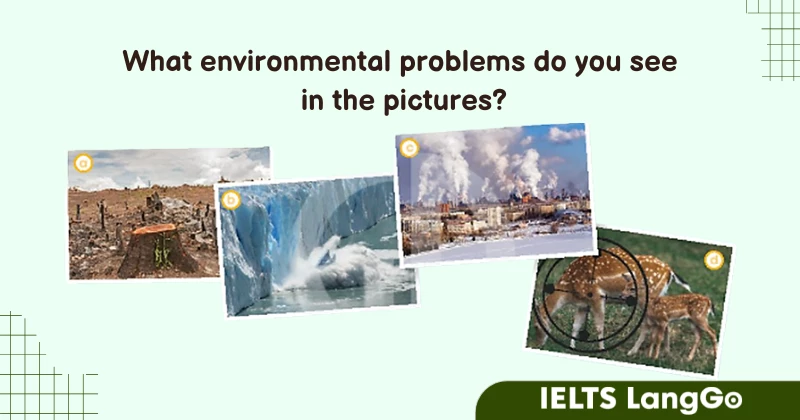
What environmental problems do you see in the pictures?
Gợi ý trả lời
Picture a: Deforestation / Forest destruction
The picture shows a deforested area where trees have been cut down, leaving only stumps and bare land. This environmental problem leads to habitat loss for wildlife and contributes to climate change.
Picture b: Polar ice melting / Global warming effects
The image depicts a massive ice cliff or glacier breaking apart, which is a clear sign of global warming. The melting of polar ice leads to rising sea levels and threatens coastal communities worldwide.
Picture c: Air pollution / Factory emissions
This picture shows industrial factories releasing large amounts of smoke and harmful gases into the atmosphere. Air pollution from factories causes serious health problems and contributes to climate change.
Picture d: Wildlife hunting / Endangered species
The image displays a young deer caught in a trap, representing the problem of illegal hunting and wildlife destruction. This threatens biodiversity and upsets the natural balance of ecosystems.
Bài 2. Read the text and choose the best title for it.
→ Đáp án: a. Environmental problems: What are they?
Bài 3. Read the text again and decide which paragraph contains the following information.
1. an example of harmful substances in the air and water → Paragraph C
2. one of the reasons for destroying wildlife habitats → Paragraph B
3. an increase in the level of the world's oceans → Paragraph A
4. an effect of illegal hunting on the ecosystem → Paragraph D
Bài 4. Complete the sentences with the information from the text. Use no more than TWO words for each answer.
1. Global warming can cause extreme weather events such as floods or heatwaves.
2. The natural habitats of many animals can be destroyed in the process of cutting down forests.
3. One of the main causes of air pollution is waste gases produced by machines and factories.
4. When many animals disappear, this damages the natural balance of ecosystems.
Bài 5. Work in groups. Discuss: Which of the problems mentioned in the text do you think is the most serious in Viet Nam?
Gợi ý trả lời:
I think air pollution is the most serious problem in Vietnam. In big cities like Hanoi and Ho Chi Minh City, there are too many motorbikes and cars on the roads. Factories also produce a lot of smoke and waste gases. The air quality is very bad, especially in the morning and evening. Many people have breathing problems and lung diseases. We need to use public transport more and reduce factory emissions.
>>> Xem chi tiết: Tiếng Anh 10 Unit 9 Reading
IV. Speaking
Phần Speaking Unit 9 giúp học sinh luyện tập kỹ năng thảo luận và thuyết trình về các giải pháp cho những vấn đề môi trường, giúp học sinh biết cách trình bày ý kiến một cách có cấu trúc và thuyết phục.
Bài 1. Match the environmental problems to the suggested solutions.
1. Disappearance of endangered animals:
→ c. Stop illegal hunting and fishing
→ e. Avoid products that are made from animal parts
2. Deforestation:
→ a. Recycle paper, plastics and wood products
→ f. Introduce strict laws to prevent the cutting of natural forests
3. Air pollution:
→ b. Use electric vehicles or public transport, and plant more trees
→ d. Stop burning leaves, rubbish and other materials
Bài 2. Complete the presentation outline with the information in the box.
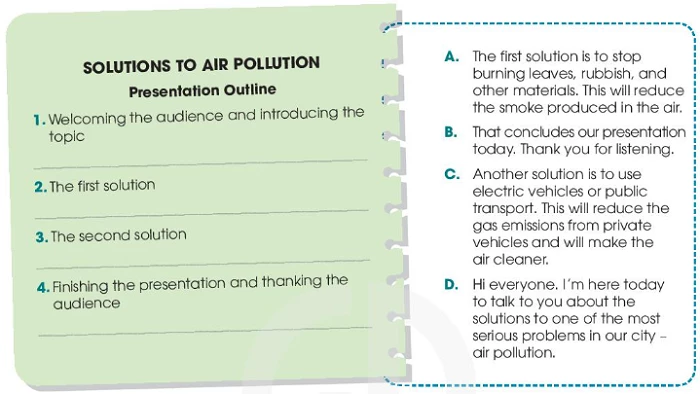
1. Welcoming the audience and introducing the topic
→ D. Hi everyone. I'm here today to talk to you about the solutions to one of the most serious problems in our city – air pollution.
2. The first solution
→ A. The first solution is to stop burning leaves, rubbish and other materials. This will reduce the smoke produced in the air.
3. The second solution
→ C. Another solution is to use electric vehicles or public transport. This will reduce the gas emissions from private vehicles and will make the air cleaner.
4. Finishing the presentation and thanking the audience
→ B. That concludes our presentation today. Thank you for listening.
Bài 3. Work in groups. Choose an environmental problem in 1 and make a presentation on the solutions to it. Use the expressions below to help you
>>> Xem bài mẫu chi tiết: Tiếng Anh 10 Unit 9 Speaking
V. Listening
Phần Listening Unit 9 giúp học sinh luyện kỹ năng nghe qua bài hội thoại giữa Nam và Mai về dự án bảo tồn động vật hoang dã có nguy cơ tuyệt chủng.
Bài 1. Work in pairs and answer the question. What is happening to the animals in the pictures?
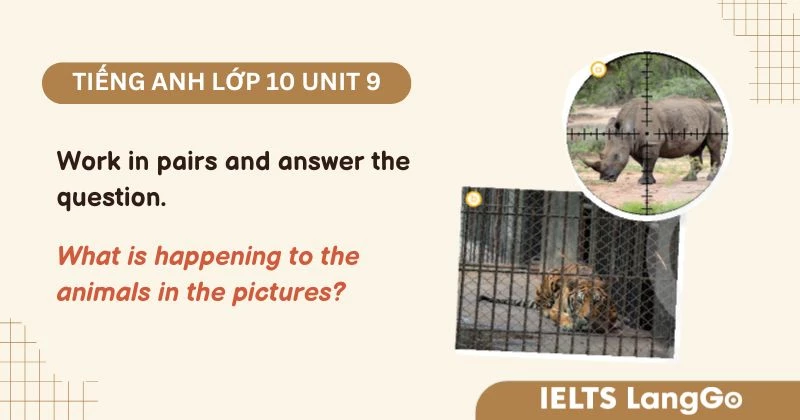
Gợi ý trả lời:
Picture a (Rhino being hunted)
The rhinoceros is being illegally hunted by poachers. This is a serious threat to endangered
Picture b (Tiger in cage):
The tiger is being kept in captivity, trapped in a cage. This shows how wild animals lose their freedom and natural habitat, which can lead to suffering and psychological problems for the animals.
Bài 2. Listen. Decide whether the following statements are true (T) or false (F).
| T/F | |
| 1. Mai will complete her mid-term project in two weeks. | F |
| 2. Nam believes that people should first be made aware of the importance of the problem. | T |
| 3. Mai thinks that illegal hunting may not destroy wild animals' natural habitats. | F |
| 4. Nam believes that illegal hunting can be prevented by banning wildlife trade. | T |
Bài 3. Listen again and complete the notes. Use ONE word for each gap.
Ways to save endangered animals:
1. Helping people understand the (1) importance of the problem
2. Introducing strict (2) laws to prevent people from illegal hunting
3. Banning wildlife (3) trade
4. Avoiding products made from endangered (4) animal parts
Bài 4. Work in groups and answer the questions. Which is the most effective way to save endangered animals? Why?
>>> Xem chi tiết: Tiếng Anh 10 Unit 9 Listening
VI. Writing
Phần Writing Unit 9 hướng dẫn học sinh viết một đoạn văn 120-150 từ về một tổ chức bảo vệ động vật hoang dã, dựa theo bài mẫu về tổ chức WWF.
1. Work in pairs. Look at the picture and answer the questions
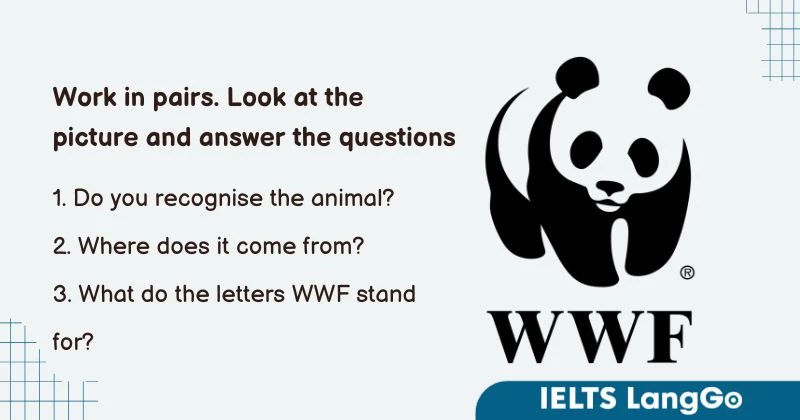
Gợi ý trả lời:
1. Do you recognise the animal?
→ Yes, it is a panda.
2. Where does it come from?
→ The panda comes from China.
3. What do the letters WWF stand for?
→ WWF stands for World Wide Fund for Nature.
Bài 2. Read the text about WWF and complete the table.
| World Wide Fund for Nature (WWF) | |
| Kind of organisation | (1) non-governmental organisation |
| Set up in | (2) 1961 |
| Aims | - (3) to stop the process of destroying the planet's natural environment - to build a future in which humans respect nature |
| Focus of their work | (4) survival of endangered animals and protection of their natural habitats |
| Number of projects supported | (5) around 1,300 environmental projects |
Bài 3. Write a paragraph (120-150 words) about Save the Elephants, using the information in the table.
>>> Xem bài mẫu chi tiết: Tiếng Anh 10 Unit 9 Writing
VII. Communication and Culture / CLIL
Phần Communication and Culture Unit 9 gồm hai nội dung: Everyday English về cách đưa ra và phản hồi lời xin lỗi, và CLIL về sự kiện Earth Hour do WWF tổ chức hàng năm.
Everyday English - Making and responding to apologies
Bài 1. Listen and complete the conversations with the expressions in the box.
(1) B. I'd like to apologise for
(2) C. That's all right
(3) D. I'm sorry to
(4) A. Never mind
Bài 2. Work in pairs. Make similar conversations making and responding to apologies. Use the expressions below to help you
Mẫu hội thoại 1
A: Oh no! I'm really sorry to have broken your vase. I didn't see it on the table.
B: Don't worry about it. It was just an old vase. The important thing is that you're not hurt.
A: Thank you for being so understanding. I'll buy you a new one to replace it.
B: That's very kind of you, but it's really not necessary.
Mẫu hội thoại 2
A: I'd like to apologise for being late to our group meeting. The bus broke down on the way here.
B: Never mind. These things happen. Did you manage to catch another bus?
A: Yes, I did, but it took much longer than usual. I hope I haven't caused too much inconvenience.
B: Don't mention it. We just started reviewing the notes anyway
CLIL - Earth Hour
Bài 1. Read the text and complete each blank of the fact file about Earth Hour with ONE word.
| EARTH HOUR | |
| Organised by | World Wide Fund for Nature |
| Held from | 8.30 p.m. – 9.30 p.m. on the last (1) Saturday of March |
| Started in | Sydney, Australia, in 2007 |
| Aims | - to show the public (2) support for protecting the environment and saving the planet; - to draw attention to (3) climate change and global energy issues; - to promote green (4) activities worldwide |
| First held in Viet Nam in | (5) 2009 with a variety of activities nationwide |
2. Work in pairs. Discuss the following questions
Gợi ý trả lời:
1. Do you want to take part in this lights-out event in Viet Nam? Why or why not?
Sample Answer:
Yes, I want to take part in Earth Hour in Viet Nam. First, it's a simple way to help protect the environment. By turning off lights for just one hour, we can save energy and reduce pollution. Second, joining this event helps me understand more about environmental problems like climate change. Third, it's meaningful to be part of a global movement with millions of people in 187 countries. This shows that many people care about our planet.
2. If you have a chance to take part in the event, what would you do?
Sample Answer:
If I can take part in Earth Hour, I will do several things. First, I will turn off all the lights and electronic devices in my house. Then, I will light some candles and spend time talking with my family about how to protect the environment in daily life.
Second, I will join outdoor activities like cleaning up the neighborhood or planting trees with my friends. These activities help make our community cleaner and greener.
Finally, I will share my Earth Hour experience on social media to encourage my friends to join the movement. I can post photos and write about why protecting the environment is important. I believe that if more young people participate, we can create positive change for our planet.
>>> Xem chi tiết: Tiếng Anh 10 Unit 9 Communication and Culture
VIII. Looking Back
Phần Looking Back Unit 9 giúp học sinh hệ thống lại toàn bộ kiến thức phát âm, từ vựng về môi trường và ngữ pháp câu tường thuật đã học trong Unit.
Pronunciation - Listen and mark the stressed syllables in the words in bold.
1. 'Don't 'buy 'products that are 'made from 'wild 'animal 'parts.
2. 'What can we 'do to 'help the 'animals in the 'wild?
3. 'Larger 'tigers tend to 'live in 'colder areas while 'smaller 'tigers 'live in 'warmer 'countries.
4. 'Elephants are en 'dangered because of il 'legal 'hunting and 'body 'part 'trade.
5. Do you 'know why so many en 'dangered 'animals are disa 'ppearing?
Vocabulary - Choose the correct word to complete each sentence.
1. Many wildlife habitats will be destroyed if people keep cutting down the forests.
2. Researchers are looking for ways to reduce the environmental impact of air pollution on the local community.
3. It's illegal to kill pandas, tigers or any other endangered animals.
4. Global warming is mainly caused by pollution and clearing of forests.
Grammar - Change the following sentences into reported speech.
1. 'The rising sea level is a result of global warming,' the teacher explained.
→ The teacher explained that the rising sea level was/is a result of global warming.
2. 'I will take part in the competition next month,' my friend told me.
→ My friend told me that he/she would take part in the competition the following month.
3. 'The clearing and burning of forests lead to air pollution,' the speaker said.
→ The speaker said that the clearing and burning of forests led/lead to air pollution.
4. 'Are you interested in joining the event this weekend, Minh?' asked Tuan.
→ Tuan asked Minh if/whether he was interested in joining the event that weekend.
5. 'When are you going to deliver your presentation on the environment, Mai?' asked Nam.
→ Nam asked Mai when she was going to deliver her presentation on the environment.
>>> Xem chi tiết: Tiếng Anh 10 Unit 9 Looking Back
IX. Project
Phần Project Unit 9 yêu cầu học sinh làm việc nhóm, tìm hiểu về một tổ chức môi trường địa phương hoặc quốc tế và thuyết trình trước lớp.
Bài thuyết trình cần bao gồm:
- Tên tổ chức là gì?
- Thành lập khi nào?
- Mục tiêu của tổ chức là gì?
- Các hoạt động của tổ chức?
>>> Xem bài mẫu chi tiết: Tiếng Anh 10 Unit 9 Project
Unit 9 Tiếng Anh 10 Global Success với chủ đề Protecting the Environment đã trang bị cho học sinh vốn từ vựng phong phú về môi trường, cấu trúc ngữ pháp câu tường thuật cùng những hiểu biết thiết thực về các vấn đề và giải pháp môi trường trong thế giới hiện đại.
Thông qua việc ôn luyện đầy đủ các kỹ năng nghe - nói - đọc - viết trong Unit này, học sinh không chỉ nâng cao trình độ tiếng Anh mà còn hình thành ý thức trách nhiệm với thiên nhiên và môi trường xung quanh - điều ngày càng quan trọng trong bối cảnh biến đổi khí hậu toàn cầu.
Hy vọng phần tổng hợp đáp án và hướng dẫn chi tiết trên đây sẽ giúp các bạn nắm chắc toàn bộ kiến thức Unit 9 và đạt kết quả cao trong học tập.
>>> Các bạn có thể xem thêm: Tiếng Anh 10 Unit 10 Ecotourism Global
BACK TO SCHOOL – Trúng Macbook Neo và hàng ngàn quà tặng khác

DEAL HỜI HẾT CỠ >> Dành riêng cho học viên đăng ký khóa học IELTS đến hết ngày 31/10
- Quay số trúng thưởng - Rinh MACBOOK xịn
- Giảm ngay 350.000đ khi đăng ký khóa 01 Level
- Ưu đãi học nhóm tới 250.000đ/ học viên
- Tặng ngay tài khoản Writing Xpert AI KHÔNG GIỚI HẠN