Đáp án Tiếng Anh 10 Unit 10 Ecotourism Global Success đầy đủ, chi tiết
 IELTS LangGo
  04/09/2026



Unit 10 Tiếng Anh lớp 10 sách Global Success với chủ đề Ecotourism (Du lịch sinh thái) giúp học sinh tìm hiểu về khái niệm du lịch thân thiện với môi trường, cách trở thành một ecotourist có trách nhiệm, đồng thời khám phá tác động của các loại hình du lịch đến thiên nhiên và cộng đồng địa phương.
Bài viết dưới đây tổng hợp đáp án và gợi ý trả lời cho toàn bộ các phần trong Unit 10, giúp các bạn học sinh nắm vững kiến thức bài học và vận dụng hiệu quả trong các bài kiểm tra cũng như trong thực tế giao tiếp.
>>> Xem thêm: Lời giải Tiếng Anh lớp 10 Global Success
I. Getting Started
Bài 1. Listen and read – An eco-friendly fieldtrip to Phong Nha Cave
Phần Getting Started Unit 10 mở đầu bằng cuộc trò chuyện giữa cô Hoa, Nam và Mai về chuyến dã ngoại thân thiện với môi trường đến hang Phong Nha, Quảng Bình. Qua đó, học sinh làm quen với chủ đề Ecotourism và những hành động nên và không nên làm khi tham quan địa điểm tự nhiên.
Bài 2. Read the conversation again. Then find and correct a mistake in each sentence below.
1. damage → learn about
2. will → will not/won't
3. a lot of → less
Bài 3. Put each phrase into the correct column.
| Dos | Don'ts |
| explore the place | damage the environment |
| learn about the place | leave litter behind |
Bài 4. Complete these sentences from 1.
1. Nam says, 'If I add some to my rock collection, it will be the best at school!'
2. Ms Hoa says, 'If I were you, I wouldn't bring too many snacks.'
>>> Xem chi tiết: Tiếng Anh 10 Unit 10 Getting Started
II. Language
Phần Language Unit 10 tập trung vào ba nội dung: phát âm ngữ điệu (intonation), từ vựng về ecotourism, cùng ngữ pháp về câu điều kiện loại 1 và loại 2 (Conditional sentences Type 1 and Type 2).
Pronunciation – Intonation
Bài 1. Listen to these sentences. Pay attention to the intonation and repeat.
1. I'll also try to bring snacks with less packaging. (Falling tone)
2. What's an eco-friendly fieldtrip? (Falling tone)
3. Can we bring snacks? (Rising tone)
Bài 2. Work in pairs and role-play this conversation. Pay attention to the intonation. Then listen and check
Mum: Have you packed for the trip tomorrow? → Rising tone
Mai: Yes, I have. → Falling tone
Mum: Why are you taking so little food? → Falling tone
Mai: Because I don't want to leave litter behind. It's not good for the environment. → Falling tone
Mum: That's a good idea. → Falling tone
Vocabulary – Ecotourism
Bài 1. Match each sentence on the left with its explanation on the right.
1 - b: I am responsible for protecting the environment. → I understand it is my duty to protect the environment.
2 - a: I am aware of the damage I may cause to the environment. → I know that when I travel, I may damage the environment.
3 - e: I help people learn about the environmental impact of tourism. → I tell people about the positive and negative effects of tourism on the environment.
4 - d: I help local businesses make a profit. → I help local people earn some money by using local services and buying local products.
5 - c: I buy traditional arts and crafts to help local culture and businesses. → I buy handmade things to help local artists and craftsmen or craftswomen earn some money and introduce their culture to more people.
Bài 2. Complete these sentences with the highlighted words in 1.
1. We can help local artists make a profit by buying handmade arts and crafts.
2. Many tourists are not aware of the impact of their actions on the local community.
3. Both local people and tourists should be responsible for protecting the environment.
>>> Xem thêm: Từ vựng Unit 10 lớp 10 Global Success chủ đề Ecotourism
Grammar – Conditional sentences Type 1 and Type 2
Bài 1. Decide whether these statements can be real (R) or not (N).
1. If I were a bird, I would fly. → N
2. If we work hard, we will get good marks. → R
3. If my parents were 10 years younger, they would travel around the world. → N
4. If it rains tomorrow, we will stay at home. → R
Bài 2. Put the verbs in brackets in the correct forms.
1. If tourists buy local products, more of their money will stay in the community.
2. If we lived in the countryside, we would grow our own vegetables.
3. If my grandmother were still alive, she would be a hundred today.
4. If people give up flying, they will reduce their carbon footprint.
>>> Xem chi tiết: Tiếng Anh 10 Unit 10 Language
III. Reading
Phần Reading Unit 10 giới thiệu bốn tờ rơi về các tour du lịch sinh thái nổi tiếng trên thế giới, giúp học sinh phát triển kỹ năng đọc để tìm thông tin cụ thể và mở rộng hiểu biết về du lịch sinh thái toàn cầu.
Bài 1. Work in pairs. Answer these questions.
1. Have you ever been on an ecotour?
Gợi ý trả lời:
Sample 1:
Yes, I have. Last summer, my family went on an ecotour to Cuc Phuong National Park. We stayed in eco-friendly lodges, learned about wildlife conservation, and participated in tree-planting activities. It was an amazing experience that taught me the importance of protecting nature.
Sample 2: No, I haven't been on an ecotour yet, but I would love to try one. I'm particularly interested in ecotours that focus on marine conservation or mountain trekking. I believe such tours would help me understand environmental issues better while enjoying beautiful natural scenery.
2. Look at the photos in 2. What do you think tourists do on these tours?
Gợi ý trả lời:
Looking at the photos, I can see several ecotour activities:
- In the first photo showing terraced rice fields, tourists probably go trekking through the mountains, visit local villages, and experience traditional farming life.
- The underwater photo suggests tourists go diving or snorkeling to explore coral reefs and observe marine life.
- The photo with elephants indicates tourists go on safari tours to observe wildlife in their natural habitats.
- The whale-watching photo shows tourists taking boat trips to see whales and other marine animals.
Bài 2. Read the brochures. Then work in pairs to solve the crossword using words from the brochures.
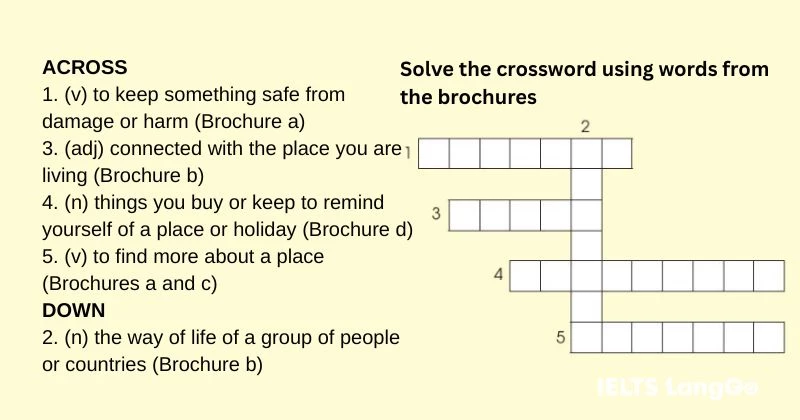
ACROSS:
-
protect - (v) to keep something safe from damage or harm (Brochure a)
-
local - (adj) connected with the place you are living (Brochure b)
-
souvenirs - (n) things you buy or keep to remind yourself of a place or holiday (Brochure d)
-
explore - (v) to find more about a place (Brochures a and c)
DOWN:
-
culture - (n) the way of life of a group of people or countries (Brochure b)
Bài 3. Which tour does each statement below talk about? Write a, b, c or d.
1. You can buy arts and crafts to help protect the environment. → d
2. You can learn how to help protect wildlife. → c
3. This tour is not suitable for families with children. → b
4. This tour offers educational videos about the environment. → a
Bài 4. Work in groups. Think of new ideas for making one of the tours better for the environment.
Gợi ý trả lời:
For Great Barrier Reef Tour, Australia:
Idea 1: Provide reef-safe sunscreen to all tourists instead of regular sunscreen, which contains chemicals that harm coral reefs.
Idea 2: Limit the number of daily visitors to prevent overcrowding and reduce stress on the marine ecosystem.
Idea 3: Use solar-powered boats instead of fuel-powered ones to reduce carbon emissions and water pollution.
For Sapa Trekking Tour, Viet Nam:
Idea 1: Organize waste collection activities where tourists help pick up litter along the trekking routes, keeping the mountains clean.
Idea 2: Partner with local communities to ensure tourist money directly supports environmental conservation projects in the area.
Idea 3: Provide reusable water bottles and set up water refill stations along the route to reduce plastic bottle waste.
>>> Xem chi tiết: Tiếng Anh 10 Unit 10 Reading
IV. Speaking
Phần Speaking Unit 10 giúp học sinh luyện tập kỹ năng thảo luận về những việc nên và không nên làm khi đi du lịch sinh thái, từ đó rèn luyện ý thức trách nhiệm với môi trường.
Bài 1. Match each verb on the left with a phrase on the right.
1 - c: litter on the beach or the street
2 - d: avoid crowded places
3 - a: follow walking paths and trails
4 - b: hunt wild animals
5 - f: waste water and electricity
6 - e: buy locally made souvenirs
Bài 2. Work in pairs. Discuss which of the things in 1 we should or should not do to become ecotourists.
Gợi ý trả lời:
Things we SHOULD do:
- Follow walking paths and trails
- Buy locally made souvenirs
Things we SHOULD NOT do:
- Litter on the beach or the street
- Hunt wild animals
- Waste water and electricity
- Visit crowded places
Bài 3. Work in groups. Talk about what tourists should or should not do if they are on an ecotour to a tourist attraction in your local area.
Gợi ý thảo luận:
Student A: What tourist attraction in our local area should we talk about?
Student B: I think we should discuss Phong Nha-Ke Bang National Park. It's a UNESCO World Heritage Site in central Vietnam and is home to the world's largest cave systems.
Student C: That's a good choice. The park has diverse ecosystems, but increasing numbers of tourists are threatening this precious environment. So, what do you suggest tourists should do on an ecotour to Phong Nha-Ke Bang?
Student A: First of all, I suggest that tourists should follow designated paths and trails when exploring the caves. This helps protect delicate cave formations and underground ecosystems.
Student B: I agree. Another thing tourists should do is to hire local guides who understand the environment and can educate visitors about conservation. This also provides sustainable income for local communities.
Student C: Those are great suggestions. It will also be better if tourists buy locally made souvenirs such as traditional crafts and organic products from ethnic minorities living in the area. What about things tourists should not do?
Student A: Well, one of the things tourists should not do is to litter in the park or caves. We suggest bringing reusable water bottles and taking all waste back with them.
Student B: Absolutely. Another thing they ought not to do is to touch or remove stalactites, stalagmites, or any natural formations. These geological wonders took millions of years to form.
Student C: I also suggest that tourists should avoid making loud noises that can disturb wildlife, especially rare species like langurs and cave-dwelling bats.
Student A: Do you believe these suggestions will really help protect Phong Nha-Ke Bang?
Student B: Definitely! If tourists follow these rules, it will significantly benefit both the environment and local people. The park's unique ecosystem will be preserved for future generations.
Student C: I think local people will benefit too. When the environment is well-preserved, local communities will have sustainable livelihoods through responsible tourism.
Student A: What can we do to help promote ecotourism in Phong Nha-Ke Bang?
Student B: We can help by raising awareness through social media campaigns and organizing cleanup activities.
Student C: That's right. We can also volunteer as eco-guides during holidays to educate other tourists about responsible tourism practices.
Bài 4. Share your ideas with the whole class. Vote for the best ideas
>>> Xem chi tiết: Tiếng Anh 10 Unit 10 Speaking
V. Listening
Phần Listening Unit 10 giúp học sinh luyện kỹ năng nghe qua bài giới thiệu của hướng dẫn viên về tour du lịch sinh thái tại đồng bằng sông Cửu Long, bao gồm các hoạt động tham quan chợ nổi, làng nghề và sinh hoạt cùng người dân địa phương.
Bài 1. Work in pairs. Look at the photos from an ecotour in the Mekong Delta. What do you think ecotourists can do there?
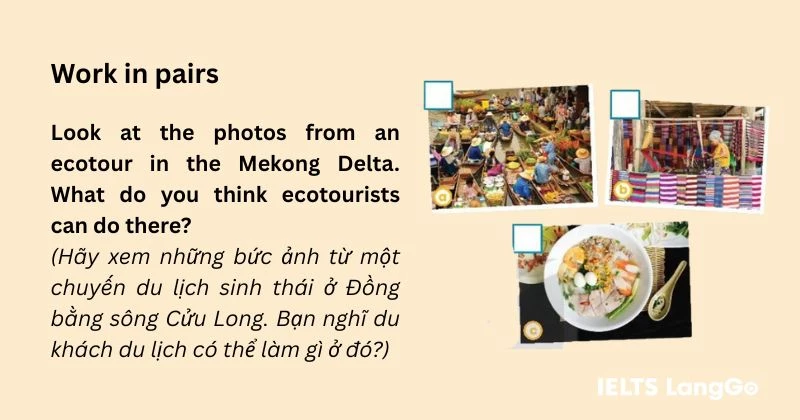
Gợi ý trả lời:
Picture a - Floating Market
Ecotourists can visit the floating market to experience the daily life of local people on the river. They can observe how vendors sell fresh fruits, vegetables, and local products directly from their boats. This is a great opportunity to learn about traditional river commerce and interact with friendly local sellers.
Picture 2 - Weaving Workshop
Ecotourists can visit a local weaving workshop to watch artisans create beautiful traditional textiles. They can learn about the weaving techniques passed down through generations and even try weaving themselves.
Picture 3 - Local Food
Ecotourists can enjoy traditional meals prepared with fresh local ingredients. They can taste authentic Mekong Delta cuisine, learn about local cooking methods, and understand how food connects to the river ecosystem. Eating with host families also provides cultural exchange opportunities.
Bài 2. Listen to a tour guide introducing the tour. Number the pictures in 1 in the order you hear them.
1 - Picture a (Floating Market)
2 - Picture 2 (Weaving Workshop)
3 - Picture 3 (Local Food)
Bài 3. Listen again. Fill in each gap in the brochure below with ONE word.
Sunshine Travel
MEKONG DELTA ECOTOUR (Day 1)
Join our (1) eco-friendly tour to explore the Mekong Delta:
- Cai Be Floating Market: Experience the daily life of the people on the river.
- Cham River Village: Visit a weaving workshop and learn about (2) local people's weaving skills.
- Arts and crafts market: Buy locally made (3) souvenirs .
- Evening meal: Enjoy (4) traditional food cooked by the host family.
Bài 4. Work in pairs. Discuss the questions.
Which part of the tour do you like most? Why?
Gợi ý trả lời:
Sample Answer 1:
I like the Cai Be Floating Market most because it's very special. I want to see how people sell fruits and vegetables from their boats. It's different from normal markets, and I think it will be exciting. I can also take nice photos there and talk to local people.
Sample Answer 2:
I'm most interested in visiting the weaving workshop. I love traditional crafts, and I want to see how people make beautiful cloth. It's amazing that they still use old techniques. I also want to try weaving myself to see if it's difficult. This activity helps local people keep their traditional skills.
>>> Xem chi tiết: Tiếng Anh 10 Unit 10 Listening
VI. Writing
Phần Writing Unit 10 hướng dẫn học sinh viết một đoạn quảng cáo website (120-150 từ) cho tour du lịch sinh thái đến làng rau Hội An (Đà Nẵng, Việt Nam), kết hợp mô tả điểm đặc biệt, hoạt động tham quan và lời khuyên để chuyến đi thân thiện với môi trường.
Bài 1. Look at the photos of an ecotour to Hoi An villages (Da Nang, Viet Nam), and complete the notes below.
Gợi ý trả lời
What do you think is special about Hoi An villages?
- beautiful vegetable and herb gardens
- traditional crafts and local culture
- peaceful countryside atmosphere
What do you think tourists can do there?
- work on a local farm
- explore the villages by boat
- learn traditional crafts
- enjoy local organic food
What can tourists do to make their trip more eco-friendly?
- buy handmade products to help local businesses
- use eco-friendly transportation like bicycles
- avoid single-use plastics
- respect local customs and environment
Bài 2. Rewrite these sentences about Hoi An villages. Use the expressions below to help you.
1. Hoi An villages are famous for their beautiful vegetable and herb gardens.
→ Hoi An villages are well-known for their beautiful vegetable and herb gardens.
2. Tourists can work on a local farm in the morning.
→ Tourists can spend time working on a local farm in the morning.
3. Tourists should buy handmade products to help local businesses.
→ Tourists are recommended to buy handmade products to help local businesses.
Bài 3. Write a website advertisement (120–150 words) for an ecotour to Hoi An villages.
>>> Xem chi tiết: Tiếng Anh 10 Unit 10 Writing
VII. Communication and Culture / CLIL
Phần Communication and Culture Unit 10 gồm hai nội dung: Everyday English về cách xin và đưa ra lời khuyên (Asking for and giving advice) trong các tình huống đi du lịch, và CLIL về tác động của các loại hình du lịch đến môi trường.
Everyday English – Asking for and giving advice
Bài 1. Listen to a conversation between a woman and a tour guide. Fill in each gap with ONE word you hear.
Woman: Excuse me. What do you think we (1) should wear tomorrow?
Guide: Well, it may be windy on the beach, so if I (2) were you, I would bring some warm clothes.
Woman: Thanks. And my friend is interested in diving. (3) Should he bring his equipment?
Guide: I don't think that would be a good idea because the sea will probably be rough tomorrow. I'd (4) recommend surfing instead. People can rent surfboards and wetsuits at the beach shop.
Woman: That's a great idea. Thanks!
Bài 2. Work in pairs. Make similar conversations asking for and giving advice about trips.
Mẫu hội thoại:
Tourist: Can you help me with something? I'm planning to go hiking in Sa Pa next week. What do you think I should bring?
Guide: Well, Sa Pa can be quite cold in the mountains. If I were you, I would bring warm jackets and waterproof clothing. The weather can change quickly.
Tourist: That's helpful. Should I book accommodation in advance?
Guide: You should definitely book ahead, especially on weekends. It's also a good idea to hire a local guide who knows the trails well.
Tourist: Thanks for your advice!
CLIL - Environmental Impact of Tourism
Bài 1. Read the text below and fill in each gap in the table with ONE of the highlighted words from the text.
| Negative impact | Positive impact |
| (1) Mass tourism | (2) ecotourism |
| (3) sustainable tourism | |
| (4) responsible tourism |
Bài 2. Which kind of tourism does each description below fit best?
| Description | Mass tourism | Ecotourism | Sustainable tourism | Responsible tourism |
| 1. It attracts many tourists at the same time. | ✓ | |||
| 2. It stresses the active role and specific actions of visitors in saving the environment. | ✓ | |||
| 3. It stresses the role of the whole tourist industry. | ✓ |
>>> Xem chi tiết: Tiếng Anh 10 Unit 10 Communication and Culture
VIII. Looking Back
Phần Looking Back Unit 10 giúp học sinh hệ thống lại toàn bộ từ vựng, phát âm và ngữ pháp câu điều kiện đã học trong Unit thông qua các bài tập thực hành tổng hợp.
Vocabulary - Choose the correct words to complete the conversation.
Mai: Ms Hoa, what is (1) sustainable tourism?
Ms Hoa: Well, the aim of this kind of tourism is to (2) protect the environment, respect local culture, and keep (3) profits local.
Mai: Can you give me an example?
Ms Hoa: When travelling, we should not (4) litter on the street. We should also be (5) aware of the local traditions and respect them.
Mai: So is this kind of tourism similar to (6) ecotourism?
Ms Hoa: Well, it's a form of sustainable tourism because it has a positive (7) impact on the environment.
Pronunciation - Work in pairs. Role-play the conversation above. Try to use appropriate intonation.
Phần này yêu cầu học sinh thực hành hội thoại ở bài tập trên với ngữ điệu đúng.
Grammar - Put the verbs in brackets in the correct forms.
1. If I were you, I would live with a host family so that I can learn more about the local culture.
2. If we work together, we will be able to reduce the negative impact of tourism on the environment.
3. If we allow more people to crowd the city centre, we will have to deal with environmental pollution in the future.
4. If we had enough money, we would go on an ecotour to Finland. Instead, we're staying in Viet Nam in the summer.
>>> Xem chi tiết: Tiếng Anh 10 Unit 10 Looking Back
IX. Project - Design an Ecotour
Phần Project Unit 10 yêu cầu học sinh làm việc nhóm để thiết kế một chuyến du lịch sinh thái đến địa danh du lịch địa phương và thuyết trình trước lớp.
Bài thuyết trình cần bao gồm:
- What is the local tourist attraction?
- What is it famous for?
- What can tourists do there?
- What are some eco-friendly activities that tourists can do there?
>>> Xem bài mẫu chi tiết: Tiếng Anh 10 Unit 10 Project
Unit 10 Tiếng Anh 10 Global Success với chủ đề Ecotourism đã trang bị cho học sinh vốn từ vựng phong phú về du lịch sinh thái, cấu trúc ngữ pháp câu điều kiện loại 1 và loại 2, cùng những hiểu biết thiết thực về tác động của du lịch đối với môi trường và cộng đồng.
Hy vọng phần tổng hợp đáp án và hướng dẫn chi tiết trên đây sẽ giúp các bạn nắm chắc toàn bộ kiến thức Unit 10 và đạt kết quả cao trong học tập.
Các bạn có thể tham khảo:
BACK TO SCHOOL – Trúng Macbook Neo và hàng ngàn quà tặng khác

DEAL HỜI HẾT CỠ >> Dành riêng cho học viên đăng ký khóa học IELTS đến hết ngày 31/10
- Quay số trúng thưởng - Rinh MACBOOK xịn
- Giảm ngay 350.000đ khi đăng ký khóa 01 Level
- Ưu đãi học nhóm tới 250.000đ/ học viên
- Tặng ngay tài khoản Writing Xpert AI KHÔNG GIỚI HẠN