Đáp án Tiếng Anh lớp 9 Unit 9 Global Success chủ đề World Englishes
 IELTS LangGo
  25/02/2026



Unit 9 Tiếng Anh lớp 9 về chủ đề World Englishes giúp các bạn học sinh hiểu thêm về sự khác biệt thú vị giữa các biến thể của tiếng Anh trên thế giới. Bên cạnh đó, bài học còn giúp các bạn mở rộng vốn từ vựng, cấu trúc ngữ pháp và luyện các kỹ năng Nghe, Nói, Đọc, Viết xoay quanh chủ đề của Unit
Trong bài viết này, IELTS LangGo sẽ cung cấp hướng dẫn và gợi ý trả lời cho các bài tập giúp để các bạn tham khảo và nắm vững nội dung bài học hơn. Cùng theo dõi nhé.
I. Getting Started - What do you mean?
1. Listen and read
Mở đầu phần Getting Started là cuộc làm quen giữa các bạn trong lớp và Jack - một học sinh trao đổi đến từ New York.
2. Fill in each blank with no more than TWO words
Đáp án:
1. Jack is an exchange student from New York.
2. This is the first time Jack has visited Viet Nam.
3. Most students at Jack’s school wear pants and T-shirts.
4. American English and British English have some differences in vocabulary.
5. Not all students in Jack’s school are Americans but they all speak English.
3. Match the words and phrases with their definitions
1 - b. exchange student: a student who attends a school in a foreign country for a period of time
2 - e. mean: to express or represent something
3 - a. vocabulary: all the words in a language
4 - c. immigrants: people who have come to live permanently in a different country
5 - d. first language : the language someone learns to speak from birth
4. Fill in each blank with a word or phrase from 3
Đáp án:
1. – What does your name mean, Mi? – It’s the name of a bird.
2. English vocabulary is increasing because it borrows words from other languages.
3. In Australia, there are a lot of immigrants who have come from other countries.
4. His first language is Vietnamese, but he can speak English and French fluently.
5. This year our school has a(n) exchange student from Britain. She will study with us for one month.
5. Quiz: Match British English with American English so that they mean the same. Who is the quickest?
Đáp án:
- flat (British English) = apartment (American English)
- holiday (British English) = vacation (American English)
- jumper (British English) = sweater (American English)
- chips (British English) = French fries (American English)
- football (British English) = soccer (American English)
Do you know any other pairs of words?
- lorry (British English) = truck (American English)
- petrol (British English) = gas/gasoline (American English)
- lift (British English) = elevator (American English)
- cinema (British English) = movie theater (American English)
- shop (British English) = store (American English)
>> Xem lời giải chi tiết tại: Tiếng Anh 9 Unit 9 Getting Started
II. A Closer Look 1 - Vocabulary & Pronunciation
Vocabulary
Phần Vocabulary giúp các bạn học sinh làm quen với từ vựng chủ đề ngôn ngữ.
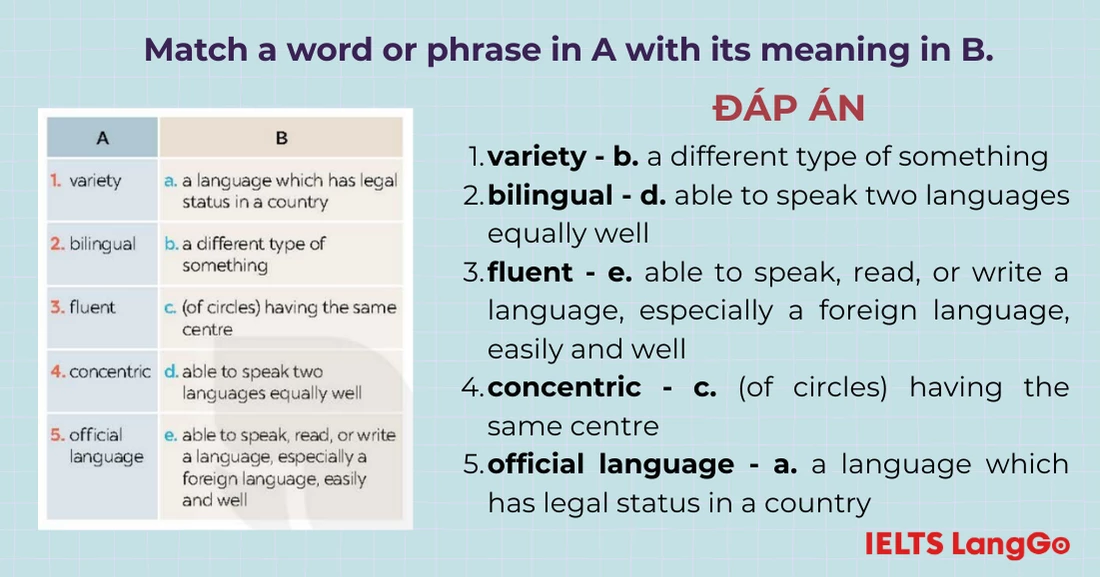
1. Match a word or phrase in A with its meaning in B.
Đáp án:
1 - b. variety - a different type of something
2 - d. bilingual - able to speak two languages equally well
3 - e. fluent - able to speak, read, or write a language, especially a foreign language, easily and well
4 - c. concentric - (of circles) having the same centre
5 - a. official language - a language which has legal status in a country
2. Match a verb in A with a phrase in B to make a meaningful expression.
Đáp án:
1 - d. translate from Vietnamese into English
2 - e. copy words into a notebook
3 - b. pick up a new language
4 - c. look up new words in an English-English dictionary
5 - a. go over the grammatical points
3. Choose the correct word to complete each sentence.
Đáp án:
1. English is a(n) official / first language in Singapore besides Malay, Mandarin, and Tamil.
→ official
2. Although he was born in Britain, he is fluent / bilingual in Vietnamese.
→ fluent
3. After you pick / look up a word in the dictionary, remember to make an example with it.
→ look
4. How many books have you picked / translated from English into Vietnamese?
→ translated
5. Remember to go / copy over the words you have learnt in class.
→ go
Pronunciation
Phần Phát âm giúp các bạn học sinh ôn tập quy tắc nhấn trọng âm đối với các từ có hậu tố -ion và -ity.
4. Listen and repeat the words. Pay attention to the word stress.
| -ion | -ity |
| relation - /rɪˈleɪʃn/ | charity - /ˈtʃærəti/ |
| decision - /dɪˈsɪʒn/ | quality - /ˈkwɒləti/ |
| position - /pəˈzɪʃn/ | clarity - /ˈklærəti/ |
| education - /ˌedʒuˈkeɪʃn/ | ability - /əˈbɪləti/ |
| operation - /ˌɒpəˈreɪʃn/ | obesity - /əʊˈbiːsəti/ |
5. Listen and repeat the sentences. Mark the stress in the underlined words.
1. They had a discussion about the quality of the courses at their language centre.
- discussion - /dɪˈskʌʃn/: nhấn âm 2 (ngay trước -ion).
- quality - /ˈkwɒləti/: nhấn âm 1 (ngay trước -ity).
2. Pay attention to her ability to express herself in English.
- attention - /əˈtenʃn/: nhấn âm 2 (ngay trước -ion).
- ability - /əˈbɪləti/: nhấn âm 2 (ngay trước -ity).
3. I have an intention of organising an English class for the community.
- intention - /ɪnˈtenʃn/: nhấn âm 2 (ngay trước -ion).
- community - /kəˈmjuːnəti/: nhấn âm 2 (ngay trước -ity).
4. Let’s do a revision activity before the exam.
- revision - /rɪˈvɪʒn/: nhấn âm 2 (ngay trước -ion).
- activity - /ækˈtɪvəti/: nhấn âm 2 (ngay trước -ity).
5. What is the function of the word ‘identity’ in this sentence?
- function - /ˈfʌŋkʃn/: nhấn âm 1 (ngay trước -ion).
- identity - /aɪˈdentəti/: nhấn âm 2 (ngay trước -ity).
>> Xem lời giải chi tiết tại: Tiếng Anh 9 Unit 9 A Closer Look 1
III. A Closer Look 2 - Grammar
Phần A Closer Look 2 Unit 9 lớp 9 hướng dẫn các bạn học sinh cách sử dụng các đại từ quan hệ trong mệnh đề quan hệ xác định (Defining relative clauses) - một trong những chủ điểm ngữ pháp quan trọng trong chương trình Tiếng Anh 9.
1. Choose the correct answer A, B, C, or D to complete each sentence.
1. English is the language ______ is known as a global language.
A. who
B. which
C. whose
D. what
→ Đáp án: B. which
2. People ______ speak English well can find jobs in international companies more easily.
A. who
B. which
C. whose
D. why
→ Đáp án: A. who
3. People from countries ______ do not share a common language use English to work together effectively.
A. who
B. which
C. whose
D. where
→ Đáp án: B. which
4. The woman ______ son won the English speaking contest felt very proud.
A. who
B. which
C. whose
D. when
→ Đáp án: C. whose
5. I met a man ______ first language is Arabic at the conference.
A. who
B. which
C. what
D. whose
→ Đáp án: D. whose
2. Underline the relative clause in each sentence. Decide if the relative pronoun is the subject (S) or object (O) of the relative clause and if we can or cannot omit it.
Đáp án:
| Câu | Chủ ngữ (S) hay Tân ngữ (O) | Có thể lược bỏ không? |
| 1. The new vocabulary items which we learnt yesterday are difficult to remember. | O | Yes |
| 2. I don't like the grammar exercises which are in this book. | S | No |
| 3. The man who translated this novel into Vietnamese must be proficient in English. | S | No |
| 4. The students who love languages can join our Reading Club. | S | No |
| 5. The teacher who we admire can speak three languages. | O | Yes |
3. Are these sentences right or wrong? Correct them if necessary.
1. My sister doesn’t like films have unhappy endings. → Wrong
→ Câu đúng: My sister doesn’t like films which have unhappy endings.
2. What is the name of the man who is the director of the language centre? → Right
3. One of the four official languages people use in Singapore is English. → Right.
4. I like the English lesson which Ms Oanh taught yesterday. → Right.
5. Students who grades are high can compete in this contest. → Wrong
→ Câu đúng: Students whose grades are high can compete in this contest.
4. Combine the two sentences into one, using a relative pronoun.
Đáp án:
1. I met a woman. Her husband is a famous linguist.
→ I met a woman whose husband is a famous linguist.
2. My friend’s father gave us the tickets. He owns a travel agency.
→ My friend’s father, who owns a travel agency, gave us the tickets.
3. The grammar exercise was very complicated. Nobody could do it.
→ The grammar exercise which nobody could do was very complicated.
4. I study English in a language school. It is in the centre of the city.
→ I study English in a language school which is in the centre of the city.
5. The student completed the quiz the fastest. The teacher praised him.
→ The teacher praised the student who completed the quiz the fastest.
5. GAME: Clues for you
Work in two teams. A student from each team gives clues about an object or a person in class, using a relative clause. Students from the other team guess which object or person it is.
Ví dụ 1:
A: It is a thing which helps us calculate numbers.
B: Is it a calculator?
A: Yes, it is.
Ví dụ 2:
A: She is the teacher who teaches us English.
B: Is that the English teacher?
A: Yes, she is.
Ví dụ 3:
A: It is an object that students use to carry books.
B: Is it a school bag?
A: Yes, it is.
>> Xem lời giải chi tiết tại: Tiếng Anh 9 Unit 9 A Closer Look 2
IV. Communication
Phần Communication Unit 9 lớp 9 giúp các bạn học sinh nắm được các mẫu câu để nói lời chúc may mắn và đưa ra phản hồi phù hợp; đồng thời khám phá thêm những sự thật thú vị về tiếng Anh.
Everyday English: Saying good luck and responding
1. Listen and read the conversations. Pay attention to the highlighted parts
Tom: Good luck with your English exam.
Mi: Thanks. I'll try my best.
Phong: I’ve heard that you’re moving to the US. I wish you all the best of luck.
Neighbour: Thank you so much.
2. Work in pairs. Practise saying good luck and responding in the following situations
Gợi ý hội thoại:
Tình huống 1: Your friend is giving a presentation in English this week.
- A: Good luck with your English presentation this week!
- B: Thanks, I hope it goes well.
- A: I wish you all the best of luck with your university entrance exam next week.
- B: Thank you so much. I'm a bit nervous!
- A: Best of luck with your further study in the UK, teacher!
- B: Thanks. I'll miss you all.
Interesting facts about English
3. Read the interesting facts below about English. Order them from the most interesting to the least interesting.
Với bài tập này, các bạn có thể tự đưa ra thứ tự theo ý kiến riêng của mình nhé.
Các sự thật thú vị về Tiếng Anh:
1. The most common letter in English is 'e'.
2. Only two English words in current use end in '-gry'. They are 'angry' and 'hungry'.
3. The word 'uncopyrightable' is the longest English word in normal use which contains no letter more than once.
4. The longest English word without a true vowel (a, e, i, o, or u) is 'rhythms'.
5. 'Queueing' and 'cooeeing' are the two words with five consecutive vowels (five vowels in a row).
4. Work in groups. Work out the answers to the questions in the quiz
1. Which of these languages has the highest number of native speakers?
A. English
B. Chinese
C. Spanish
→ Đáp án: B. Chinese
2. Which language do people use the most at international events?
A. English
B. Chinese
C. Spanish
→ Đáp án: A. English
3. Americans call it "truck". What do the British call it?
A. Car
B. Bus
C. Lorry
→ Đáp án: C. Lorry
4. The British call it "chemist's". What do Americans call it?
A. Shop
B. Drugstore
C. Store
→ Đáp án: B. Drugstore
5. Which is the longest word in English which has only one vowel?
A. Length
B. Strengths
C. Depth
→ Đáp án: B. Strengths
5. Share your group's answers with the class. Which group has the most correct answers?
Sau khi hoàn thành phần Quiz, các bạn hãy so sánh kết quả với các nhóm khác nhé.
>> Xem lời giải chi tiết tại: Tiếng Anh 9 Unit 9 Communication
V. Skills 1 - Reading & Speaking
Phần Skills 1 Unit 9 Tiếng Anh lớp 9 giúp học sinh rèn luyện hai kỹ năng quan trọng: Reading qua bài đọc về mô hình World Englishes và Speaking với phần thảo luận về chủ đề từ mượn trong tiếng Anh.
Reading
1. Look at the diagram. Put the names of the countries where English is spoken in the correct circle.
Đáp án:
1. Inner Circle: The UK, New Zealand
2. Outer Circle: Singapore, Malaysia
3. Expanding Circle: Viet Nam, Russia
2. Read the text and choose the correct answer A, B, C, or D.,
1. What is the text mainly about?
A. Professor Braj Kachru.
B. The three circles of World Englishes.
C. Native speakers of English.
D. The development of English.
→ Đáp án: B. The three circles of World Englishes.
2. The word "model" in paragraph 2 means _______.
A. an excellent person
B. an example to copy
C. a small copy of something
D. a description of a system
→ Đáp án: D. a description of a system
3. The phrase "this circle" in paragraph 5 refers to the _______.
A. model
B. Inner Circle
C. Outer Circle
D. Expanding Circle
→ Đáp án: D. Expanding Circle
3. Read the text again and fill in each blank in the summary with no more than TWO words.
Đáp án:
| Kachru's Model | |
| Inner Circle | ● English is the (1) first language. ● Countries: UK, USA, Australia, etc. ● Speakers provide the standards. |
| Outer Circle | ● English is the second or (2) official language. ● Countries: India, Singapore, the Philippines, etc. ● Speakers (3) follow the standards. |
| Expanding Circle | ● English is a (4) foreign language. ● Countries: Brazil, Russia, Viet Nam, etc. ● Speakers follow the (5) rules established. |
Speaking
4. Work in pairs. Read the following words. What do all the words have in common?
| banh mi, sushi, robot, piano, kung fu |
Gợi ý trả lời:
→ They are all borrowed words (or loanwords) in English. They come from other languages but are used in English.
5. Work in groups. Discuss and write the meaning / explanation of each word and choose the language of origin for each word from the given list. Then present your answers to the class.
| Chinese, Japanese, Vietnamese, Italian, Czech. |
Gợi ý trả lời:
| Words | Meaning / Explanation | Language of origin |
| banh mi | A type of Vietnamese sandwich filled with cold meats, pâté, and vegetables. | Vietnamese |
| sushi | A Japanese dish consisting of small balls or rolls of vinegar-flavoured cold cooked rice served with a garnish of raw fish, vegetables, or egg. | Japanese |
| kung fu | A Chinese system of fighting without weapons. | Chinese |
| robot | A machine that can perform a complicated series of tasks automatically. | Czech |
| piano | A large musical instrument played by pressing black and white keys on a keyboard. | Italian |
Bài thuyết trình mẫu:
Hello everyone. Did you know that many English words actually come from other languages? Today, our group will introduce five interesting examples.
Let's start with a famous word from our country: 'banh mi'. As you know, it comes from Vietnamese. It refers to a delicious Vietnamese sandwich filled with meat, pâté, and vegetables. Next, we have a popular dish: 'sushi'. This word is borrowed from Japanese. It describes a dish of rice mixed with vinegar, usually served with raw fish. Moving on to sports, we have 'kung fu'. This term originates from Chinese. It is a well-known style of fighting without weapons. How about technology? The word 'robot' actually comes from Czech. It is used to describe a machine that can perform complicated tasks automatically. Last but not least is 'piano'. This word comes from Italian. It is a large musical instrument that we play by pressing the keyboard.
That brings us to the end of our presentation. We hope you learned something new about English vocabulary today. Thanks for your attention!
>> Xem lời giải chi tiết tại: Tiếng Anh 9 Unit 9 Skills 1
VI. Skills 2 - Listening & Writing
Phần Skills 2 giúp học sinh rèn luyện hai kỹ năng quan trọng là Listening (Nghe) qua bài nghe về các phương pháp học từ vựng tiếng Anh hiệu quả và Writing (Viết) qua bài tập viết đoạn văn chia sẻ về kỹ năng khó nhất khi học tiếng Anh và các giải pháp để cải thiện kỹ năng đó.
Listening
1. Work in pairs. Look at the pictures and answer the questions.
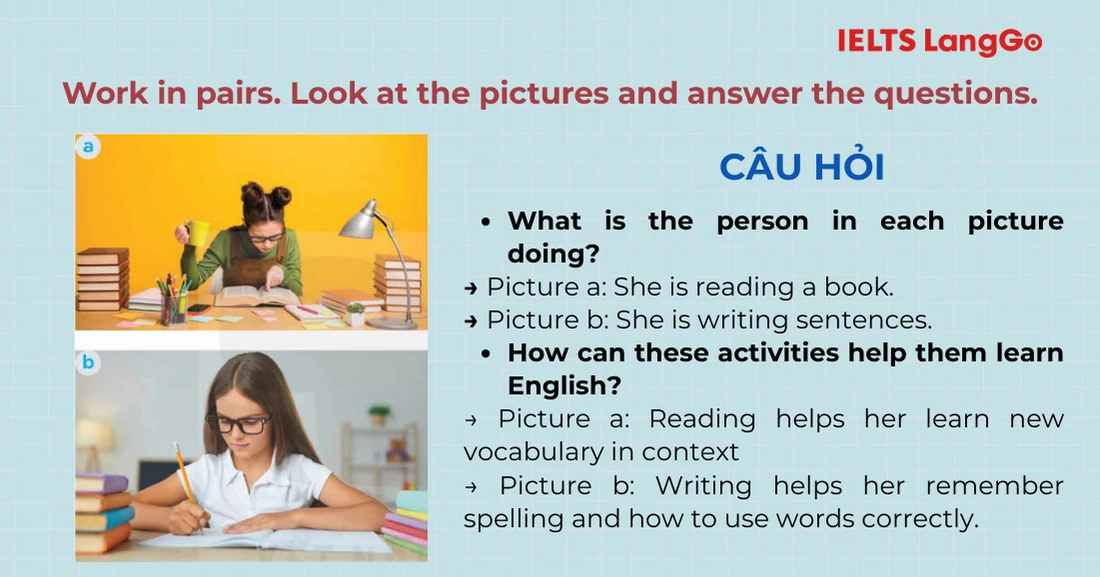
Gợi ý trả lời:
1. What is the person in each picture doing?
→ Picture a: She is reading a book.
→ Picture b: She is doing her homework/writing sentences.
2. How can these activities help them learn English?
→ Picture a: Reading helps her learn new vocabulary in context and understand grammar structures better.
→ Picture b: Writing helps her remember spelling and how to use words correctly.
2. Listen to Trang talking. Decide if the statements are true (T) or false (F).
| Câu hỏi | Đáp án | Dẫn chứng |
| 1. Trang has studied English for seven years. | F | “I've learnt English for six years and I usually find it challenging to learn its vocabulary.” |
| 2. She talks about how she has learnt English vocabulary and grammar. | F | “Here are some tips I've tried to improve my vocabulary learning.” |
| 3. She has learnt new words from reading English books. | T | “Firstly, I spend time reading different kinds of English books, from short stories to novels.” |
| 4. She is confident about her English vocabulary now. | T | “I've done these things regularly and now I'm quite confident about my English vocabulary.” |
3. Listen again and fill in each blank with no more than TWO words.
Đáp án:
Tips to improve English vocabulary learning
1. Reading English books:
- Guessing the (1) meaning.
2. Using a good dictionary:
- Checking the meaning and (2) pronunciation.
3. Using a vocabulary notebook:
- (3) Copying all new words into a notebook.
4. (4) Speaking in English:
- Trying to use the words learnt and (5) picking up more new words.
Writing
4. Work in pairs. Discuss the questions below.
Gợi ý trả lời:
1. What is the thing you find most challenging when learning English?
→ I find speaking the most challenging.
2. What have you done to improve it?
→ To improve it, I started practising speaking alone, watching English movies, listening to US-UK music, and joining an English-speaking club.
5. Write a paragraph (100 – 120 words) about the most challenging thing you face when learning English and what you have done to improve it.
Bài viết mẫu:
When learning English, I find speaking the most challenging, and I have done several things to improve it. Firstly, I used to be very shy and afraid of making mistakes. To overcome this, I started practising speaking alone in front of a mirror. This helped me feel more comfortable with my facial expressions. Secondly, I had trouble with pronunciation and intonation. I decided to watch English movies and listen to US-UK music every day to mimic native speakers. I also used online dictionaries to check the pronunciation of difficult words. Finally, I joined an English-speaking club at my school. Talking with friends helps me react faster and speak more naturally. Thanks to these efforts, my speaking skills are getting better day by day.
>> Xem lời giải chi tiết tại: Tiếng Anh 9 Unit 9 Skills 2
VII. Looking Back
Phần Looking Back Unit 9 lớp 9 giúp các bạn học sinh ôn tập từ vựng về chủ đề World Englishes và ngữ pháp về mệnh đề quan hệ xác định.
Vocabulary
1. Fill in each blank with a word from the box.
| bilingual, concentric, mean, fluent, immigrants |
Đáp án:
1. What does this word mean in English?
2. The Kachru’s model has three concentric circles.
3. The little boy talks to his mum in Vietnamese and to his dad in English. He’s bilingual.
4. Many children in this area are fluent English speakers, but they can’t write in English.
5. The number of immigrants in this country has increased quickly for the last three years.
2. Choose the correct answer A, B, C, or D to complete each sentence.
1. My students usually go ______ their homework before they hand it in.
A. into
B. over
C. in
D. up
→ Đáp án: B. over
2. Do you know how many ______ of English are there?
A. grammars
B. vocabulary
C. varieties
D. official languages
→ Đáp án: C. varieties
3. For homework, please copy these English sentences ______ your notebook.
A. into
B. over
C. on
D. up
→ Đáp án: A. into
4. She’s good at ______ English short stories into Vietnamese.
A. translating
B. picking
C. looking
D. copying
→ Đáp án: A. translating
5. After living in Singapore for several years, she has ______ up some Singaporean English.
A. copied
B. gone
C. looked
D. picked
→ Đáp án: D. picked
Grammar
3. Read each sentence and circle the relative pronoun which can be omitted.
Đáp án:
1. These are the words which are the same in both British English and American English.
→ which: Không thể lược bỏ
2. English is the language which people use the most in the world.
→ which: Có thể lược bỏ
3. The boy who is giving a presentation in English on the stage is my student.
→ who: Không thể lược bỏ
4. Spanish is the language which has the second largest number of native speakers.
→ which: Không thể lược bỏ
5. The exchange student who we invited to join our club comes from the Philippines, so his English is so good.
→ who: Có thể lược bỏ
4. Combine the two sentences, using a relative pronoun. Start the new sentence with the given phrase.
Đáp án:
1. The English-English dictionary is on the table. My dad gave it to me last year.
→ The English-English dictionary which my dad gave to me last year is on the table.
2. She used some words in her speech. These words are from French.
→ She used some words which are from French in her speech.
3. He has learnt English on a website. I recommended the website to him two years ago.
→ He has learnt English on a website which I recommended to him two years ago.
4. Some languages have a lot of speakers. English is one of them.
→ English is one of the languages which have a lot of speakers.
5. My sister is learning English at a language centre. It has the best teachers in our town.
→ My sister is learning English at a language centre which has the best teachers in our town.
>> Xem lời giải chi tiết tại: Tiếng Anh 9 Unit 9 Looking Back
VIII. Project - English Around The World
Project Unit 9 lớp 9 Global Success với chủ đề “English Around The World” là một dự án học tập giúp các bạn học sinh khám phá tiếng Anh trong bối cảnh toàn cầu.
1. Choose a country where people use English as a second or an official language.
2. Collect information about
| Number of English speakers |
|
| Other languages its people speak |
|
| The roles of English in the country |
|
3. Make a poster about this country.
4. Present your group’s poster to the class.
>> Xem bài mẫu chi tiết tại: Project Unit 9 Tiếng Anh 9
Unit 9 Tiếng Anh lớp 9 về chủ đề World Englishes không chỉ giúp học sinh hiểu rõ hơn về sự khác biệt về các biến thể tiếng Anh trên thế giới, mà còn giúp các bạn rèn luyện các kỹ năng giao tiếp tiếng Anh xoay quanh chủ đề này.
Hy vọng rằng với phần đáp án và gợi ý trả lời từ IELTS LangGo, các bạn học sinh sẽ nắm vững nội dung của Unit và vận dụng hiệu quả trong các bài kiểm tra sắp tới.
BACK TO SCHOOL – Trúng Macbook Neo và hàng ngàn quà tặng khác

DEAL HỜI HẾT CỠ >> Dành riêng cho học viên đăng ký khóa học IELTS đến hết ngày 31/10
- Quay số trúng thưởng - Rinh MACBOOK xịn
- Giảm ngay 350.000đ khi đăng ký khóa 01 Level
- Ưu đãi học nhóm tới 250.000đ/ học viên
- Tặng ngay tài khoản Writing Xpert AI KHÔNG GIỚI HẠN