Lời giải Tiếng Anh lớp 8 Unit 4 chủ đề Ethnic Groups of Viet Nam
 IELTS LangGo
  09/12/2025




Tiếng Anh lớp 8 Unit 4 với chủ đề Ethnic Groups of Vietnam giúp các bạn học sinh làm quen với tên gọi, văn hóa và đặc điểm truyền thống của nhiều dân tộc trong nước. Bài học giúp mở rộng vốn từ vựng về trang phục, nghề truyền thống và lễ hội, đồng thời củng cố các cấu trúc ngữ pháp quan trọng trong tiếng Anh.
Bài viết này sẽ cung cấp đáp án chi tiết giúp các bạn học sinh tổng hợp kiến thức, ôn tập chuẩn bị kiểm tra.
I. Getting Started - I'm from the Tay ethnic group
1. Listen and read
Phần mở đầu là cuộc trò chuyện giữa Tom và Lai về Hà Giang và dân tộc Tày. Qua đó, bài nghe đã cung cấp từ vựng về nhà sàn và cuộc sống yên bình gần gũi thiên nhiên tại nơi đây
2. Read the conversation again and circle the correct answers.
Đáp án.
Câu 1: What are Tom and Lai talking about?
→ C. Life of the Tay people.
Câu 2: A "stilt house" ______
→ B. is on high posts
Câu 3: Lai mentions ______ of the Tay people.
→ A. folk dances
3. Match the pictures with the words and phrases from the conversation.
Đáp án:
1. stilt house → c
2. terraced fields → a
3. bamboo → d
4. five-colour sticky rice → b
4. Complete the sentences with the words and phrases from the box.
Đáp án:
1. I love mua sap, a popular folk dance of the Thai people.
2. Their beautiful stilt house overlooks a large rice field.
3. A: What is the name of a popular Tay's musical instrument ?- B: It's dan tinh.
4. Every ethnic group has their own traditional culture.
5. Of the 54 ethnic groups in Viet Nam, the Kinh is the largest.
5. GAME - Where are they?
Work in groups. Discuss and label the map with the names of the ethnic groups from the box. The first team to get all the correct answers wins.
Đáp án:
1. Nung
2. Hmong
3. Cham
4. Ede
5. Bahnar
6. Khmer
>> Xem chi tiết hướng dẫn giải tại đây: Tiếng Anh 8 Unit 4 Getting Started
II. A Closer Look 1 - Vocabulary & Pronunciation
Phần bài học này giúp mở rộng vốn từ vựng về dân tộc thiểu số và nắm vững cách phát âm chuẩn 2 âm /k/ và /g/ trong tiếng Anh.
Vocabulary
1. Write a word or phrase from the box under each picture.
Đáp án:
1. wooden statue
2. Rong house
3. weaving
4. bamboo flute
5. gong
6. terraced field
2. Match the words and phrases with their meanings.
Đáp án:
- c 2. a 3. e 4. d 5. b
3. Complete the sentences with the words and phrases from the box.
Đáp án:
1. It's interesting to learn about the unique features of an ethnic group's traditional culture.
2. Most mountain girls know how to weave clothing.
3. The Cham in Ninh Thuan raise sheep and cows.
4. A communal house is for community meetings and events.
5. There are fewer Nung than Kinh, so they are an ethnic minority group.
6. Children in both the lowlands and highlands help raise their family's livestock.
Pronunciation
4. Listen and repeat the words. Pay attention to the sounds /k/ and /g/.
Đáp án:
| /k/ | /g/ |
| cultural, communal, musical, folk, overlook | gong, garden, gathering, tiger, pig |
5. Listen and repeat the sentences. Pay attention to the underlined words.
1. The kitchen is for family gatherings .
- kitchen - /ˈkɪtʃɪn/ → chứa âm /k/ ở đầu.
- gatherings - /ˈɡæðərɪŋz/ → chứa âm /g/ ở đầu.
2. Tigers and monkeys live in the forest.
- Tigers - /ˈtaɪɡəz/ → chứa âm /g/ ở giữa.
- monkeys - /ˈmʌŋkiz/ → chứa âm /k/ ở giữa.
3. I love five- colour sticky rice.
- colour - /ˈkʌlə(r)/ → chứa âm /k/ ở đầu.
- sticky - /ˈstɪk.i/ → chứa âm /k/ ở giữa.
4. Yesterday, we harvested cucumbers from our garden.
- cucumbers - /ˈkjuːkʌmbəz/ → chứa âm /k/ ở đầu và giữa.
- garden - /ˈɡɑːdn/ → chứa âm /g/ ở đầu.
5. Most girls know how to cook.
- girls - /ɡɜːlz/ → chứa âm /g/ ở đầu.
- cook - /kʊk/ → chứa âm /k/ ở đầu và cuối.
>> Xem chi tiết hướng dẫn giải tại đây: Tiếng Anh 8 Unit 4 A Closer Look 1
III. A Closer Look 2 - Grammar
Phần này tập trung vào hai chủ điểm ngữ pháp quan trọng: Yes/No – Wh questions và danh từ đếm được/không đếm được.
1. Change the sentences into Yes / No questions.
1. Women play an important role in a Jrai family.
→ Do women play an important role in a Jrai family?
2. Mua sap is a popular folk dance of the Thai people.
→ Is Mua sap a popular folk dance of the Thai people?
3. We didn't have boarding schools for minority students in 1950.
→ Did we have boarding schools for minority students in 1950?
4. I attended the Ban Flower Festival in Dien Bien last year.
→ Did you attend the Ban Flower Festival in Dien Bien last year?
5. We will watch a documentary about the Khmer.
→ Will we watch a documentary about the Khmer?
2. Choose the correct question word for each question below
1. A: What do you like best about Sa Pa? - B: I like its local markets best.
2. A: Where can we find the most beautiful terraced fields? - B: In Mu Cang Chai.
3. A: When is the Ban Flower Festival? - B: It's in spring.
4. A: How tall is an average stilt house? - B: About 5 - 6 metres tall.
5. A: Which festival is more important for the Kinh: the Mid-Autumn or the Lunar New Year? - B: The Lunar New Year.
3. Write C (countable) or U (uncountable) for the underlined words.
Đáp án:
(1) groups → C (Countable)
(2) land → U (Uncountable)
(3) area → C (Countable)
(4) trees → C (Countable)
(5) ash → U (Uncountable)
(6) crops → C (Countable)
4. Fill in each blank with a, much, many, a little, or a few.
Đáp án:
1. My uncle has a coffee plantation in Kon Tum.
2. How many ethnic groups live on the Hoang Lien Son mountain range?
3. There are only a few waterwheels left in my village.
4. You should add a little more water to your noodles. It's a bit dry.
5. How much information about the Van Kieu have you collected?
5. GAME - Word games
Work in groups. Think of six nouns related to each of the topics below, in which three nouns are countable and three nouns are uncountable. The group that comes up with the correct six words first wins.
Gợi ý từ vựng theo từng chủ đề:
TOPIC 1: LEISURE TIME
- Countable nouns: game, book, movie, hobby, friend, activity, sport, park, picture,...
- Uncountable nouns: music, entertainment, fun, relaxation, exercise, reading, shopping,…
TOPIC 2: LIVING IN THE MOUNTAINS
- Countable nouns: house, mountain, tree, village, animal, crop, terrace, river, …
- Uncountable nouns: nature, land, air, water, wood, rice, weather, wildlife, …
>> Xem chi tiết hướng dẫn giải tại đây: Tiếng Anh 8 Unit 4 A Closer Look 2
IV. Communication
Phần bài tập này hướng dẫn các bạn học sinh đưa ra ý kiến thông qua các tình huống trò chuyện về phong tục, trang phục và đời sống của các dân tộc Việt Nam.
1. Listen and read the conversation. Pay attention to the highlighted parts.
Tom: What do you think about life in the mountains?
Trang: I think it’s very interesting. People in the mountains live close to nature.
Tom: What about you, Mai? What do you think?
Mai: To my way of thinking, there are better services in the city.
2. Work in pairs. Make a similar conversation to ask and give opinions about these topics.
Topic 1: Playing traditional games
Hội thoại gợi ý:
A: Hi! What do you think about playing traditional games?
B: I think it's really fun! Traditional games like tug of war and blindman's buff are exciting. They help us exercise and learn about our culture.
A: That's interesting. What about you, C? What do you think?
C: To my way of thinking, traditional games are better than modern games. They bring people together and don't need expensive equipment. Everyone can join in!
A: I agree with both of you. In my opinion, we should play traditional games more often to preserve our heritage.
Topic 2: Living close to nature
Hội thoại gợi ý:
A: What do you think about living close to nature?
B: Well, I think it has both advantages and disadvantages. It's peaceful and healthy, but there might be fewer job opportunities and modern facilities.
A: That's true. What about you, C? What do you think?
C: To my way of thinking, it depends on your lifestyle. If you want a quiet life and don't mind limited services, living close to nature is perfect. But if you need good schools, hospitals, and career options, city life might be better.
A: I see your point. I think the ideal situation would be living in a place that's close to nature but still has access to basic services. That way, you get the best of both worlds!
3. QUIZ - How much do you know about ethnic groups in Viet Nam?
1. There are ____ ethnic groups in Viet Nam. → C. 54
2. Ethnic minority groups form about ____ of the total population of Viet Nam. → B. 13.
3. They mainly live _____ → B. in the mountain.
4. The Jrai decorate houses for the dead with a lot of____. → A. wood statue
5. The Khmer mostly earn their living from weaving and ____. → C. fishing
6. Picture ____ shows a Thai woman's costume. → C
4. Work in pairs. Read the information below about the Jrai. Take turns to ask and answer about the information.
Đoạn hội thoại gợi ý
A: Hi! I'm curious about the Jrai people. How many Jrai people are there in Vietnam? B: According to the 2019 census, there are 513,930 Jrai people. They're actually the largest minority group in the Central Highlands!
A: Wow, that's interesting! Where do they mainly live?
B: They mainly live in Gia Lai province, which is in the Central Highlands region.
A: What type of houses do they live in?
B: They live in traditional stilt houses - houses built on high posts.
A: That's cool! Now it's your turn to ask me questions about their economy and culture.
B: Okay! How do the Jrai people earn their living?
A: They have diverse economic activities. They grow crops like rice and corn, do weaving, plant industrial trees such as coffee, cacao, and rubber, and they even raise buffalos and elephants!
B: Elephants? That's amazing! What about their culture?
A: The Jrai have very rich traditional culture. They have folk dances, songs, traditional games, and many musical instruments. Oh, and one interesting thing - women play the dominant role in their families!
B: That's fascinating! I'd love to learn more about them.
5. Work in groups. Share with your group the information about the Jrai people you find interesting.
You may start sharing your opinion with:
- I like _________ because _________
- I think that _____________________
>> Xem chi tiết hướng dẫn giải tại đây: Tiếng Anh 8 Unit 4 Communication
V. Skills 1 - Reading & Speaking
Phần bài tập này tập trung vào 2 kỹ năng chính là Reading và Speaking xoay quanh chủ đề về Stilt houses (Nhà sàn).
Reading
1. Write the words and phrase from the box under the correct pictures.
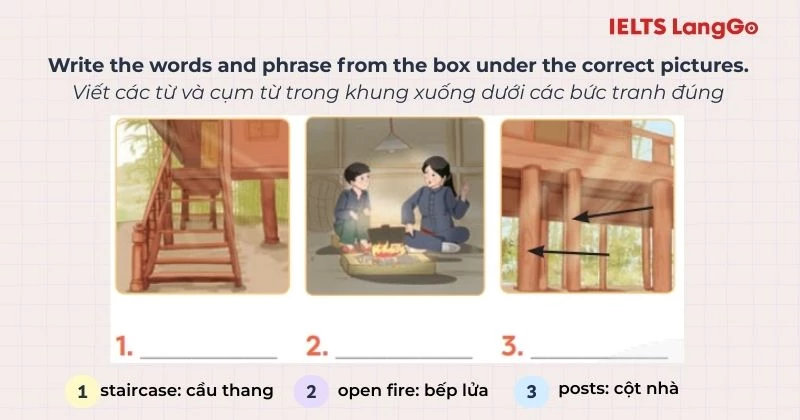
Đáp án:
1: staircase
2: open fire
3: posts
2. Read the passage and tick (✓) T (True) or F (False).
Đáp án:
1. FALSE - Only a few minority groups live in stilt houses.
2. FALSE - All stilt houses look alike.
3. TRUE - Family gatherings take place by the open fire in the middle of the house.
4. TRUE - The Rong house serves as the centre of an Ede village.
3. Read the passage again and fill in each blank with ONE word.
1. A stilt house shows the traditional culture of the owner.
2. The Tay's and Nung's stilt houses overlook a field.
3. The Thai's stilt houses overlook a mountain or forest.
4. The largest and tallest house in an Ede village is the Rong house.
Speaking
4. Work in pairs. Discuss and tick (✓) the features of a stilt house from the list below.
A stilt house __________
[ ] has a flat cement roof
[✓] stands on big posts
[✓] is made from natural materials
[ ] has a modern toilet
[ ] is a flat in a big block
[✓] is close to nature
Gợi ý thảo luận:
In my opinion, a stilt house is very special. Unlike modern houses, it stands on big posts high above the ground. It is mainly made from natural materials like wood, bamboo, and leaves. Living in a stilt house is wonderful because it is very close to nature.
5. Work in pairs. Ask and answer about the type of home each of you lives in. Take notes of your partner’s answers and report what you find to the class.
Câu hỏi gợi ý:
- What type of home do you live in?
=> I live in a [flat / house / stilt house...].
- What materials is it made from?
=> It is made from [brick / cement / wood / concrete...].
- What is the most important part of your home? What do you do there?
=> The most important part is the [living room / kitchen...]. We usually [watch TV / have dinner...] together there.
>> Xem chi tiết hướng dẫn giải tại đây: Tiếng Anh 8 Unit 4 Skills 1
VI. Skills 2 - Listening & Writing
Phần Skills 2 Unit 4 lớp 8 giúp các bạn học sinh rèn luyện 2 kỹ năng: Listening (Nghe hiểu) và Writing (Viết) xoay quanh chủ đề Ethnic Groups of Viet Nam.
Listening
1. Match the phrases with the correct pictures.
Đáp án:
1 - c: catching fish
2 - a: weaving clothing
3 - b: growing crops
2. Listen and tick (✓) the activities that minority children do to help their families.
Đáp án:
1. [✓] look after the house
2. [✓] weave clothing
3. [✓] prepare food
4. [ ] build houses
5. [✓] grow crops
6. [✓] raise livestock
3. Listen again and circle the correct answer A, B, or C.
1. Minority children usually learn to work at C.six.
2. Girls A. weave clothing.
3. Boys B. raise livestock
4. Children learn traditions through C. stories
5. The number of minority children going to school is A. going up
Writing
4. Note five things you do to help your family.
Gợi ý trả lời:
- Clean the house / Sweep the floor
- Wash the dishes
- Water the plants / flowers
- Feed the pets (dogs/cats)
- Look after my younger brother/sister
- Take out the rubbish
- Fold the clothes
5. Write a paragraph (80 - 100 words) about the things you do to help your family. Use the ideas in 4.
Đoạn văn mẫu:
Although I am busy with my studies, I always try to help my parents with household chores. Every morning, I make my own bed and tidy up my room before going to school. In the afternoon, after finishing my homework, I often help my mom prepare dinner by washing vegetables and setting the table. After dinner, I am responsible for washing the dishes and taking out the rubbish. At weekends, I also water the plants on the balcony and feed our cat. Helping my family makes me feel happy and responsible.
>> Xem chi tiết hướng dẫn giải tại đây: Tiếng Anh 8 Unit 4 Skills 2
VII. Looking Back
Phần Looking Back là bài học tổng hợp giúp các bạn học sinh ôn tập Từ vựng và Ngữ pháp trọng tâm đã học trong Unit 4.
Vocabulary
1. Match the words and phrases with the pictures.
Đáp án:
1 - c: weaving
2 - a: folk dance
3 - e: open fire
4 - b: fishing
5 - d: minority group
2. Complete the sentences with the words and phrases from the box.
Đáp án:
1. Minority groups have their own musical instruments like the dan tinh, gong, t'rung.
2. The Kinh use sticky rice to make banh chung and banh tet.
3. For most minority groups like the Bahnar and Ede, the communal house, usually known as Rong house, is the heart of the village.
4. My grandmother taught me to sing many folk songs.
5. The staircase of a Muong's stilt house has an odd number of steps: 5, 7, or 9.
Grammar
3. Write questions from the clues.
1. Did you attend the Khmer's Moon Worship Festival last year?
2. How many ethnic minority groups are there in Viet Nam?
3. Where do the Hmong live?
4. What did you do at the Ede's Harvest Festival last October?
5. How old are minority children when they start helping the family?
4. There is one incorrect underlined word in each sentence. Circle and correct it.
Đáp án:
1. A big stilt houses stands on high posts.
→ houses => house
2. The Lahu build their houses from wood and wild banana leave.
→ leave => leaves
3. Much people in remote areas travel on foot.
→ Much => Many
4. Most minority women weave clothes and do houseworks.
→ houseworks => housework
5. In the mountains, there is not many land for growing crops.
→ Many => Much
>> Xem chi tiết hướng dẫn giải tại đây: Tiếng Anh 8 Unit 4 Looking Back
VIII. Project - Our Ethnic Groups
Phần bài tập này giúp học sinh áp dụng kiến thức tiếng Anh vào thực tế thông qua các hoạt động nhóm thú vị xoay quanh chủ đề các dân tộc thiểu số.
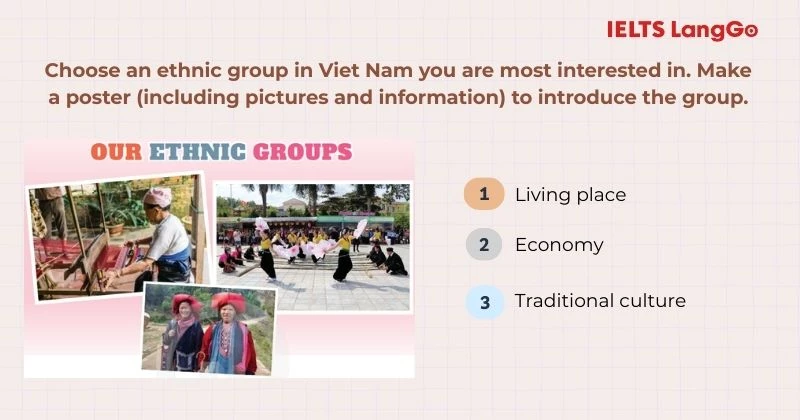
1. Choose an ethnic group in Viet Nam you are most interested in.
Gợi ý: Bạn có thể lựa chọn các dân tộc với nhiều đặc điểm thú vị đã được giới thiệu trong Unit 4 như: Dân tộc H'mông (The Hmong), Dân tộc Thái (The Thai), Dân tộc Ê-đê (The Ede), Dân tộc Chăm (The Cham), hoặc Dân tộc Mường (The Muong)...
2. Do a little research about it, focusing on its:
- Living place
- Economy
- Traditional culture
Gợi ý nội dung:
- Population: About 1.3 million.
- Living place: Northern mountainous provinces (Ha Giang, Lao Cai, Son La...).
- Economy: Growing rice on terraced fields, growing corn, weaving, making handicrafts.
- Culture: Colourful costumes, Love Market (Sa Pa), Gau Tao festival.
3. Make a poster (including pictures and information) to introduce the group.
Nội dung nên bao gồm:
- Hình ảnh: Sưu tầm ảnh về trang phục, nhà cửa, lễ hội của dân tộc đó
- Nội dung: Viết các thông tin ngắn gọn, súc tích (dùng gạch đầu dòng, không viết đoạn văn quá dài trên poster)
- Trang trí: Sử dụng màu sắc tươi sáng, họa tiết phù hợp với chủ đề
4. Present your poster to the class.
(Trình bày áp phích của bạn trước lớp)
>> Xem chi tiết hướng dẫn giải tại đây: Tiếng Anh 8 Unit 4 Project
Unit 4 Tiếng Anh Lớp 8 về chủ đề Ethnic Groups of Viet Nam với các bài tập từ vựng, ngữ pháp và kỹ năng đã giúp các bạn học sinh tăng cường hiểu biết và phát triển khả năng diễn đạt tiếng Anh về chủ đề văn hóa.
Hy vọng bộ đáp án và gợi ý chi tiết trên sẽ giúp các bạn nắm vững kiến thức Unit 4 và tự tin hoàn thành các bài tập tương tự. Hãy tiếp tục đồng hành cùng IELTS LangGo để nâng cao trình độ tiếng Anh mỗi ngày nhé!
BACK TO SCHOOL – Trúng Macbook Neo và hàng ngàn quà tặng khác

DEAL HỜI HẾT CỠ >> Dành riêng cho học viên đăng ký khóa học IELTS đến hết ngày 31/10
- Quay số trúng thưởng - Rinh MACBOOK xịn
- Giảm ngay 350.000đ khi đăng ký khóa 01 Level
- Ưu đãi học nhóm tới 250.000đ/ học viên
- Tặng ngay tài khoản Writing Xpert AI KHÔNG GIỚI HẠN