Giải Tiếng Anh Lớp 9 Unit 4: Remembering the Past (Đáp án chi tiết)
 IELTS LangGo
  03/11/2025



Trong Unit 4 Tiếng Anh lớp 9 về chủ đề Remembering the Past (Nhớ về quá khứ), các bạn học sinh sẽ được khám phá những giá trị lịch sử và truyền thống văn hóa qua các di tích, phong tục và lối sống của người xưa. Đây là một chủ đề thú vị giúp các em hiểu thêm về nguồn gốc và sự phát triển của các nền văn hóa khác nhau.
Bài viết này sẽ cung cấp gợi ý trả lời và đáp án cho đầy đủ các phần trong Unit 4, giúp các bạn nắm chắc kiến thức và đạt kết quả cao trong các bài kiểm tra môn Tiếng Anh.
I. Getting Started - At an English lesson
1. Listen and read
Phần mở đầu giới thiệu một tiết học tiếng Anh với các nhóm học sinh trình bày về các di tích lịch sử nổi tiếng như Angkor Wat ở Campuchia, Dinh Bang Communal House ở Việt Nam và Windsor Castle ở Anh. Qua đó, các bạn sẽ làm quen với từ vựng và cấu trúc câu liên quan đến chủ đề lịch sử và di sản.
2. Read the conversation again and answer the questions
Đáp án:
1. Angkor Wat is about 900 years old (built in the 12th century).
2. It's a national historic site. It's quite magnificent and about 300 years old.
3. Windsor Castle is in England.
4. Preservation efforts help us know a lot about our history and life in the past.
3. Complete each sentence with a word or a phrase from the box
Đáp án:
1. The best way to preserve our cultural heritage is to share it with others.
2. Vietnamese people take great pride in their culture which has been well preserved for thousands of years.
3. The foreign tourists gave a magnificent performance of the Vietnamese folk songs and dances.
4. Thanks to your kind contribution, we were able to save the ancient monument.
5. Many beautiful old castles are no longer occupied.
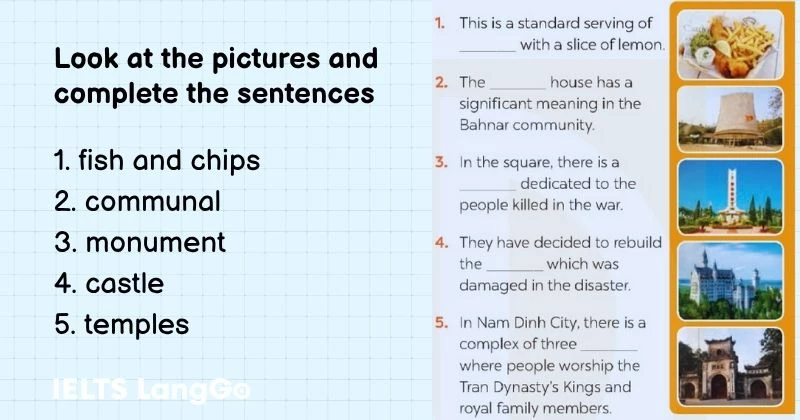
4. Look at the pictures and complete the sentences
Đáp án:
1. This is a standard serving of fish and chips with a slice of lemon.
2. The communal house has a significant meaning in the Bahnar community.
3. In the square, there is a monument dedicated to the people killed in the war.
4. They have decided to rebuild the castle which was damaged in the disaster.
5. In Nam Dinh City, there is a complex of three temples where people worship the Tran Dynasty's Kings and royal family members.
5. GAME - Remembering past events
Đây là trò chơi nhóm về kiến thức lịch sử. Học sinh làm việc theo nhóm và trả lời các câu hỏi. Nhóm nào có nhiều câu trả lời đúng hơn sẽ thắng.
Gợi ý trả lời:
1. Who decided to move our capital from Hoa Lu to Dai La (Thang Long) in 1010? → King Ly Thai To
2. When did Columbus discover the Americas? → In 1492
3. When was the United States founded? → On July 4, 1776
4. When did Nguyen Ai Quoc first go abroad? → In 1911
5. What happened in world history in 1914? → World War I began
Who was the last king of Viet Nam? → King Bao Dai
>> Xem chi tiết đáp án và giải thích: Tiếng Anh 9 Unit 4 Getting Started
II. A Closer Look 1 - Vocabulary & Pronunciation
Phần này tập trung vào việc mở rộng vốn từ vựng về cuộc sống trong quá khứ và cách bảo tồn các giá trị truyền thống, đồng thời luyện phát âm các phụ âm /m/ và /l/.
Vocabulary - Life in the past & Preserving values of the past
1. Complete the following table. There is one example
Đáp án:
| Verb | Noun |
| protect | protection |
| 1. promote | promotion |
| 2. recognise | recognition |
| 3. contribute | contribution |
| 4. observe | observation |
| 5. preserve | preservation |
| 6. occupy | occupation |
2. Complete the following sentences, using the correct forms of the words from 1
Đáp án:
1. People in these mountainous areas still preserve their local customs and traditions.
2. The invention of the seat belt made a good contribution to road safety.
3. We believe that preservation of these old structures will benefit the community in many ways.
4. The aim of the culture festival is the promotion of friendship and tourism.
5. In 2006, Duong Lam became the first village that was recognised as a national historic and cultural relic.
3. Complete the following sentences with the words from the box
Đáp án:
1. Stonehenge, England, one of the oldest stone structures in the world, is about 5,000 years old.
2. If you are busy, you can get a takeaway from one of these restaurants.
3. It's our duty to keep our customs and traditions alive for future generations.
4. Windsor Castle is about a thousand years old but it's absolutely magnificent.
5. Festivals, which are handed down from one generation to the next, are an important way to promote tourism.
Pronunciation - /m/ and /l/
4. Listen and repeat the words. Pay attention to the sounds /m/ and /l/
| /m/ | /l/ |
| monument /ˈmɒnjumənt/ | landscape /ˈlændskeɪp/ |
| magnificent /mæɡˈnɪfɪsnt/ | celebrate /ˈselɪbreɪt/ |
| programme /ˈprəʊɡræm/ | value /ˈvæljuː/ |
| custom /ˈkʌstəm/ | culture /ˈkʌltʃə(r)/ |
| grandma /ˈɡrænmɑː/ | national /ˈnæʃnəl/ |
5. Listen and repeat the sentences. Pay attention to the underlined words
1. The collection includes objects of the Middle Ages.
2. You should be careful when shopping in this mall.
3. This monument is small but magnificent.
4. They maintain these windmills as working museums.
5. David fell off his bike and hurt his ankle.
>> Xem chi tiết đáp án và giải thích: Tiếng Anh 9 Unit 4 A Closer Look 1
III. A Closer Look 2 - Grammar
Phần ngữ pháp Unit 4 tập trung vào hai chủ điểm quan trọng: thì quá khứ tiếp diễn (past continuous) để mô tả hành động đang diễn ra trong quá khứ, và cấu trúc "wish + past simple" để diễn tả điều ước không có thật ở hiện tại.
The past continuous
1. Put the verbs in brackets in the past continuous
Đáp án:
1. My dad first met my mum when he was visiting Hoi An Ancient Town.
2. Tom had a nightmare while he was sleeping in the camp by the old castle.
3. David hurt his foot while he was going down the steps of the pagoda.
4. My brother was just sitting while was looking around the weaving workshop.
5. Were you watching TV at 9 p.m. last night? There was a very good programme on Duong Lam Ancient Village preservation.
2. Complete the sentences, using the past continuous forms of the given verbs
Đáp án:
1. People were preserving the monument for years because it had great value.
2. When I finished school, my family was living in the countryside.
3. People were building the Taj Mahal - a World Heritage Site while Shah Jahan was emperor.
4. "Were you still working on the coffee farm when the war broke out, Grandpa?"
5. I was making a presentation when the microphone stopped working.
Wish + past simple
3. Put the verbs in brackets in the correct forms
Đáp án:
1. The children wish they got more presents every Christmas.
2. I wish I had enough money to visit London and Windsor Castle.
3. Do you wish we had a swimming pool in our school?
4. We wish we could spend our summer holiday at the seaside.
5. I wish I could go back to my grandparents' time.
4. Read the passage and write down five things that Jenny might wish for. Look at the example
Đáp án gợi ý:
1. Jenny wishes she didn't have to clean the room every day.
2. Jenny wishes her sister didn't lie in bed reading or playing computer games all the time.
3. Jenny wishes her sister didn't put dirty clothes on her bed.
4. Jenny wishes she had her own room.
5. Jenny wishes her sister could/would change her way.
5. Work in pairs. Tell your partner three wishes
You can refer to the following:
- Your everyday life
- Your study at school
- Your family (family members, relationship, ...)
- Your friends
Gợi ý trả lời
About everyday life:
- I wish I had more free time to do the things I love.
- I wish I could wake up early every morning.
- I wish I didn't have to do so many household chores.
About study:
- I wish I were better at Math.
- I wish I could remember English vocabulary more easily.
- I wish our school had a bigger library.
About family:
- I wish my parents didn't have to work so hard.
- I wish I had a younger brother or sister.
- I wish my family could travel abroad together.
About friends:
- I wish my best friend lived closer to me.
- I wish I could spend more time with my friends.
- I wish I had more friends who share the same interests as me.
>> Xem chi tiết đáp án và giải thích: Tiếng Anh 9 Unit 4 A Closer Look 2
IV. Communication - Everyday English & Traditional values
Phần này giúp học sinh học cách cảm ơn và đáp lại lời cảm ơn trong giao tiếp hàng ngày, đồng thời tìm hiểu về cách các gia đình Việt Nam gìn giữ truyền thống.
Everyday English - Thanking and responding
1. Listen and read the conversations. Pay attention to the highlighted parts
Hội thoại 1:
Kate: Thank you very much for showing us around Angkor Wat.
Guide: You're welcome.
Hội thoại 2:
Alice: Thanks a lot for telling us about life in the countryside.
Mi: No problem.
2. Work in pairs. Make similar conversations to express thanks and respond in the following situations
Gợi ý hội thoại:
Situation 1: You thank the village head for showing you around the craft workshop.
Student A: Thank you so much for showing us around your craft workshop. We learned a lot today.
Village head: You're welcome. I'm glad you enjoyed it.
Student A: The traditional techniques are really impressive.
Village head: Thank you. Feel free to come back anytime.
Situation 2: You thank your friend for lending you an interesting book.
Student A: Hey, thanks a lot for letting me borrow that book about Vietnamese history.
Student B: You're welcome! Did you finish it already?
Student A: Yes, it was really fascinating. I couldn't put it down.
Student B: I'm so glad you liked it! You can borrow more books anytime.
How our families keep traditions alive
3. Read the passage and complete the table
Đáp án:
| Anniversaries | Festivals | Holidays |
| 1. death anniversaries | 2. Mid-Autumn Festival | 4. Tet |
| 3. New Harvest Festival | 5. National Day |
4. Work in pairs. Ask and answer about how your family observes customs and traditions
Mẫu hội thoại:
Student A: What festival(s) does your family celebrate every year?
Student B: We celebrate the Mid-Autumn Festival and Tet. What about your family?
Student A: My family also celebrates Tet, and we never miss the Lunar New Year Festival.
Student B: That's wonderful! Do you have any special activities during these festivals?
Student A: Yes, during Tet we make banh chung together and visit our relatives.
5. Work in groups. Give a short talk about one of the things in 4 that you and your family do to preserve traditions, for example celebrating family members' birthdays
Sample:
Hello everyone. I'm going to talk about how my family keeps Vietnamese traditions alive by celebrating Tet, the Lunar New Year.
Tet is the most important holiday in Vietnam, and my family takes it very seriously. Our preparations begin about a month before Tet. First, we clean our entire house thoroughly because Vietnamese people believe this removes bad luck from the old year. We also repaint our house and decorate it with peach blossoms and kumquat trees.
One week before Tet, we start making banh chung, which is a traditional square sticky rice cake. This is my favorite part because the whole family works together. My grandmother supervises while my parents and I wrap the rice, mung beans, and pork in dong leaves. We cook them overnight, and the delicious smell fills our house.
On New Year's Eve, we have a big feast with traditional foods like pickled vegetables, boiled chicken, and spring rolls. At midnight, we set off firecrackers to welcome the new year. On the first day of Tet, we wear new clothes, visit the pagoda, and go to our grandparents' house to wish them health and happiness.
Throughout the three-day holiday, we visit relatives and friends. Adults give children lucky money in red envelopes, which symbolizes good fortune. My grandmother always tells us stories about Tet celebrations when she was young, helping us understand our heritage.
By celebrating Tet this way year after year, we preserve Vietnamese customs, strengthen family bonds, and teach younger generations about our cultural identity. These traditions connect us to our past and will continue into our future.
Thank you for your attention. I hope you enjoyed learning about how my family celebrates Tet.
>> Xem chi tiết đáp án và giải thích: Tiếng Anh 9 Unit 4 A Communication
V. Skills 1 - Reading & Speaking
Phần này phát triển kỹ năng đọc hiểu về món ăn truyền thống của Anh - fish and chips, và kỹ năng nói về các món ăn truyền thống của Việt Nam.
Reading
1. Work in groups. Discuss the following question
Câu hỏi: What do you know about England?
Gợi ý trả lời:
- England is part of the United Kingdom, located in Europe. Its capital city is London, one of the most famous cities in the world.
- England has many iconic landmarks such as Big Ben, the Tower of London, Buckingham Palace, and Stonehenge.
- English originated from England and is now spoken worldwide.
- Fish and chips is a famous traditional English dish. English people also enjoy afternoon tea.
- England is the birthplace of football (soccer), and the English Premier League is one of the most popular football leagues in the world.
2. Read the text and write the underlined words in the box
Đáp án:
| Meaning / Explanation | Word |
| 1. linked or connected | associated |
| 2. difficult to change or destroy | deep-rooted |
| 3. started to be seen | appeared |
| 4. necessary and important | basic |
3. Read the text again and tick (✓) T (True) or F (False) for each sentence
Đáp án:
| T | F | |
| 1. English people take great pride in their traditions. | ✓ | |
| 2. Fish and chips has been around for hundreds of years. | ✓ | |
| 3. The earliest fish and chip shop opened in London in 1860. | ✓ | |
| 4. Peas, vinegar, lemon, or ketchup are necessary for fish and chips. | ✓ | |
| 5. Fish and chips is not healthy as it has a lot of oil. | ✓ | |
| 6. Fish and chips is sold in many countries now. | ✓ |
Speaking
4. Work in pairs. Match 1-5 in column A with a-e in column B
Đáp án:
| A | B |
| 1. name of the dish | c. banh chung |
| 2. history | e. originated in 6th Hung King's time |
| 3. basic ingredients | a. glutinous rice, green beans, pork |
| 4. on what occasion it's eaten | b. at Tet, on the Hung Kings' anniversary |
| 5. type of dish | d. traditional dish |
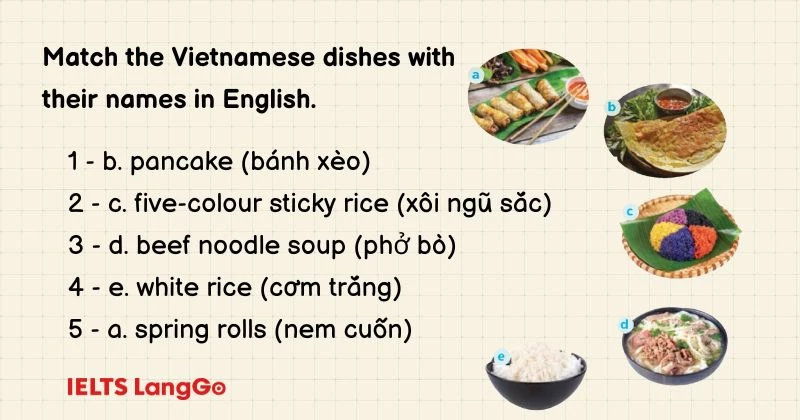
5. Work in groups. Match the Vietnamese dishes with their names in English
Đáp án:
1 - b. pancake (bánh xèo)
2 - c. five-colour sticky rice (xôi ngũ sắc)
3 - d. beef noodle soup (phở bò)
4 - e. white rice (cơm trắng)
5 - a. spring rolls (nem cuốn)
Choose a typical traditional Vietnamese dish and talk about it
Your talk should include:
- the name of the dish
- the basic ingredients
- when / on what occasion it is eaten
- whether you like it or not
Sample:
Today I would like to talk about banh chung, one of the most iconic traditional Vietnamese dishes.
Banh chung is a square sticky rice cake that has been part of Vietnamese culture for thousands of years. According to legend, it originated during the 6th Hung King's reign. The story tells of Lang Lieu, a prince who created this cake to represent the Earth in a cooking competition, which helped him win the throne.
The basic ingredients of banh chung are quite simple but meaningful. It consists of glutinous rice, green beans (mung beans), and pork, all wrapped in dong leaves (a special type of leaf) and tied with bamboo strings. The rice represents the white clouds, the green beans symbolize plants on Earth, and the pork represents animals. The square shape of the cake represents the Earth.
Banh chung is traditionally eaten during Tet holiday (Vietnamese Lunar New Year) and on the Hung Kings' anniversary (the 10th day of the third lunar month). It is an essential dish on the ancestral altar during these occasions. Making banh chung is often a family activity where everyone gathers together to prepare and boil the cakes overnight.
Personally, I really love banh chung! I enjoy its unique taste - the softness of the sticky rice combined with the rich flavor of pork and the slight sweetness of mung beans. I especially like eating it with pickled onions and Vietnamese sausage (giò lụa). For me, banh chung is not just food; it's a symbol of family reunion and Vietnamese cultural identity. Every time I eat banh chung, I feel connected to my ancestors and proud of our traditions.
>> Xem chi tiết đáp án và giải thích: Tiếng Anh 9 Unit 4 Skills 1
VI. Skills 2 - Listening & Writing
Phần này rèn luyện kỹ năng nghe hiểu về ngày xưa ở trường học và viết đoạn văn miêu tả về những ngày học của mình trong quá khứ.
Listening
1. Match each phrase with the right picture
Đáp án:
1 - b: walking barefoot
2 - a: talking face to face
3 - c: playing a traditional game
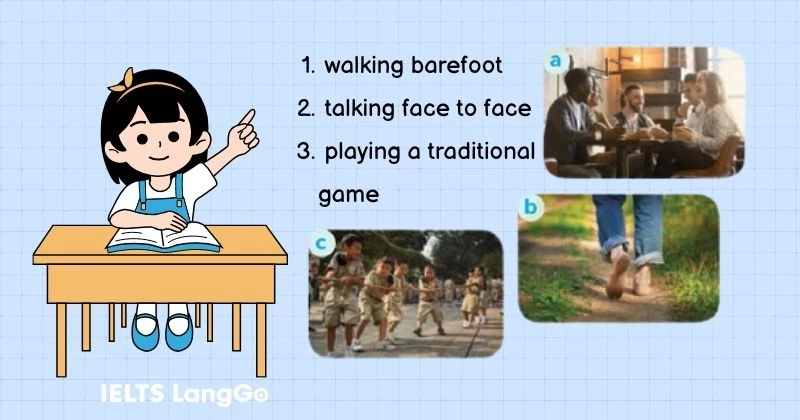
2. Listen to the talk between Thanh and his grandma and tick (✓) the things you hear
Đáp án:
☑ 1. Three-month summer holiday
☑ 2. Lessons in the morning only
□ 3. A lot of extra lessons
☑ 4. Walking barefoot
□ 5. Chatting on mobile phones
3. Listen again and choose the correct answers
Đáp án:
1. B. grandma's school days
2. A. homework
3. A. always
4. C. traditional games
Writing
4. Work in pairs. Ask and answer about school days in the past
Your talk may include the following:
- school time (When ...)
- school subjects (What ...)
- leisure time activities (What ...)
- summer holiday (How long ...)
- means of transport to school (How ...)
You can refer to the listening text for your answers.
Gợi ý hội thoại:
Student A: When did students have lessons in the past?
Student B: They had lessons in the morning only. In the afternoon, they helped their parents with housework or fieldwork.
Student A: What subjects did they study?
Student B: They didn't have many subjects like today. They didn't have music and arts, or computer science like we do now.
Student A: What did they do in their leisure time?
Student B: They played traditional games such as hide-and-seek, tug of war, and skipping. They also helped their families after school.
Student A: How long was their summer holiday?
Student B: Their summer holiday was three months long. They did lots of things during the summer.
Student A: How did they go to school?
Student B: They walked to school all the time. Many of them even went barefoot because they didn't have shoes or sandals.
5. Write a paragraph (100-120 words) about school days in the past
You can begin your writing with:
"In the past, students had lessons in the morning only. ____________"
Đoạn văn gợi ý:
In the past, students had lessons in the morning only. After finishing their morning classes, they returned home to help their parents with housework or work in the fields. Students didn't have many subjects to study like today; they mainly focused on basic subjects such as Vietnamese and Math. Their summer holiday lasted for three months, during which they helped their families with the harvest season. Most students walked to school, and many of them went barefoot because their families could not afford to buy shoes. During break time, they enjoyed playing traditional games like jump rope, hide and seek, and marble games. Life was simple but full of memorable moments.
>> Xem chi tiết đáp án và giải thích: Tiếng Anh 9 Unit 4 Skills 2
VII. Looking Back
Phần ôn tập giúp học sinh củng cố lại kiến thức đã học trong Unit 4.
Vocabulary
1. Choose the correct answer A, B, C, or D
Đáp án:
1. A. tradition
2. B. events
3. B. structures
4. D. ancient
5. C. occupied
2. Finish the sentence by completing each blank with a word. The first letter of each word is given
Đáp án:
1. The custom of worshipping ancestors is a beautiful and rich tradition in Vietnamese culture.
2. The custom of sending a greeting card has become a deep-rooted tradition in many Western countries.
3. A country's cultural heritage is a valuable resource.
4. Festivals, which are handed down from one generation to the next, are an important way to promote tourism.
5. Besides the key ingredient, another secret to achieving the perfect fish and chips is the temperature of the oil.

Grammar
3. Put the verb in brackets in the past continuous to complete each sentence
Đáp án:
1. Luckily, the sun was shining brightly when we reached the campsite.
2. They were building the Ho Chi Minh Mausoleum from 1973 to 1975.
3. When their mum came home, they were not studying; they were chatting noisily.
4. Were they still waiting when the tour guide arrived?
5. I was thinking of my grandmother for years after she died.
4. Rewrite the following sentences, using wish
Đáp án:
1. She doesn't have an iPhone. She'd like to have one.
→ She wishes she had an iPhone.
2. I'm sorry that I don't have a three-month summer holiday as my grandma did.
→ I wish I had a three-month summer holiday as my grandma did.
3. I want my parents to let me make my own decisions, but they don't.
→ I wish my parents would let me make my own decisions.
4. Mike wants to play musical instruments, but he can't.
→ Mike wishes he could play musical instruments.
5. My dad is very busy. I want him to have more time with me.
→ I wish my dad had more time with me.
>> Xem chi tiết đáp án và giải thích: Tiếng Anh 9 Unit 4 Looking back
VIII. Project - Life in your neighbourhood 40 years ago
Phần dự án cuối unit giúp học sinh thực hành kỹ năng thu thập thông tin, làm việc nhóm và trình bày về cuộc sống ở khu phố của mình cách đây 40 năm.
1. Work in groups. Collect information and pictures about life in your area about 40 years ago
You may need to ask your grandparents and/or old people or use the Internet to find information.
You can refer to the following:
- means of transport (on foot, on horseback, by bicycle, ...)
- home life (electric devices, cooking, ...)
- community services (electricity, running water, library, communal house, ...)
- ...
2. Make a poster. Write or print the information and stick the pictures on the poster
3. Give a presentation to the class
>> Xem chi tiết hướng dẫn và bài mẫu: Tiếng Anh 9 Unit 4 Project
Tiếng Anh 9 Unit 4 về chủ đề Remembering the Past đã giúp các bạn học sinh khám phá những giá trị lịch sử, văn hóa và truyền thống quý báu của nhân loại. Qua Unit này, các bạn không chỉ được mở rộng vốn từ vựng về cuộc sống trong quá khứ mà còn nắm vững hai cấu trúc ngữ pháp quan trọng: thì quá khứ tiếp diễn và "wish + past simple".
Hy vọng rằng phần đáp án và gợi ý trả lời cho các bài tập trên đây sẽ giúp các bạn nắm vững kiến thức Unit 4, tự tin hoàn thành các bài tập và đạt kết quả cao trong học tập. Hãy tiếp tục ôn tập thường xuyên và áp dụng kiến thức đã học vào giao tiếp thực tế để ngày càng tiến bộ hơn nhé.
BACK TO SCHOOL – Trúng Macbook Neo và hàng ngàn quà tặng khác

DEAL HỜI HẾT CỠ >> Dành riêng cho học viên đăng ký khóa học IELTS đến hết ngày 31/10
- Quay số trúng thưởng - Rinh MACBOOK xịn
- Giảm ngay 350.000đ khi đăng ký khóa 01 Level
- Ưu đãi học nhóm tới 250.000đ/ học viên
- Tặng ngay tài khoản Writing Xpert AI KHÔNG GIỚI HẠN