
Giải Cam 19 Listening - Test 2 Part 3: Đáp án & Giải thích chi tiết
 IELTS LangGo
  11/06/2026



Bạn đang luyện tập Cam 19 Listening Test 2 Part 3 về chủ đề "Challenges in footwear recycling" và cảm thấy hơi lúng túng với dạng bài Multiple choice kết hợp Matching? Đừng lo! Bài viết này sẽ giúp bạn phân tích chi tiết từng câu hỏi, hiểu rõ chiến lược làm bài hiệu quả, và nắm vững các từ khóa quan trọng trong Cam 19 Listening Test 2 Part 3.
1. Bài nghe Cambridge 19 Listening Test 2 Part 3: Challenges in footwear recycling
Questions 21 - 24
Choose the correct letter, A, B or C.
21. At first, Don thought the topic of recycling footwear might be too
-
limited in scope.
-
hard to research.
-
boring for listeners.
22. When discussing trainers, Bella and Don disagree about
-
how popular they are among young people.
-
how suitable they are for school.
-
how quickly they wear out.
23. Bella says that she sometimes recycles shoes because
-
they no longer fit.
-
she no longer likes them.
-
they are no longer in fashion.
24. What did the article say that confused Don?
-
Public consumption of footwear has risen.
-
Less footwear is recycled now than in the past.
-
People dispose of more footwear than they used to.
Questions 25 and 28
What reasons did the recycling manager give for rejecting footwear, according to the students?
Choose FOUR answers from the box and write the correct letter, A-F.
Reason
-
one shoe was missing
-
the colour of one shoe had faded
-
one shoe had a hole in it
-
the shoes were brand new
-
the shoes were too dirty
-
the stitching on the shoes was broken
Footwear
25. the high-heeled shoes
26. the ankle boots
27. the baby shoes
28. the trainers
Questions 29 - 30
Choose the correct letter, A, B or C.
29. Why did the project to make ‘new’ shoes out of old shoes fail?
-
People believed the ‘new’ pairs of shoes were unhygienic.
-
There were not enough good parts to use in the old shoes.
-
The shoes in the ‘new’ pairs were not completely alike.
30. Bella and Don agree that they can present their topic
-
from a new angle.
-
with relevant images.
-
in a straightforward way.
Phân tích đề bài và chiến lược làm bài:
Bài tập của phần này bao gồm 10 câu, thuộc dạng Multiple choice và Matching statement.
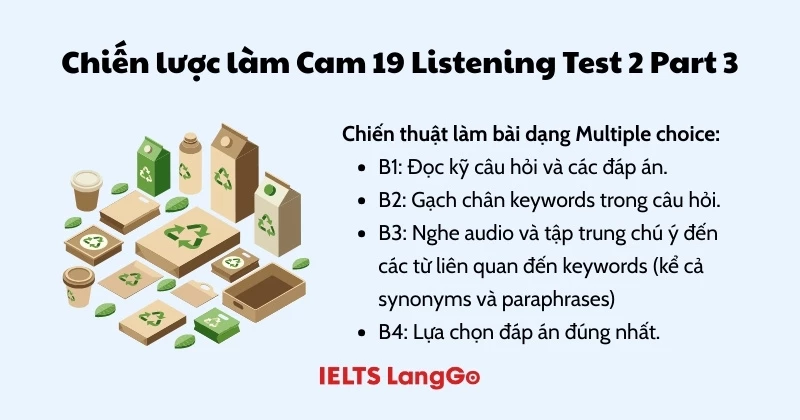
Chiến thuật làm bài dạng Multiple choice:
- B1: Đọc kỹ câu hỏi và các đáp án.
- B2: Gạch chân keywords trong câu hỏi.
- B3: Nghe audio và tập trung chú ý đến các từ liên quan đến keywords (kể cả synonyms và paraphrases)
- B4: Lựa chọn đáp án đúng nhất.
Chú ý:
- Các câu hỏi sẽ luôn xuất hiện theo thứ tự nên nếu các bạn cần phải luôn chú ý đến các câu hỏi sau để tránh bị lỡ mất nhé
- Hãy tận dụng thời gian tốt để đọc hết phần câu hỏi ở dạng bài này do lượng thông tin là khá nhiều và nếu không có đủ thời gian đọc thì sẽ ảnh hưởng đến chất lượng bài nghe
Chiến thuật làm bài dạng Matching statement:
- B1: Đọc kỹ câu hỏi và các đáp án.
- B3: Gạch chân keywords trong câu hỏi và đáp án.
- B4: Nghe audio và tập trung chú ý đến các từ liên quan đến keywords (kể cả synonyms và paraphrases)
- B5: Lựa chọn đáp án đúng nhất.
2. Đáp án và giải thích Cam 19 listening test 2 part 3: Challenges in footwear recycling
Sau khi làm xong Cam 19 Listening Test 2 Part 3, đây là lúc kiểm tra đáp án và hiểu rõ giải thích cho từng câu hỏi:
| 21 | A | 26 | B |
| 22 | B | 27 | A |
| 23 | B | 28 | C |
| 24 | B | 29 | C |
| 25 | E | 30 | A |
Question 21:
Đáp án: A
Keyword câu hỏi:
21. At first, Don thought the topic of recycling footwear might be too
-
limited in scope.
-
hard to research.
-
boring for listeners.
Keyword bài nghe:
DON: Well, before I started reading it, I thought recycling footwear, well, although it’s quite interesting, perhaps there isn’t enough to say about it, [...]
Giải thích:
- Đáp án A nói rằng lúc đầu, Don nghĩ chủ đề tái chế giày dép có thể bị quá giới hạn trong phạm vi mà trong bài Don có nói: Thật ra, trước khi đọc, mình nghĩ tái chế giày dép, thì… mặc dù khá thú vị nhưng có lẽ không có nhiều điều để nói -> CHỌN
- Đáp án B nói rằng Don nghĩ nó quá khó để nghiên cứu nhưng không có thông tin trong bài -> LOẠI
- Đáp án C nói rằng Don nghĩ nó quá nhàm chán cho người nghe nhưng trong bài Don đã nói là nó thú vị -> LOẠI
Question 22:
Đáp án: B
Keyword câu hỏi:
22. When discussing trainers, Bella and Don disagree about
-
how popular they are among young people.
-
how suitable they are for school.
-
how quickly they wear out.
Keyword bài nghe:
DON: One of the things I didn’t realise until I read the article was just how many pairs of trainers get recycled!
[...]
DON: I guess they are very hard-wearing, but don’t they look a bit casual for school uniform? I don’t think they’re right for that.
BELLA: Actually, I think some of them look quite smart on pupils …
Giải thích:
- Đáp án B nói rằng khi bàn luận về giày thể thao, Bella và Don không đồng ý về việc chúng phù hợp cho trường học như thế nào mà trong bài, Don thì nói chúng nhìn hơi sơ sài quá so với đồng phục trường nhưng Bella lại nói rằng chúng trông khá đẹp khi học sinh đeo -> CHỌN
- Đáp án A nói rằng họ không đồng ý về việc chúng phổ biến đối với người trẻ như nào mà trong bài Bella nói nhiều người trẻ đeo nó và Don bảo Don biết điều đó -> LOẠI
- Đáp án C nói rằng họ không đồng ý về việc chúng sẽ hỏng nhanh như nào mà trong bài không có thông tin về việc này -> LOẠI
Question 23:
Đáp án: B
Keyword câu hỏi:
23. Bella says that she sometimes recycles shoes because
-
they no longer fit.
-
she no longer likes them.
-
they are no longer in fashion.
Keyword bài nghe:
BELLA: I must admit, I’ve recycled some perfectly good shoes, that haven’t gone out of fashion and still fit, just because they don’t look great on me any more. That’s awful isn’t it?
Giải thích:
- Đáp án B nói rằng Bellas thường tái chế giày dép vì cô ấy không còn thích chúng nữa mà trong bài Bella lại nói: Mình phải thú thật là từng đem tái chế vài đôi giày vẫn còn tốt, không lỗi mốt và vẫn vừa chân, chỉ vì chúng không hợp với mình nữa -> CHỌN
- Đáp án A nói rằng vì chúng không còn vừa nữa nhưng trong bài Bella nói chúng vẫn còn vừa -> LOẠI
- Đáp án C nói rằng chúng không còn hợp thời trang nữa nhưng trong bài Bella nói chúng vẫn chưa hết thời -> LOẠI
Question 24:
Đáp án: B
Keyword câu hỏi:
24. What did the article say that confused Don?
-
Public consumption of footwear has risen.
-
Less footwear is recycled now than in the past.
-
People dispose of more footwear than they used to.
Keyword bài nghe:
DON: No. But then it said that the amount of recycled footwear has fallen: it’s 6 percent now compared to a previous level of 11 percent. That doesn’t seem to make sense.
Giải thích:
- Đáp án B nói rằng việc làm Don bối rối là ít giày dép được tái chế bây giờ hơn là trong quá khứ mà trong bài Don nói: Đúng, nhưng nó cũng nói lượng giày tái chế lại giảm: giờ chỉ còn 6% so với mức trước đây là 11%. Nghe chẳng hợp lý chút nào -> CHỌN
- Đáp án A nói rằng đó là sự tiêu thụ giày dép đã tăng nhưng trong bài khi Bella nói điều đó không làm cô ấy ngạc nhiên thì Don cũng đồng tình -> LOẠI
- Đáp án C nói rằng đó là việc mọi người vứt nhiều giày dép hơn so với trước kia nhưng trong bài không có thông tin -> LOẠI
Question 25:
Đáp án: E
Keyword câu hỏi:
25. the high-heeled shoes
E. the shoes were too dirty
Keyword bài nghe:
BELLA: Mmm. Let’s start with the ladies’ high-heeled shoes. What did he say about those?
DON: He said they were probably expensive – the material was suede and they were beige in colour – it looked like someone had only worn them once, but in a very wet field so the heels were too stained with mud and grass to re-sell them.
Giải thích: Trong bài Don nói rằng những đôi giày cao gót bị bẩn vì bùn và cỏ nên không bán lại được, đồng nghĩa với đáp án E là chúng quá bẩn
Question 26:
Đáp án: B
Keyword câu hỏi:
26. the ankle boots
B. the colour of one shoe had faded
Keyword bài nghe:
BELLA: OK … and the leather ankle boots. What was wrong with them?
DON: Apparently, the heels were worn – but that wasn’t the problem. One of the shoes was a much lighter shade than the other one – it had obviously been left in the sun.
Giải thích: Trong bài Don nói một trong 2 chiếc có màu nhạt hơn chiếc còn lại, điều này đồng nghĩa với đáp án B là màu sắc của một chiếc bị phai
Question 27:
Đáp án: A
Keyword câu hỏi:
27. the baby shoes
A. one shoe was missing
Keyword bài nghe:
BELLA: Sure. Then there were the red baby shoes.
DON: Oh yes – we’re told to tie shoes together when we put them in a recycling bin, but people often don’t bother.
BELLA: You’d think it would have been easy to find the other, but it wasn’t. [...]
Giải thích: Trong bài Bella nói rằng mọi người nghĩ là dễ khi đi tìm một chiếc nhưng thực ra là không dễ chút nào, đồng nghĩa với đáp án A là một chiếc giày bị mất
Question 28:
Đáp án: C
Keyword câu hỏi:
28. the trainers
A. one shoe had a hole in it
Keyword bài nghe:
DON: The trainers were interesting. He said they looked like they’d been worn by a marathon runner.
BELLA: Yeah – weren’t they split?
DON: Not exactly. One of the soles was so worn under the foot that you could put your finger through it.
Giải thích:Trong bài Don nói một trong hai đế giày bị mòn đến mức có thể đưa ngón tay được qua nó, đồng nghĩa với đáp án C là một chiếc có một cái lỗ.
Question 29:
Đáp án: C
Keyword câu hỏi:
29. Why did the project to make ‘new’ shoes out of old shoes fail?
-
People believed the ‘new’ pairs of shoes were unhygienic.
-
There were not enough good parts to use in the old shoes.
-
The shoes in the ‘new’ pairs were not completely alike.
Keyword bài nghe:
DON: Mmm. What did you think about the project his team set up to avoid this by making new shoes out of the good parts of old shoes?
BELLA: It sounded like a good idea. They get so many shoes, they should be able to match parts. I wasn’t surprised that it failed, though. I mean who wants to buy second-hand shoes really? Think of all the germs you could catch!
DON: Well, people didn’t refuse them for that reason, did they? It was because the pairs of shoes weren’t identical.
Giải thích:
- Đáp án C nói rằng lý do dự án làm những đôi giày mới từ những đôi cũ thất bại là vì những đôi giày mới nhìn không giống nhau mà trong bài Bella có nói là bởi vì hai chiếc trong một đôi không giống nhau -> CHỌN
- Đáp án A nói rằng lý do là vì mọi người tin rằng những đôi giày mới không sạch sẽ nhưng trong bài khi Don nói mọi người không muốn mua giày dùng rồi vì những con vi khuẩn mà Bella lại đó đó không phải là lý do họ từ chối chúng -> LOẠI
- Đáp án B nói rằng lý do vì không có để phần tốt của giày cũ để làm thành giày mới nhưng trong bài không có thông tin -> LOẠI
Question 30:
Đáp án: A
Keyword câu hỏi:
30. Bella and Don agree that they can present their topic
-
from a new angle.
-
with relevant images.
-
in a straightforward way.
Keyword bài nghe:
DON: It’s not as simple as you first think, and we can show that by taking a very different approach to it.
BELLA: Absolutely. So let’s discuss …
Giải thích:
- Đáp án A nói rằng Bella và Don đều đồng ý rằng họ có thể thuyết trình chủ đề từ góc độ mới mà trong bài Bella có nói họ có thể thuyết trình bằng việc đi theo một cách tiếp cận khác và Don đồng ý -> CHỌN
- Đáp án B nói rằng họ có thể thuyết trình chủ đề với những hình ảnh có liên quan nhưng trong bài không có thông tin -> LOẠI
- Đáp án C nói rằng họ có thể thuyết trình chủ đề theo một cách thẳng thắn nhưng trong bài không có thông tin -> LOẠI
3. Transcript bài: Challenges in footwear recycling
Để hiểu sâu hơn về Cam 19 Listening Test 2 Part 3, việc đối chiếu với transcript là vô cùng quan trọng. Hãy đọc kỹ đoạn hội thoại dưới đây nhé:
Transcript:
BELLA: Hi Don – did you get the copy of the article on recycling footwear that I emailed you?
DON: Yeah – it’s here … I’ve had a look at it.
BELLA: So do you think it’s a good topic for our presentation?
DON: Well, before I started reading it, I thought recycling footwear, well, although it’s quite interesting, perhaps there isn’t enough to say about it, cos we put shoes in recycling bins, they go to charity shops and that’s about it.
BELLA: … but there’s much more to it than that.
DON: I realise that now and I’m keen to research the topic more.
BELLA: That’s great.
DON: One of the things I didn’t realise until I read the article was just how many pairs of trainers get recycled!
BELLA: Well, a lot of young people wear them all the time now. They’ve become more popular than ordinary shoes.
DON: I know. I guess they are very hard-wearing, but don’t they look a bit casual for school uniform? I don’t think they’re right for that.
BELLA: Actually, I think some of them look quite smart on pupils … better than a scruffy old pair of shoes.
DON: So do you keep shoes a long time?
BELLA: Yes. Though I do tend to wear my old pairs for doing dirty jobs like cleaning my bike.
BELLA: I must admit, I’ve recycled some perfectly good shoes, that haven’t gone out of fashion and still fit, just because they don’t look great on me any more. That’s awful isn’t it?
DON: I think it’s common because there’s so much choice. The article did say that recent sales of footwear have increased enormously.
BELLA: That didn’t surprise me.
DON: No. But then it said that the amount of recycled footwear has fallen: it’s 6 percent now compared to a previous level of 11 percent. That doesn’t seem to make sense.
BELLA: That’s because not everything goes through the recycling process. Some footwear just isn’t good enough to re-sell, for one reason or another, and gets rejected.
BELLA: So let’s find some examples in the article of footwear that was rejected for recycling.
DON: OK. I think there are some in the interview with the recycling manager. Yeah – here it is.
BELLA: Mmm. Let’s start with the ladies’ high-heeled shoes. What did he say about those?
DON: He said they were probably expensive – the material was suede and they were beige in colour – it looked like someone had only worn them once, but in a very wet field so the heels were too stained with mud and grass to re-sell them.
BELLA: OK … and the leather ankle boots. What was wrong with them?
DON: Apparently, the heels were worn – but that wasn’t the problem. One of the shoes was a much lighter shade than the other one – it had obviously been left in the sun. I suppose even second-hand shoes should look the same!
BELLA: Sure. Then there were the red baby shoes.
DON: Oh yes – we’re told to tie shoes together when we put them in a recycling bin, but people often don’t bother.
BELLA: You’d think it would have been easy to find the other, but it wasn’t. That was a shame because they were obviously new.
DON: The trainers were interesting. He said they looked like they’d been worn by a marathon runner.
BELLA: Yeah – weren’t they split?
DON: Not exactly. One of the soles was so worn under the foot that you could put your finger through it.
BELLA: Well, we could certainly use some of those examples in our presentation to explain why 90 percent of shoes that people take to recycling centres or bins get thrown into landfill.
DON: Mmm. What did you think about the project his team set up to avoid this by making new shoes out of the good parts of old shoes?
BELLA: It sounded like a good idea. They get so many shoes, they should be able to match parts. I wasn’t surprised that it failed, though. I mean who wants to buy second-hand shoes really? Think of all the germs you could catch!
DON: Well, people didn’t refuse them for that reason, did they? It was because the pairs of shoes weren’t identical.
BELLA: They still managed to ship them overseas, though.
DON: That’s another area we need to discuss.
BELLA: You know I used to consider this topic just from my own perspective, by thinking about my own recycling behaviour without looking at the bigger picture. So much happens once shoes leave the recycling area.
DON: It’s not as simple as you first think, and we can show that by taking a very different approach to it.
BELLA: Absolutely. So let’s discuss …
Bản dịch:
BELLA: Chào Don – cậu đã nhận được bản sao bài báo về tái chế giày dép mà mình gửi qua email chưa?
DON: Ừ – ở đây rồi … mình đã xem qua rồi.
BELLA: Vậy cậu nghĩ đây có phải là một chủ đề hay cho bài thuyết trình của chúng ta không?
DON: Thật ra, trước khi đọc, mình nghĩ tái chế giày dép, thì… mặc dù khá thú vị nhưng có lẽ không có nhiều điều để nói, vì chúng ta bỏ giày vào thùng tái chế, rồi chúng được đưa đến các cửa hàng từ thiện, thế là hết.
BELLA: … nhưng còn nhiều thứ hơn thế nữa.
DON: Giờ thì mình nhận ra rồi, và mình cũng rất muốn tìm hiểu thêm về chủ đề này.
BELLA: Tuyệt quá.
DON: Một trong những điều mình không ngờ là số lượng giày thể thao được tái chế lại nhiều đến vậy!
BELLA: Ừ, bây giờ nhiều bạn trẻ mang giày thể thao suốt. Chúng còn phổ biến hơn cả giày thường.
DON: Biết rồi. Mình đoán chúng bền thật đấy, nhưng chẳng phải trông hơi xuề xòa so với đồng phục đi học sao? Mình thấy nó không phù hợp lắm.
BELLA: Thực ra mình nghĩ một số đôi giày thể thao trông khá lịch sự khi học sinh mang … còn hơn một đôi giày cũ kỹ, sờn rách.
DON: Vậy cậu thường giữ giày lâu không?
BELLA: Có chứ. Nhưng mình thường dùng mấy đôi cũ để làm việc bẩn, như dọn xe đạp chẳng hạn.
BELLA: Mình phải thú thật là từng đem tái chế vài đôi giày vẫn còn tốt, không lỗi mốt và vẫn vừa chân, chỉ vì chúng không hợp với mình nữa. Nghe thật tệ đúng không?
DON: Mình nghĩ chuyện này khá phổ biến, vì có quá nhiều sự lựa chọn. Bài báo cũng nói doanh số giày dép gần đây tăng mạnh.
BELLA: Điều đó thì không làm mình ngạc nhiên.
DON: Đúng, nhưng nó cũng nói lượng giày tái chế lại giảm: giờ chỉ còn 6% so với mức trước đây là 11%. Nghe chẳng hợp lý chút nào.
BELLA: Đó là vì không phải mọi đôi giày đều qua được quy trình tái chế. Một số giày không đủ tiêu chuẩn để bán lại, vì nhiều lý do, và bị loại bỏ.
BELLA: Vậy hãy tìm trong bài báo vài ví dụ về những đôi giày bị loại bỏ khi tái chế nhé.
DON: Ừ. Mình nghĩ có vài ví dụ trong phần phỏng vấn quản lý trung tâm tái chế. Đây rồi.
BELLA: Mmm. Bắt đầu với đôi giày cao gót nữ nhé. Ông ấy nói gì về chúng?
DON: Ông ấy bảo chúng có lẽ đắt tiền – chất liệu bằng da lộn và màu be – trông như chỉ được mang một lần thôi, nhưng ở một cánh đồng ướt nên gót giày dính đầy bùn và cỏ, bẩn quá nên không thể bán lại.
BELLA: Ừ … còn đôi bốt da cổ ngắn thì sao?
DON: Có vẻ như gót giày bị mòn – nhưng vấn đề không phải vậy. Một chiếc thì màu nhạt hơn chiếc còn lại – rõ ràng là bị phơi nắng. Ngay cả giày cũ thì cũng phải trông giống nhau chứ!
BELLA: Đúng rồi. Rồi còn đôi giày đỏ của em bé.
DON: À, đúng. Người ta được nhắc là buộc giày thành đôi trước khi bỏ vào thùng tái chế, nhưng thường không làm.
BELLA: Ngỡ tưởng dễ tìm chiếc còn lại, nhưng không hề. Thật tiếc vì chúng gần như mới tinh.
DON: Còn đôi giày thể thao thì khá thú vị. Ông ấy bảo trông như chúng từng được mang bởi một vận động viên marathon.
BELLA: Ừ – chẳng phải chúng bị rách sao?
DON: Không hẳn. Một chiếc đế mòn đến mức dưới bàn chân có thể thò ngón tay xuyên qua.
BELLA: Vậy mình có thể dùng những ví dụ này trong bài thuyết trình để giải thích tại sao 90% giày mang đến trung tâm tái chế cuối cùng lại bị chôn lấp.
DON: Ừm. Còn cậu nghĩ sao về dự án mà nhóm ông ấy lập ra – làm giày mới từ những phần còn tốt của giày cũ?
BELLA: Ý tưởng nghe hay đấy. Họ nhận được quá nhiều giày, chắc cũng có thể ghép các phần lại. Mình không bất ngờ khi dự án thất bại, thật ra. Ai mà muốn mua giày cũ cơ chứ? Nghĩ đến vi khuẩn thôi cũng thấy sợ!
DON: Nhưng người ta đâu có từ chối vì lý do đó, phải không? Là vì những đôi giày ghép lại trông không giống nhau.
BELLA: Đúng, nhưng họ vẫn xuất khẩu được ra nước ngoài.
DON: Đó cũng là một mảng nữa mình cần bàn tới.
BELLA: Cậu biết không, trước đây mình chỉ nghĩ đến chủ đề này từ góc độ cá nhân, tức là cách mình tái chế giày dép, chứ chưa bao giờ nhìn vào bức tranh lớn hơn. Thật ra, có rất nhiều việc xảy ra sau khi giày rời khỏi điểm tái chế.
DON: Nó không đơn giản như ta nghĩ ban đầu, và chúng ta có thể chứng minh điều đó bằng cách tiếp cận theo một hướng rất khác.
BELLA: Chính xác. Vậy thì chúng ta hãy bàn tiếp nhé…
Hy vọng qua bài viết này, bạn đã nắm được chiến lược làm bài Cam 19 Listening Test 2 Part 3, hiểu rõ cách paraphrase của đề thi và biết cách xác định đáp án chính xác. Đừng quên lưu lại bài viết này để ôn tập, và chia sẻ cho bạn bè cùng luyện thi IELTS nhé!
>>> Bạn có thể tham khảo:
BACK TO SCHOOL – Trúng Macbook Neo và hàng ngàn quà tặng khác

DEAL HỜI HẾT CỠ >> Dành riêng cho học viên đăng ký khóa học IELTS đến hết ngày 31/10
- Quay số trúng thưởng - Rinh MACBOOK xịn
- Giảm ngay 350.000đ khi đăng ký khóa 01 Level
- Ưu đãi học nhóm tới 250.000đ/ học viên
- Tặng ngay tài khoản Writing Xpert AI KHÔNG GIỚI HẠN