Đáp án Tiếng Anh lớp 9 Unit 10 Global Success chủ đề Planet Earth
 IELTS LangGo
  20/03/2026



Unit 10 Tiếng Anh lớp 9 về chủ đề Planet Earth giúp học sinh tìm hiểu về hành tinh của chúng ta - Trái Đất, đồng thời mở rộng vốn từ vựng và luyện các kỹ năng xoay quanh chủ đề này.
Trong bài viết này, IELTS LangGo sẽ cung cấp đáp án và gợi ý trả lời cho tất cả các bài tập giúp các bạn học sinh nắm chắc kiến thức và vận dụng hiệu quả trong các bài kiểm tra cũng như giao tiếp thực tế.
I. Getting Started - In a science club
1. Listen and read
Đoạn hội thoại là cuộc trò chuyện tại một câu lạc bộ khoa học về hành tinh Trái Đất.
2. Read the conversation again and tick (✓) T (True) or F (False) for each sentence.
1 - F. The students are asking about the Solar System.
2 - T. Another name for Earth is the Blue Planet.
3 - F. Water covers four fifths of Earth.
4 - T. Water bodies and landforms are essential habitats for plants and animals.
5 - T. Mr An thinks pollution is threatening the habitats of plants and animals.
3. Write a word or phrase from the box under the correct picture.
Đáp án:
(1) - landforms
(2) - flora and fauna
(3) - liquid water
(4) - outer space
(5) - water bodies
(6) - Solar System
4. Complete each sentence with a word or phrase from 3.
1. Flora and fauna refer to the plants and animals of a particular place.
2. Oceans, seas, rivers, and lakes are different types of water bodies on Earth.
3. There are eight planets in the Solar System.
4. The Soviet Union launched Sputnik 1 into outer space in 1957.
5. Some examples of landforms include mountains, grassland, and deserts.
5. QUIZ: Work in groups. Answer the following questions.
Gợi ý trả lời:
1. How many continents are there on Earth?
→ There are 7 continents
2. How many oceans are there on Earth?
→ There are 5 oceans
3. How many moons orbit Earth?
→ One.
4. Which gas is essential for life on Earth?
→ Oxygen.
5. Which planet has conditions similar to those on Earth?
→ Mars.
>> Xem chi tiết hướng dẫn giải tại: Tiếng Anh 9 Unit 10 Getting Started
II. A Closer Look 1
Vocabulary
Phần Vocabulary giúp học sinh luyện tập các từ vựng liên quan đến Trái Đất, thiên nhiên và môi trường.
1. Write a word or phrase from the box under each picture.
Đáp án:
(1) - flora and fauna
(2) - habitats
(3) - poles
(4) - grassland
(5) - nature reserves
(6) - food chain
2. Complete each sentence with a word or phrase from 1.
Đáp án:
1. In a food chain, some animals eat other animals and become food for a third group of animals.
2. A grassland is often wide and its plants are mostly grass and flowers.
3. Areas of land to protect animals and plants are called nature reserves.
4. The North and South poles are both extremely cold and icy.
5. Natural habitats for pandas are bamboo forests.
3. Choose the correct answer A, B, C, or D.
1. When humans use a natural habitat for farming and housing, they cause ________.
A. climate change
B. global warming
C. habitat loss
D. ecological balance
→ Đáp án: C. habitat loss
2. When Earth's average temperature increases, we face ________.
A. ecological balance
B. global warming
C. pollution
D. protection
→ Đáp án: B. global warming
3. Each of us can lend a hand to ________ the natural environment.
A. hunt
B. change
C. preserve
D. pollute
→ Đáp án: C. preserve
4. We can keep a(n) ________ by stopping hunting and cutting down trees.
A. ecological balance
B. habitat loss
C. climate change
D. nature reserve
→ Đáp án: A. ecological balance
5. One way to ________ Mother Earth is by planting more trees.
A. keep
B. harm
C. provide
D. protect
→ Đáp án: D. protect
Pronunciation - Rhythm in sentences
Phần phát âm hướng dẫn học sinh cách nhận biết và nhấn đúng trọng âm vào các từ mang nội dung chính để tạo ra nhịp điệu tự nhiên khi nói tiếng Anh.
4. Listen to the sentences and pay attention to the bold syllables. Does the speaker place stress on them?
Đáp án:
1. Earth is the third planet from the Sun.
2. Oceans, seas, rivers, and lakes are water bodies.
3. The North and South poles are extremely cold and icy.
4. Do moonquakes last up to half an hour?
5. Preserving natural resources is very important.
Does the speaker place stress on them?
=> Yes, the speaker places stress on them.
5. Circle the stressed syllables in the sentences. Listen, check, and repeat.
Đáp án:
1. We’re doing a study on climate change.
2. What is the distance from Earth to Mars?
3. They’ll have a discussion on natural habitats.
4. Plants provide us with food, oxygen, and energy.
5. Our school organised various activities on Earth Day.
>> Xem lời giải chi tiết tại: Tiếng Anh 9 Unit 10 A Closer Look 1
III. A Closer Look 2
Bài học này giúp các bạn học sinh nắm được cấu trúc và cách dùng mệnh đề quan hệ không xác định (Non-defining relative clauses).
1. Complete the sentences with correct relative pronouns.
1. Planet Earth, which is also called the Blue Planet, is covered with water and land.
2. Peter Molnar, who has done many studies on climate change, is one of the best-known Earth scientists.
3. Neil Armstrong, whose trip to the moon marked a giant leap for mankind, was the first to walk on the moon.
4. Suoi Thau, which is in Ha Giang, is one of the most gorgeous grasslands in Viet Nam.
5. People often do green things to protect Earth on the Earth Day, which is celebrated on 22nd April.
2. Underline the relative clauses. Tick (✓) if the relative clause can be omitted.
1. [ ✓ ] The second planet from the Sun is Venus, which is sometimes called the Earth’s sister.
2. [ ✓ ] The ocean, which is the body of salt water, contains 97% of Earth’s water.
3. [ ] Landforms make up the areas which include mountains, hills, plains, and plateaus.
4. [ ✓ ] One of the world’s most famous Earth scientists is James Hutton, who is a British geologist.
5. [ ✓ ] Arctic Ocean ice and water make up a habitat for polar bears, whose main food is seals.
3. Complete each sentence (1 – 5) with a non-defining relative clause (A – E).
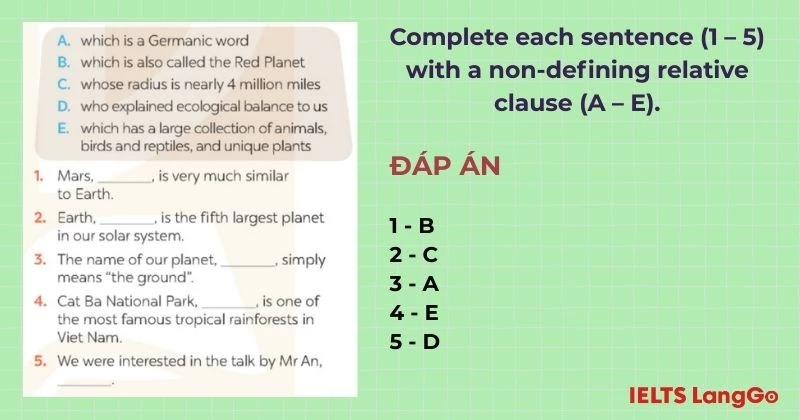
Đáp án:
1 - B: Mars, which is also called the Red Planet, is very much similar to Earth.
2 - C: Earth, whose radius is nearly 4 thousand miles, is the fifth largest planet in our solar system.
3 - A: The name of our planet, which is a Germanic word, simply means “the ground”.
4 - E: Cat Ba National Park, which has a large collection of animals, birds and reptiles, and unique plants, is one of the most famous tropical rainforests in Viet Nam.
5 - D: We were interested in the talk by Mr An, who explained ecological balance to us.
4. Combine the two sentences into one, using a non-defining relative clause.
1. The Moon is Earth’s only natural satellite. Its surface is dark.
→ The Moon, whose surface is dark, is Earth’s only natural satellite.
2. Moonquakes are much weaker than Earthquakes. Moonquakes can last up to half an hour.
→ Moonquakes, which can last up to half an hour, are much weaker than Earthquakes.
3. Mars has mountains and canyons on its surface. It is a rocky planet like Earth.
→ Mars, which is a rocky planet like Earth, has mountains and canyons on its surface.
4. Venus is considered the twin sister of Earth. Venus has a similar size and structure as Earth.
→ Venus, which has a similar size and structure as Earth, is considered the twin sister of Earth.
5. We should protect rivers and lakes. Rivers and lakes provide humans with their main sources of fresh water.
→ We should protect rivers and lakes, which provide humans with their main sources of fresh water.
5. GAME: Work in two groups.
Take turns to say aloud one of the places in the table. The other group explains or gives more information about it. The team that has the most correct sentences wins.
Gợi ý trả lời:
1. The Nile, which is the longest river, flows into the Mediterranean Sea.
2. Pacific Ocean, which covers 30% of planet surface, is the largest ocean.
3. Viet Nam, which has the shape of letter S, has a long coastline.
4. The Sahara, which is the largest desert, has almost no rainfall.
5. Mount Fansipan, which is the highest peak in Viet Nam, is also called the 'Roof of Indochina'.
>> Xem lời giải chi tiết tại: Tiếng Anh 9 Unit 10 A Closer Look 2
IV. Communication
Phần Communication giúp học sinh nắm được các mẫu câu dùng để thuyết phục ai đó làm gì và cách đáp lại, đồng thời giúp các bạn hiểu thêm các môi trường sống trên Trái Đất.
Everyday English - Persuading someone to do something and responding
1. Listen and read the conversations. Pay attention to the highlighted parts.
Hội thoại 1:
Mi: Have you read this book about the Solar System?
Tom: Not yet. I don't feel like reading it.
Mi: Why don't you give it a go? You will like it.
Tom: OK, I'll think about that.
Hội thoại 2:
Lan: How would you feel about contributing to the fund to protect our wildlife?
Local resident: Contribute to a fund?
Lan: Yes, your contribution would really help us out.
Local resident: Alright. I'll make a contribution.
2. Work in pairs. Make similar conversations with the following situations.
Tình huống 1: You persuade your friend to watch a movie about planet Earth.
Hội thoại mẫu:
You: Have you watched the new documentary about planet Earth?
Friend: Not yet. I don't feel like watching documentaries.
You: It has so many beautiful scenes of nature. Why don't you give it a go? You will absolutely like it.
Friend: OK, I'll think about that.
Tình huống 2: You persuade local people to contribute to a fund to build a nature reserve.
You: How would you feel about contributing to the fund to build a new nature reserve in our area?
Local resident: A nature reserve fund?
You: Yes, your contribution would really help us out to protect endangered animals.
Local resident: Alright. I'll make a contribution.
Earth's habitats
3. Read the short descriptions of various habitats and match them with their features.
Đáp án:
1 - c. Polar regions - extremely cold, dry, covered in snow and ice
2 - d. Forests - the lungs of Earth, home to many species
3 - b. Oceans - largest, produce oxygen and adjust the climate
4 - a. Grasslands - two main types and are crucial for livestock grazing
4. Work in pairs. Choose two habitats and compare them.
Gợi ý so sánh Oceans và Forests:
| Feature | Oceans | Forests |
| their specific types / examples | - The Pacific Ocean - The Atlantic Ocean - The Indian Ocean - The Southern Ocean - The Arctic Ocean | - Tropical forests - Temperate forests - Boreal forests |
| their importance | - Produce more than 50% of the Earth’s oxygen - Help regulate the climate - Cover about 70% of the Earth’s surface | - Known as the “lungs of the Earth” - Produce oxygen - Help balance the climate |
| plants / animals living there
| - Sea grasses - Microscopic algae - Fish and many other marine animals | - Trees and forest plants - Bats, owls, deer, squirrels, foxes, lizards |
| other special features | - Water habitats - The Pacific is the largest ocean | - Land habitats - Many forests are being destroyed by human activities |
5. Report the results of your comparison to the class.
>> Xem bài mẫu chi tiết tại: Tiếng Anh 9 Unit 10 Communication
V. Skills 1
Phần Skills 1 giúp các bạn học sinh khám phá vai trò quan trọng của động thực vật đối với Trái Đất và thực hành thảo luận về các mối đe dọa và đề xuất hành động cụ thể để bảo vệ chúng.
Reading
1. Tick (✓) the things that show the roles of plants and animals.
Đáp án:
1. [ ✓ ] providing sources of food
2. [ ] causing habitat loss
3. [ ✓ ] keeping the ecological balance
4. [ ✓ ] making Earth beautiful
2. Read the passage and choose the correct answer A, B, C, or D.
Đáp án:
1. What is the passage mainly about?
A. The beauty of plants and animals.
B. How plants and animals protect the environment.
C. The wonder of plants and animals.
D. The natural food chain.
→ Đáp án: C. The wonder of plants and animals.
2. The author mentions ______ significant roles plants and animals play.
A. two
B. three
C. four
D. five
→ Đáp án: B. three
3. Which of the following do plants provide humans?
A. Oxygen
B. Aquatic environment
C. Carbon dioxide
D. Habitat loss
→ Đáp án: A. Oxygen.
4. Which action does NOT preserve plants and animals?
A. Planting more trees
B. Raising awareness.
C. Building nature reserves.
D. Hunting animals
→ Đáp án: D. Hunting animals.
5. The word "appreciate" means ______.
A. protect the qualities of
B. recognise the wonder of
C. learn more about
D. be aware of
→ Đáp án: B. recognise the wonder of
3. Read the passage again and fill in the diagram.
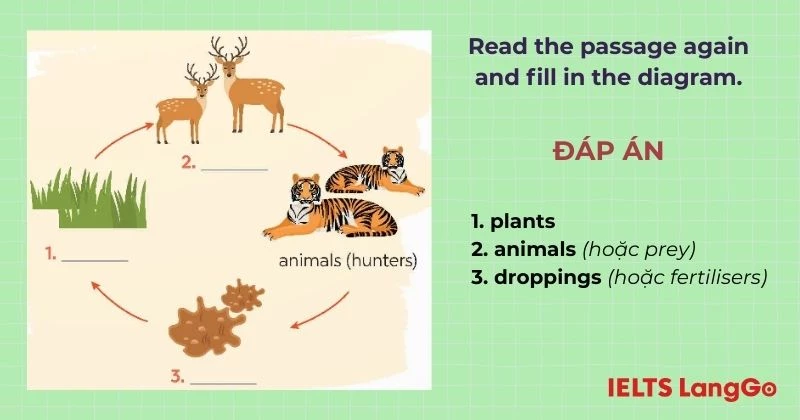
Đáp án:
(1) - plants
(2) - animals (hoặc prey)
(3) - droppings (hoặc fertilisers)
Speaking
4. Work in pairs. Discuss the threats to plants and animals and how we can protect them. You can use the ideas from the reading or your own ideas.
Gợi ý điền bảng:
| Threats | Actions |
| - habitat loss | - building nature reserves |
| - pollution | - raising people's awareness |
| - climate change | - planting more trees |
| - hunting / poaching | - stopping hunting |
5. Report the results of your discussion to the class.
Gợi ý bài nói mẫu:
Hello everyone. Today, our group would like to talk about the threats to flora and fauna and what we can do to protect them.
As you know, there are many threats to plants and animals today. First, they face habitat loss because humans cut down forests to build houses. Second, pollution and climate change make it difficult for them to survive. Finally, illegal hunting is pushing many animals to extinction.
To solve these problems, we can do several things to preserve their habitat. We should build more nature reserves to give them a safe place to live. Besides, we need to raise people's awareness of protecting the environment, stop hunting, and plant more trees. If we all work together, we can save our beautiful Earth. Thank you for listening!
>> Xem lời giải chi tiết tại: Tiếng Anh 9 Unit 10 Skills 1
VI. Skills 2
Phần Skills 2 Unit 10 Tiếng Anh lớp 9 tập trung giúp học sinh rèn luyện kỹ năng Nghe về sự tác động của động thực vật tới môi trường sống và cải thiện kỹ năng Viết qua bài tập tóm tắt nội dung.
Listening
1. Look at the pictures and answer the questions below.
Gợi ý trả lời:
1. Which animal do you see in picture A?
→ I see a beaver.
2. What is it doing in picture A?
→ It is carrying a branch in its mouth (to build a dam).
3. What do you see in picture B?
→ I see a pond and a dam made of branches and mud.
2. Listen to a conversation and choose the correct answer A, B, or C.
Đáp án:
1. Mr An is talking about ________.
A. effects of the habitats on plants and animals
B. the effects of habitat loss
C. effects of plants and animals on the habitats
→ Đáp án: C. effects of plants and animals on the habitats
2. What did Mr An suggest humans should do?
A. Bring plants and animals from one place to another.
B. Preserve habitats.
C. Use pesticides.
→ Đáp án: B. Preserve habitats.
3. Listen again and fill in each blank in the summary with ONE word.
Đáp án:
| Effects from plants | - They help or (1) harm the environment. - They make a place more beautiful. - They (2) take over the resources of local plants. |
| Effects from animals | - They can cause harm to or (3) improve a habitat. - Beavers can build dams and ponds, which helps some plants and animals. - Beavers may (4) flood the homes of other plants and animals. |
| We should | - (5) preserve habitats. - stop destroying forest habitats. - stop using (6) pesticides. |
4. Work in pairs. Ask and answer the questions below.
Gợi ý trả lời:
1. What is the main topic of Mr An’s talk?
→ It's about the effects of plants and animals on their habitats.
2. How do plants affect their habitats?
→ They make the place more beautiful, but some can harm the environment by taking over resources of local plants.
3. How do animals affect their habitats?
→ They can protect or cause harm to a habitat. For example, beavers build ponds which help some species but may destroy the homes of others.
4. What should humans do?
→ Humans should preserve habitats, stop destroying forests, and stop using pesticides.
5. Write a summary (100 – 120 words) of the main points of the conversation. Use the information in 3 and answers in 4.
Gợi ý trả lời:
Mr An talked about the effects of plants and animals on their habitats and the things people should do. Firstly, plants help make a place more beautiful. However, some imported plants can harm the environment because they take over the resources of local plants. Secondly, animals also have positive and negative impacts. For example, beavers build dams and ponds, which provide water for many plants and animals. But at the same time, this action may cause floods and destroy the homes of other species. Finally, to protect nature, Mr An suggested that humans should preserve natural habitats. We must stop destroying forests and avoid using pesticides. By doing this, we can maintain the ecological balance on Earth.
>> Xem lời giải chi tiết tại: Tiếng Anh 9 Unit 10 Skills 2
VII. Looking Back
Trong phần Looking Back Unit 10, học sinh sẽ được ôn tập Từ vựng về chủ đề Planet Earth và Ngữ pháp về mệnh đề quan hệ không xác định.
Vocabulary
1. Fill in the table with words and phrases about habitats.
Gợi ý trả lời:
Dựa vào các từ vựng đã học trong Unit 10, các bạn có thể điền thêm vào bảng như sau:
| Types of habitats | Things in a habitat |
| poles | flora and fauna |
| grasslands | water bodies |
| forests | landforms |
| oceans | food chain |
| deserts | animals and plants |
2. Complete the passage, using the words and phrases in the box.
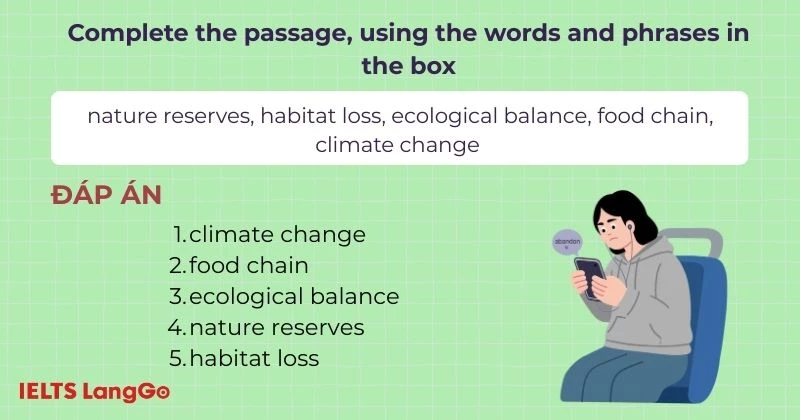
Đáp án:
Earth’s habitats are various and many are threatened. Each habitat includes living things, non-living things, and the surrounding environment. The relations of all living things and their environment in a habitat make up the habitat’s ecology.
(1) Climate change or changes in population of plants and animals can cause changes to the natural (2) food chain and the ecology. That means to maintain a(n) (3) ecological balance, we shouldn’t cause changes to the climate and the plants and animals of any habitat. In many countries, people have built (4) nature reserves to keep endangered plants and animals safe. People should also avoid activities that may cause pollution and (5) habitat loss.
Grammar
3. Complete each sentence (1 – 5) with a non-defining relative clause (A – E).
Đáp án:
1 - E: The Alps are a well-known mountain range, which attract many tourists worldwide.
2 - B: Deserts on Earth, which are large and extremely dry areas, hardly get any rain.
3 - A: People used to believe that Thor, who is considered the God of Thunder, causes storms and lightning.
4 - D: We spent time trekking, bird-watching, and kayaking in Cuc Phuong, which is the oldest national park in Viet Nam.
5 - C: James Hutton, whose work in geology is considered very important, was one of the first scientists to study geology.
4. Combine the two sentences into one, using a non-defining relative clause.
1. Boreal forests cover vast areas in Canada, Alaska, and Russia. They are also called Taiga.
→ Boreal forests, which are also called Taiga, cover vast areas in Canada, Alaska, and Russia.
2. Polar bears are endangered animals. Their natural habitat is the Arctic.
→ Polar bears, whose natural habitat is the Arctic, are endangered animals.
3. Julie Arblaster focuses on studying climate change. She is an Australian scientist.
→ Julie Arblaster, who is an Australian scientist, focuses on studying climate change.
4. Antarctica is Earth's least populated continent. It is surrounded by the Southern Ocean.
→ Antarctica, which is surrounded by the Southern Ocean, is Earth's least populated continent.
5. The natural world is the world of living things. Living things include plants and animals.
→ The natural world is the world of living things, which include plants and animals.
>> Xem lời giải chi tiết tại: Tiếng Anh 9 Unit 10 Looking Back
VIII. Project
Trong phần Project Unit 10 Lớp 9, các bạn học sinh sẽ làm việc theo nhóm để thực hiện một dự án về chủ đề "Our Flora and Fauna" (Hệ động thực vật).
Work in groups. (Làm việc nhóm)
1. Choose an area you know / like.
Gợi ý một số khu vực phổ biến tại Việt Nam mà các bạn có thể chọn: Vườn Quốc gia Cúc Phương, Vườn Quốc gia Phong Nha – Kẻ Bàng, Vườn Quốc gia Cát Tiên, Vịnh Hạ Long, hoặc khu rừng ngập mặn Cần Giờ.
2. Collect pictures of some flora and / or fauna in that area.
Ví dụ: Nếu chọn Cát Tiên, hãy tìm ảnh cây Tùng khổng lồ - Giant Tung tree, cá sấu Xiêm - Siamese crocodile, bò tót - Gaur...
3. Create a poster.
Thông tin chi tiết về Vườn Quốc gia Cát Tiên:
| An area you like | - Cat Tien National Park |
| Location | - Located in Dong Nai province. |
| The flora | - Amazing with many layers. - The most special feature: the giant Tung trees. - Ancient Lagerstroemia trees and thousands of medicinal plants. |
| The fauna | - It is home to the majestic Gaur, or wild ox. - The rare Siamese crocodiles swimming in the water. - Peacocks and hornbills. |
4. Introduce the area’s flora and fauna to the class.
>> Xem bài mẫu chi tiết tại: Project Unit 10 Tiếng Anh 9
Với chủ đề Planet Earth, Unit 10 Tiếng Anh lớp 9 đã giúp các bạn học sinh tiếp cận những kiến thức mới mẻ về hệ sinh thái của Trái Đất, đồng thời nâng cao các kỹ năng tiếng Anh qua các hoạt động và bài tập.
Mong rằng qua phần lời giải chi tiết từ IELTS LangGo, các bạn có thể dễ dàng hệ thống hóa kiến thức và tự tin áp dụng vào các bài tập tương tự cũng như các tình huống thực tế. Chúc các bạn học tốt!
BACK TO SCHOOL – Trúng Macbook Neo và hàng ngàn quà tặng khác

DEAL HỜI HẾT CỠ >> Dành riêng cho học viên đăng ký khóa học IELTS đến hết ngày 31/10
- Quay số trúng thưởng - Rinh MACBOOK xịn
- Giảm ngay 350.000đ khi đăng ký khóa 01 Level
- Ưu đãi học nhóm tới 250.000đ/ học viên
- Tặng ngay tài khoản Writing Xpert AI KHÔNG GIỚI HẠN