Tiếng Anh 11 Unit 2 Global Success: The generation gap (Đáp án chi tiết)
 IELTS LangGo
  07/09/2026



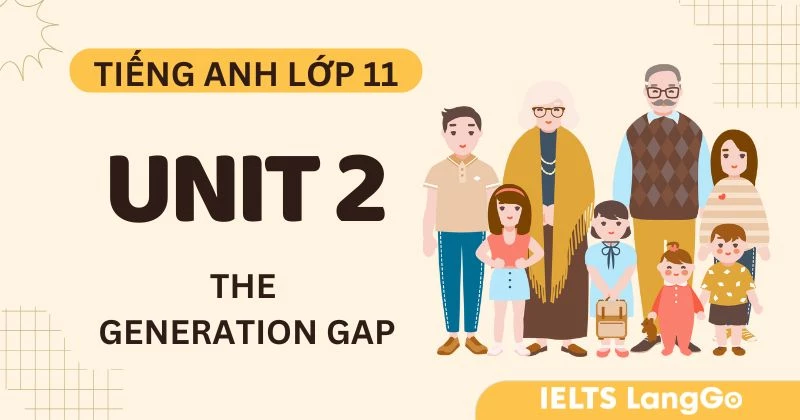
Unit 2 Tiếng Anh lớp 11 sách Global Success với chủ đề The generation gap mang đến cho học sinh những kiến thức quan trọng về khoảng cách thế hệ, sự khác biệt giữa các thế hệ trong gia đình và xã hội hiện đại.
Để giúp các bạn học sinh lớp 11 nắm vững kiến thức của bài học và đạt kết quả cao trong các bài kiểm tra, IELTS LangGo đã tổng hợp đầy đủ đáp án và hướng dẫn giải chi tiết cho từng phần trong Unit 2. Hãy cùng tìm hiểu ngay!
>>> Xem thêm: Lời giải Tiếng Anh 11 Global Success 10 Unit đầy đủ
I. Getting Started - What is a generation gap?
1. Listen and read
Phần mở đầu này là cuộc hội thoại giữa Ms Hoa, Mark và Mai về khoảng cách thế hệ. Học sinh cần nghe và đọc để hiểu nội dung chính về sự khác biệt giữa các thế hệ trong gia đình.
2. Read the conversation again. Tick (✓) the true information about Mark and Mai
Đáp án:
| Statement | Mark | Mai |
| 1. has some arguments over small things with family members. | ✓ | ✓ |
| 2. lives with grandparents who have traditional views. | ✓ | |
| 3. lives in a nuclear family. | ✓ | |
| 4. has parents who don't force their children to follow in their footsteps. | ✓ |
3. Find words or phrases in 1 that have the following meanings
Đáp án:
-
generation - all people who were born at about the same time
-
nuclear family - a family that consists of a father, a mother, and children
-
extended family - a family that includes not only parents and children but also uncles, aunts, grandparents, etc.
-
arguments - disagreements about things
4. Choose the modal verbs used in 1 to complete the sentences
Đáp án:
-
has to
-
have to
-
should
-
must
>>> Xem chi tiết: Tiếng Anh 11 Unit 2 Getting Started
II. Language
Pronunciation: Contracted forms
1. Listen and repeat. Pay attention to the contracted forms in the following sentences. What are their full forms?
Đáp án:
-
Today, we'll talk about the generation gap. → we will
-
You're right, Mark. → You are
-
We can't avoid daily arguments. → cannot
-
That's a good point. → That is
-
No, they don't. → do not
-
Now let's continue our discussion with... → let us
2. Listen and circle what you hear: contracted or full forms. Then practise saying these conversations in pairs
Đáp án:
-
What's - We'll
-
Don't you - don't
-
who'll - I will
Vocabulary: Generational differences
1. Match the words to make phrases that mean the following
Đáp án:
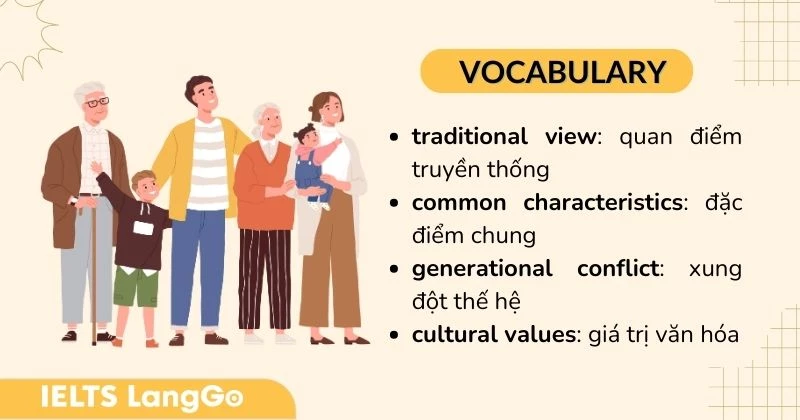
1 - d : traditional view = a belief or an opinion that has existed for a long time without changing
2 - a : common characteristics = special qualities that belong to a group of people or things
3 - b : generational conflict = a disagreement between different generations
4 - c : cultural values = beliefs about what is important in the culture of a particular society
2. Complete the sentences using the correct forms of the phrases in 1
Đáp án:
-
cultural values
-
generational conflict
-
common characteristics
-
traditional view
>>> Xem thêm: Tổng hợp Từ vựng Unit 2 lớp 11 Global Success
Grammar: Modal verbs (must, have to, and should)
2. Circle the correct answers to complete the sentences
Đáp án:
-
must
-
have to
-
should
-
had to
2. Work in pairs. Are there any rules in your family or things that you or your parents think are necessary? Share them with your partner. Use must, have to, and should
Gợi ý trả lời:
Mẫu 1:
A: I must finish my homework before watching TV.
B: That's strict! We should do homework first too, but my parents don't force us.
Mẫu 2:
A: We have to help with household chores every weekend.
B: Same here! I have to clean my room and wash dishes.
>>> Xem chi tiết: Tiếng Anh 11 Unit 2 Language
III. Reading - Different generations
1. Work in pairs. Look at the photos. Discuss what you know about the generation in each picture
Gợi ý trả lời:
| Generation X (1965-1980) | Generation Y/Millennials (early 1980s-late 1990s) | Generation Z (late 1990s-early 2010s) | |
| Age | Currently in their 40s-50s | Currently in their 20s-40s | Currently teenagers and young adults |
| Characteristics | • Independent • Adaptable to change • Value work-life balance | • Technology-savvy • Value teamwork • Curious and open to changes | • Digital natives • Creative • Entrepreneurial mindset |
| Interest | • Stability and security • Traditional communication methods | • Social media • Technology adoption | • Online activities on social media • Technology innovation |
| Life experiences | • Experienced many social changes | • Grew up during the internet boom | • Grew up with digital technology |
2. Read the article. Match the highlighted words with their meanings
Đáp án:
-
experienced → b. went through
-
curious → d. wanting to know about something
-
digital natives → e. people born in the era of technology
-
experiment → a. to try or test new ideas or methods
-
hire → c. to employ
3. Read the article again and choose the best title
Đáp án:
C. Characteristics of different generations
4. Read the article again. Tick (✓) the characteristics of each generation according to the article
Đáp án:
| Characteristics | Generation X | Generation Y | Generation Z |
| 1. They enjoy working in a team with others. | ✓ | ||
| 2. They can use apps and digital devices in creative ways. | ✓ | ||
| 3. Critical thinking is one of their common characteristics. | ✓ | ||
| 4. Most of them plan to have their own businesses. | ✓ | ||
| 5. They are known for their curiosity. | ✓ |
5. Work in groups. Discuss the following question
Do you agree with the descriptions of each generation?
Đây là câu hỏi thảo luận mở và các bạn học sinh có thể đưa ra nhiều ý kiến khác nhau.
>>> Xem chi tiết: Tiếng Anh 11 Unit 2 Reading
IV. Speaking - Talking about different generations
1. Put the sentences (A-D) in order to complete the conversation. Then practise it in pairs
Đáp án:
(1) - C
(2) - D
(3) - A
(4) - B
2. Work in pairs. Talk about the different generations of your family. Use the model and tips in 1, and the ideas below to help you
Gợi ý trả lời:
Student A: Hi! Let's talk about our families. Do you live with your extended family?
Student B: Yes, I do. I live with my parents, my grandmother, and my older brother. What about you?
Student A: I live with my parents and my younger sister. My grandparents live nearby. Do you think there are any differences between the generations in your family?
Student B: Definitely! My grandmother is in her 70s, and she holds very traditional views about many issues. For example, she believes women should focus mainly on family duties. But my parents are more open to new ways of thinking. They encourage me to pursue my career dreams.
Student A: That's interesting! In my family, my grandparents are not very good at using electronic devices. They still prefer reading newspapers instead of getting news online. However, my parents and I use smartphones and social media every day.
Student B: I can relate to that! My grandmother always asks me to help her with her smartphone. But I think each generation has its own strengths. My grandmother has a lot of life experience to share.
3. Work in groups. Discuss the following question and then report to the whole class
What are the most common generation gaps in your families?
Gợi ý trả lời:
Dưới đây là một số điểm khác biệt thế hệ thường gặp trong các gia đình, các bạn học sinh có thể tham khảo để có thêm ý tưởng khi thảo luận:
- Technology use: Older generations prefer traditional methods while younger ones embrace digital solutions
- Career choices: Grandparents often prefer stable, traditional jobs while parents support following personal interests
- Communication styles: Different preferences for direct conversation versus texting and social media
- Lifestyle choices: Disagreements about clothing, hairstyles, and leisure activities
- Values: Different views on independence, family obligations, and work-life balance
>>> Xem chi tiết: Tiếng Anh 11 Unit 2 Speaking
V. Listening - Family conflicts
1. Complete the following table about you. Work in pairs and compare your answers
Học sinh tự hoàn thành bảng về tình hình gia đình mình, sau đó so sánh với bạn cùng lớp.
2. Listen to a conversation between Kevin and Mai. Number the things they talk about in the order they are mentioned
Đáp án:
-
d. Mai's choice in clothes and hairstyle upsets her mother
-
c. Mai is not allowed to colour her hair
-
b. Mai asks Kevin if he has any disagreements with his parents
-
a. Kevin's parents limit his screen time
3. Listen to the conversation again and answer the following questions using no more than TWO words
Đáp án:
-
Mai's appearance / her appearance
-
at school
-
(his) homework
-
Kevin's eyesight / his eyesight
-
10 p.m.
4. Work in groups. Discuss the following questions
Do you agree with Mai's mother and Kevin's parents? Why/Why not?
Với câu hỏi thảo luận này, các bạn có thể đưa ra ý kiến của riêng mình nhé.
>>> Xem chi tiết: Tiếng Anh 11 Unit 2 Listening
VI. Writing - An opinion essay about limiting teenagers' screen time
1. Work in pairs. Complete the notes using the sentences (A-D) in the box
Đáp án:
-
B
-
C
-
A
-
D
2. Read an opinion essay and match each paragraph with the correct description
Đáp án:
Paragraph 1: → D. Introduction to the issue and the writer's point of view
Paragraph 2: → C. First reason for supporting this view with examples and facts
Paragraph 3: → A. Second reason for supporting this view with examples and facts
Paragraph 4: → B. Conclusion summarising the writer's point of view
3. Write an opinion essay (120-150 words) stating the opposite view
Gợi ý trả lời:
Digital devices play an essential part in teenagers' lives nowadays. I strongly believe that parents should not strictly limit their children's screen time for the following reasons.
First of all, the quality of screen time is more important than quantity. Teenagers can learn a lot of useful knowledge and necessary skills through online educational games and videos. For example, they can improve their language skills by watching English movies or develop problem-solving abilities through educational apps.
In addition, strict limitations may create unnecessary conflicts between parents and teenagers. When parents impose too many restrictions, teenagers may think their parents are not fair to them. This could widen the gap between family members and damage their relationship.
In conclusion, parents should focus on guiding their children to use digital devices wisely rather than strictly limiting screen time. This approach will help maintain family harmony while ensuring teenagers benefit from technology.
>>> Xem chi tiết: Tiếng Anh 11 Unit 2 Writing
VII. Communication and Culture / CLIL
Everyday English - Asking for and giving permission
1. Listen and complete the conversation with the expressions in the box. Then practise it in pairs
Đáp án:
(1) - D. can I
(2) - C. Certainly
(3) - A. Is it OK
(4) - B. I'm afraid not
2. Work in pairs. Use the model in 1 to make similar conversations for these situations. One of you is Student A, the other is Student B. Provide reasons for not giving permission.
Mẫu hội thoại 1
A: Dad, can I invite some friends over for a party this weekend?
B: What kind of party are you planning?
A: Just a small birthday party for my friend Tom. Would you mind if I invited about 10 people?
B: I'm afraid not this weekend. Your grandparents are visiting, and we need the house to be quiet. How about next weekend instead?
A: That sounds great! Thank you, Dad.
Mẫu hội thoại 2
B: Mom, is it OK if I color my hair? I want to try something different.
A: What color are you thinking about?
B: Maybe a dark blue or purple. Do you mind if I go to the salon this Saturday?
A: I'm sorry, but that's not possible. Those colors are too bright for school. You know the school has strict rules about hair color.
B: Oh, I understand. What about a natural brown color instead?
A: That would be fine. Sure, you can do that.
Culture: The generation gap in Asian American families
1. Read the text and complete the notes. Use no more than TWO words for each gap
Đáp án:
(1) English
(2) American traditions
(3) native
(4) cultural values
2. Work in groups. Discuss the following questions
Do you think your family would experience the same generation gap if you moved to a Western country? Why/Why not?
Với câu hỏi thảo luận này, các bạn sẽ tự đưa ra ý kiến của riêng mình tùy thuộc vào hoàn cảnh gia đình hiện tại nhé.
>>> Xem chi tiết: Tiếng Anh 11 Unit 2 Communication and Culture
VIII. Looking Back
Pronunciation
Listen and circle what you hear: contracted or full forms. Practice saying these conversations in pairs
Đáp án:
(1) mustn't
(2) don't
(3) It's
(4) I have
Vocabulary
Solve the crossword. Use the words or phrases you have learnt in this unit
Đáp án:
DOWN:
-
nuclear
-
generation
ACROSS:
-
screen time
-
extended
-
conflict
-
digital native
Grammar
Choose the correct answers A, B, C or D to complete the following sentences
Đáp án:
-
A. must
-
B. had to
-
C. mustn't
-
D. shouldn't
-
A. don't have to
>>> Xem chi tiết: Tiếng Anh 11 Unit 2 Looking back
IX. Project - Generational differences among us
Work in groups to conduct a survey about generational differences and present findings to the class.
Survey participants should include:
-
A classmate or brother/sister
-
A mother/father or someone of their generation
-
A grandma/grandpa or someone of their generation
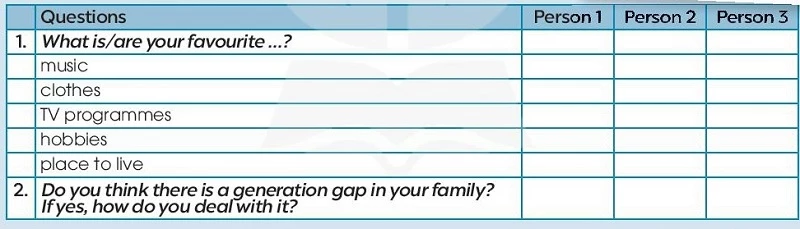
Sample Survey Results:
| Questions | Person 1 Nam (17 years old) Classmate | Person 2 Mrs. Lan (45 years old) Minh's mother | Person 3 Mr. Duc (68 years old) Minh's grandfather |
| 1. What is/are your favourite ...? | |||
| music | K-pop (BTS, BlackPink), Vietnamese rap | Ballads, Trinh Cong Son's songs | Traditional folk songs, revolutionary music |
| clothes | Oversized hoodies, ripped jeans, sneakers | Business casual, comfortable blouses | Traditional ao ba ba, simple shirts |
| TV programmes | YouTube, Netflix (Squid Game), TikTok | Korean dramas, cooking shows, news | Historical documentaries, traditional opera |
| hobbies | Gaming, social media, basketball | Gardening, cooking, reading novels | Chess, morning exercises, bird watching |
| place to live | Ho Chi Minh City - modern, convenient | Suburban area with good schools | Peaceful countryside with fresh air |
| 2. Do you think there is a generation gap in your family? If yes, how do you deal with it? | "Yes, but it's not serious. We respect each other's choices and try to understand different viewpoints." | "Sometimes yes, especially about technology and career choices. We solve it through patient conversations." | "There are differences, but love and respect help us bridge the gap. We learn from each other." |
>>> Xem chi tiết: Tiếng Anh 11 Unit 2 Project
Qua các bài học trong Unit 2 Tiếng Anh lớp 11 chủ đề The generation gap, các bạn học sinh đã được tìm hiểu về những khác biệt giữa các thế hệ, cách sử dụng động từ khuyết thiếu, kỹ năng thảo luận về xung đột gia đình và viết bài luận bày tỏ quan điểm.
Bộ đáp án chi tiết từ IELTS LangGo sẽ giúp các bạn trau dồi thêm từ vựng về sự khác biệt thế hệ, thành thạo cách sử dụng must, have to, should, đồng thời phát triển kỹ năng giao tiếp về các vấn đề gia đình. Chúc các bạn học tập tốt và áp dụng những kiến thức đã học thật hiệu quả.
>>> Xem thêm: Đáp án Tiếng Anh 11 Unit 3 Global Success: Cities of the future
BACK TO SCHOOL – Trúng Macbook Neo và hàng ngàn quà tặng khác

DEAL HỜI HẾT CỠ >> Dành riêng cho học viên đăng ký khóa học IELTS đến hết ngày 31/10
- Quay số trúng thưởng - Rinh MACBOOK xịn
- Giảm ngay 350.000đ khi đăng ký khóa 01 Level
- Ưu đãi học nhóm tới 250.000đ/ học viên
- Tặng ngay tài khoản Writing Xpert AI KHÔNG GIỚI HẠN