Hướng dẫn giải Tiếng Anh lớp 8 Unit 6 chủ đề Lifestyles chi tiết, đầy đủ
 IELTS LangGo
  22/12/2025



Phần Unit 6 Tiếng Anh 8 về chủ đề Lifestyles mang đến những kiến thức thú vị về lối sống khác nhau của các dân tộc trên thế giới từ sinh hoạt hằng ngày đến các nét văn hóa đặc trưng. Thông qua các bài học, các bạn học sinh không chỉ mở rộng vốn từ vựng chủ đề phong cách sống mà còn rèn luyện ngữ pháp, 4 kỹ năng Nghe - Nói - Đọc - Viết gắn với thực tiễn.
Trong bài viết này, IELTS LangGo sẽ hướng dẫn và cung cấp đáp án và gợi ý trả lời cho từng phần của Unit 6, giúp các bạn học sinh học tập hiệu quả và tự tin hơn trong các bài kiểm tra.
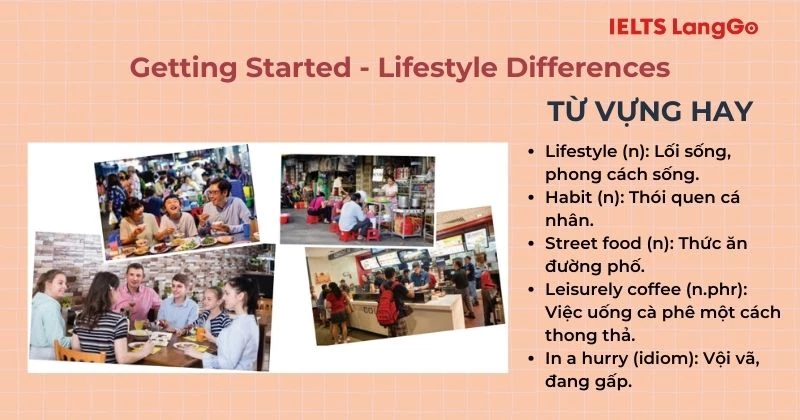
I. Getting Started - Lifestyle Differences
1. Listen and read
Phần mở đầu là đoạn hội thoại giữa Nam và Tom về những khác biệt trong lối sống giữa Việt Nam và đất nước của Tom giúp các bạn học sinh học thêm từ vựng về các lối sống khác nhau.
2. Read the conversation again and complete the table.
Đáp án:
(1) surnames
(2) on the street
(3) store or restaurant
3. Complete each sentence with a word or phrase from the box.
Đáp án:
1. A balanced diet and exercise are important for a healthy lifestyle.
2. Handshaking, bowing, and hugging are some of the ways in which people greet one another.
3. Waiters and waitresses serve food in restaurants.
4. Going out for breakfast has become a common practice in this city.
5. My mum is in the habit of keeping everything in the kitchen bright and clean.
4. Label each picture with a word or phrase from the box.
Đáp án:
- Tranh 1: street food
- Tranh 2: food in restaurants
- Tranh 3: pizza
- Tranh 4: online learning
- Tranh 5: greeting
5. Quiz: Greetings around the world.
Gợi ý trả lời:
1. Which is probably the most common way of greeting around the world?
→ A. Shaking hands.
2. In the USA, people greet each other by _______.
→ B. saying "Hello"
3. Thais greet their elders by saying "sawadee" and _______.
→ B. slightly bowing to them
4. The Maori of New Zealand greet each other by_______.
→ B. pressing their noses together
5. How do people in Japan normally greet each other?
→ A. They bow to each other
>> Xem chi tiết hướng dẫn giải tại đây: Tiếng Anh 8 Unit 6 Getting Started
II. A Closer Look 1 - Vocabulary & Pronunciation
Phần này gồm các bài tập giúp các bạn học sinh hiểu rõ hơn về các thói quen trong cuộc sống, cách mô tả hoạt động hằng ngày và thực hành phát âm hai âm /ə/ và /ɜː/.
Vocabulary
1. Match the words and phrases with the pictures.
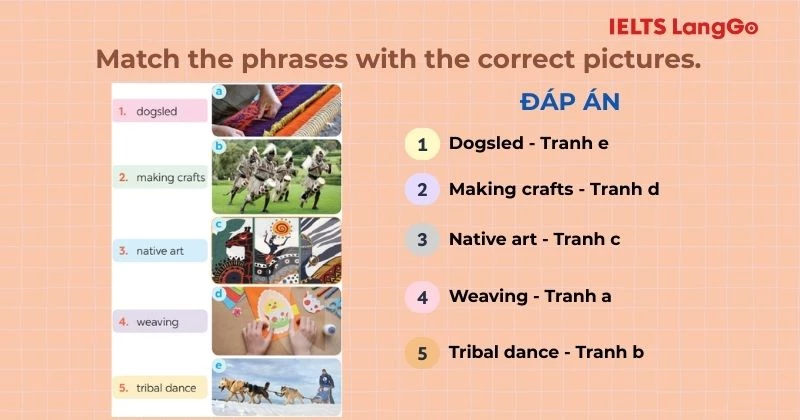
Đáp án:
1 - e: Dogsled
2 - d: Making crafts
3 - c: Native art
4 - a: Weaving
5 - b: Tribal dance
2. Complete the sentences with the words and phrases from the box.
Đáp án:
1. The traditional craft of the villagers is weaving bamboo baskets.
2. We all joined in the tribal dances when we attended the local festival.
3. The gallery in the city centre has an excellent collection of native art.
4. Hoa is very keen on making crafts. She loves to knit gloves after school.
5. The dogsled is still used as a means of transport in Alaska today.
3. Choose the correct answer A, B, or C to complete each sentence.
Đáp án:
1. The tribal women know how to _______ these threads into beautiful clothes.
→ A. weave
2. She comes from Korea, so her _______ language is Korean.
→ B. native
3. Sticking out one’s tongue was a way of greeting in _______ Tibetan culture.
→ A. traditional
4. How do people _______ New Years in your country, Jack?
→ C. celebrate
5. We like that restaurant: it _______ very delicious food.
→ B. serves
Pronunciation
4. Listen and repeat the words. Pay attention to the sounds /br/ and /pr/.
Đáp án:
| /br/ | /pr/ |
| bridge, broccoli, breakfast, algebra, celebrate. | present, practise, precious, programme, express. |
5. Listen and practise the sentences. Underline the words with the sound /br/ and circle the words with the sound /pr/.
Đáp án:
1. My brother says online learning improves our IT skills.
- /br/: brother - /ˈbrʌð.ər/
- /pr/: improves - /ɪmˈpruːvz/
2. Santa Claus brings a lot of presents to children.
- /br/: brings - /brɪŋz/
- /pr/: presents - /ˈprez.ənts/
3. She briefly introduced the new programme.
- /br/: briefly - /ˈbriːf.li/
- /pr/: programme - /ˈproʊ.ɡræm/
4. He spent a lot of time preparing for his algebra test.
- /br/: algebra - /ˈæl.dʒə.brə/
- /pr/: preparing - /prɪˈper.ɪŋ/
5. My mum prays at the temple before breakfast on Sundays.
- /br/: breakfast - /ˈbrek.fəst/
- /pr/: prays - /preɪz/
>> Xem chi tiết hướng dẫn giải tại đây: Tiếng Anh 8 Unit 6 A Closer Look 1
III. A Closer Look 2 - Grammar
Phần này tập trung vào các cấu trúc ngữ pháp về Thì tương lai đơn và Câu điều kiện loại 1 để mô tả sự thay đổi trong thói quen sống.
1. Use the verbs from the box with will or won't to complete these dialogues
Đáp án:
1. Alice: Are you taking exams next week, Phong?
Phong: I’m not sure. The teacher will tell us tomorrow.
2. Linh: Where are you going on the holiday, Chris?
Chris: We're planning to visit Ta Ho Village. We will attend the local festival, but we won't join the tribal dance as it is late in the evening.
3. Dad: Are you having online lessons tomorrow?
Daughter: No. We won't have lessons, but we will do experiments in the lab.
2. Arrange these words and phrases in the correct order to form meaningful sentences.
Đáp án:
1. We / first-term exams / our / will take / very soon /.
→ We will take our first-term exams very soon.
2. Alaska / they / in an igloo / stay / when / visit / Will they /?
→ Will they stay in an igloo when they visit Alaska?
3. She / the tribal groups / to help them / will work with / revive their culture /.
→ She will work with the tribal groups to help them revive their culture.
4. online learning / in / I won't choose / the second semester /.
→ I won't choose online learning in the second semester.
5. I'll come / to / I go / to London / if / this summer / see you /.
→ I'll come to see you if I go to London this summer.
3. Give the correct tense of the verbs in brackets, using the first conditional.
Đáp án:
1. If you eat an apple every day, you will stay healthy.
2. Will Dan wear a kilt if he goes to Scotland?
3. He will have sore eyes if he spends too much time on the computer.
4. If you don't do anything bad, you won't get into trouble.
5. Will she be able to eat the soup if I put some chillies in it?
4. Fill in each blank with IF or UNLESS.
Đáp án:
1. Unless we eat lunch now, we won’t arrive at the cinema on time.
2. The teacher will be furious if you don’t do the homework.
3. I won’t eat kimchi when I go to Korea unless I have to.
4. If you turn on the light, you will be able to see better.
5. You won’t be able to find the house unless you use your GPS. There’s no one around.
5. Complete the following sentences to make them true for you. Then share your answers with a partner.
Gợi ý đặt câu:
1. If it rains tomorrow, I will stay at home and read books.
2. Unless I get good marks, my parents won't let me go out this weekend.
3. If I have free time this weekend, I will go to the cinema with my friends.
4. If I study harder, I will pass the exam easily.
5. Unless I go to bed early, I will be very tired tomorrow morning.
>> Xem chi tiết hướng dẫn giải tại đây: Tiếng Anh 8 Unit 6 A Closer Look 2
IV. Communication
Phần này hướng dẫn các bạn cách thể hiện sự chắc chắn trong giao tiếp, đồng thời mở rộng hiểu biết về ẩm thực các quốc gia trên thế giới.
1. Listen and read the conversations. Pay attention to the highlighted sentences.
Hội thoại 1:
Nam: Can I come over to your house on Sunday?
Tom: Sure. You're welcome.
Hội thoại 2:
Alice: Vietnamese cooking uses a lot of vegetables and herbs.
Mai: Yes, certainly.
2. Work in pairs. Make similar conversations to express certainty in the following situations.
Gợi ý hội thoại:
Tình huống 1: You ask your friend to help you with your maths homework.
Student A: Could you help me with this difficult maths problem?
Student B: Sure. I can help you after school.
Tình huống 2: You say that Vietnamese love seafood.
Student A: Do you think seafood is popular in Viet Nam?
Student B: Yes, certainly. With a long coastline, Vietnamese people really love seafood.
3. Quiz: How much do you know about the cuisines of different countries?
Đáp án:
1. Which country is famous for pasta and pizza?
→ B. Italy.
2. Which country is famous for kimchi?
→ A. Korea.
3. England is well-known for _______.
→ C. fish and chips
4. Sushi comes from _______.
→ A. Japan
5. In which country do you think kangaroo steak is common?
→ B. Australia.
4. Work in groups. Read the two passages and discuss the questions below.
Câu hỏi thảo luận: Do you prefer Italian or Indian food? Why / Why not?
Gợi ý trả lời:
Lựa chọn 1: Thích đồ Ý (Italian food)
I prefer Italian food because I am a big fan of pizza and pasta. The taste of melted cheese on a pizza is amazing. Also, Italian food is quite popular and easy to find in my city.
Lựa chọn 2: Thích đồ Ấn (Indian food)
I prefer Indian food because I love spicy food. The curry sauce is very rich and flavorful. I also like eating with naan bread. It’s a very unique experience.
5. Work in groups. Talk about the typical food in your area. Discuss the following.
Các gợi ý thảo luận:
- Staple food: Lương thực chính (Ví dụ: Rice - cơm).
- Favourite food: Món ăn yêu thích (Ví dụ: Pho, Bun cha...).
- Foods eaten on special occasions: Món ăn dịp đặc biệt (Ví dụ: Banh chung, ...).
Hội thoại mẫu:
A: What is the staple food in your area?
B: It’s rice. We eat rice in almost every meal, usually with meat, fish, and vegetables.
C: That’s right. And what is your favourite food?
B: My favourite food is Pho. It’s delicious, and you can eat it for breakfast, lunch, or dinner. How about you?
C: I love Bun Cha. It’s a specialty of Hanoi.
A: And what foods do you often eat on special occasions like Tet?
B: Oh, definitely Banh Chung (Chung cakes) and boiled chicken. They are traditional dishes that we must have during Tet holiday.
>> Xem chi tiết hướng dẫn giải tại đây: Tiếng Anh 8 Unit 6 Communication
V. Skills 1 - Reading & Speaking
Phần này tập trung vào 2 kỹ năng là Reading với bài đọc về cuộc sống tại Alaska và Speaking với chủ đề cách gìn giữ các lối sống truyền thống.
Reading
1. Work in groups. Look at the picture and discuss what you know about Alaska (its location, climate, native people, culture…)
Gợi ý trả lời: Alaska is a state in the USA. It is very cold there and has a lot of snow. People often use dog sleds to travel.
2. Match the highlighted words in the text with their meanings.
Đáp án:
1. d - maintain: to keep, make something continue
2. a - styles: particular ways of doing something
3. c - experience: to do or feel something
4. b - mushers: people who drive dogsleds
3. Read the text again and answer the questions.
Đáp án
1. What is the population of Alaska?
→ The population of Alaska is about 730,000.
2. Who have special styles of carving or weaving?
→ Various native groups have their own special styles of carving or weaving.
3. Where can we find the culture of the native peoples in Alaska?
→ We can find the culture of native peoples in Alaska in their villages.
4. How long is the Iditarod Trail Sled Dog Race?
→ The Iditarod Trail Sled Dog Race is a 1,510km.
5. Is the Iditarod Trail Sled Dog Race an international competition?
→ Yes, it is. Mushers from all over the world come to Anchorage each March to compete for cash and prizes.
Speaking
4. Work in pairs. Look at the pictures and use the cues to talk about what people in some places do to maintain their traditional lifestyle.
Gợi ý hội thoại:
TOPIC 1: Chau An Village
Student A: What do people in Chau An Village do to maintain their traditional lifestyle?
Student B: They perform traditional dances and hold festivals. This helps keep their ancient culture alive.
TOPIC 2: Dam Ri Village
Student A: How about Dam Ri Village? What do they do there?
Student B: Well, they maintain their traditions by cooking and selling traditional food. They also spend time making crafts to sell to visitors.
TOPIC 3: Son Ca Village
Student A: What activities do people in Son Ca Village do to preserve their lifestyle?
Student B: They focus on clothing and music. Specifically, they maintain their lifestyle by weaving clothing and singing folk songs.
5. Work in pairs. Ask and answer about how people in your area maintain their traditional lifestyle. You can use the ideas in 4 and the reading text in 1.
Bài mẫu tham khảo (Về làng gốm Bát Tràng)
A: Do people in your hometown still keep their old lifestyle?
B: Yes, they do. I live near a craft village.
A: Interesting! What do they do to maintain it?
B: People there still make pottery by hand. They also teach the younger generation how to paint patterns on the products.
A: Do they hold any festivals?
B: Yes, every spring, they organise a village festival to worship the craft ancestors and introduce their products to tourists.
>> Xem chi tiết hướng dẫn giải tại đây: Tiếng Anh 8 Unit 6 Skills 1
VI. Skills 2 - Listening & Writing
Phần bài học này gồm các bài tập rèn luyện kỹ năng Nghe về ảnh hưởng của công nghệ đến lối sống, luyện tập kỹ năng Viết qua chủ đề bày tỏ ý kiến cá nhân ưu nhược điểm của việc học trực tuyến.
Listening
1. Work in groups. Which of the following do you think is more influenced by modern technology? Tick (✓) your choice(s).
Đáp án:
- ways of communicating ✔
- traditional food and drink
- ways of learning ✔
2. Listen to the conversation and tick (✓) T (True) or F (False).
Đáp án:
1. TRUE - When Mai was studying online, the power went off.
2. TRUE - Chris likes studying online as it's convenient.
3. FALSE - Mai says it's easy to concentrate when learning online.
4. FALSE - Chris disagrees that technology improves friendship.
5. TRUE - Mai thinks technology is changing our way of learning and working.
3. Listen again and choose the correct answer to each question.
1. The talk is generally about ______.
→ A. the impact of modern technology
2. Both Mai and Chris think that modern technology is ______.
→ B. changing our lifestyle
3. Mai wants to go to class because ______.
→ C. she wants to interact with her teachers and friends
4. Which of the following is true?
→ C. Mai thinks online learning has some weak points
Writing
4. Look at the list below. Put the ideas about online learning in the correct columns.
Đáp án:
| Advantages | Disadvantages |
| - convenient - comfortable - more freedom - independent | - difficult to concentrate - no real interaction - harmful to our eyes - expensive equipment |
5. Write a paragraph (80 – 100 words) about the advantages OR disadvantages of online learning. You can refer to the listening and the ideas in 4.
Bài mẫu 1: The Advantages of Online Learning
In my opinion, online learning has many benefits for students. First of all, it is very convenient and comfortable. We can study anywhere, at home or in a café, without travelling to school. This helps us save a lot of time. Secondly, online learning gives us more freedom and makes us become independent learners. We can choose our own pace of study and search for information on the Internet easily. Finally, we can review the lessons many times by watching the recorded videos. In short, online learning is a flexible and effective way to study in modern life.
Bài mẫu 2: The Disadvantages of Online Learning
Besides the benefits, online learning also has some significant disadvantages. The biggest problem is that it is difficult to concentrate. There are many distractions at home, so students may not pay full attention to the lesson. Another drawback is that there is no real interaction with teachers and friends. This can make the lessons boring and less effective. Moreover, looking at computer screens for a long time is harmful to our eyes. Students may get tired or have eye problems. Finally, buying computers and good internet connection requires expensive equipment, which is hard for poor families.
>> Xem chi tiết hướng dẫn giải tại đây: Tiếng Anh 8 Unit 6 Skills 2
VII. Looking Back
Ở phần này, học sinh sẽ được hệ thống lại lại những kiến thức nền tảng về Từ vựng và Ngữ pháp của chủ đề Lifestyles.
Vocabulary
1. Match each word or phrase with its meaning.
Đáp án:
1 - c: lifestyle - the way in which individuals or groups of people live and work.
2 - d: common practice - the usual way of doing something
3 - e: street food - ready-to-eat food or drink sold in a street or other public places
4 - a: making crafts - making things with one's hands, using skills
5. - b: dogsled - a vehicle pulled by dogs (usually over snow)
2. Complete each sentence with a word or phrase from the box.
Đáp án:
1. My younger sister is in the habit of listening to music while studying.
2. The native people there greeted us warmly when we arrived.
3. Many people are trying to adopt a healthy lifestyle these days.
4. I believe that online lessons are not as interesting as offline lessons.
5. It is difficult for some villages to maintain their traditional lifestyle.
Grammar
3. Complete the sentences, using the correct tense of the verbs in brackets.
Đáp án:
1. No worries. The organisers will send us an invitation soon.
2. Unless they behave, those children won't be welcome here.
3. Do you think online learning will become the new mode of education?
4. If I win the competition, I will donate half of the prize money to charity.
5. Will we have to keep to the left when we drive in Singapore next week?
4. Rewrite the following sentences, so that their meaning stays the same.
Đáp án:
1. Don’t play computer games for too long. You will harm your eyes.
→ If you play computer games for too long, you will harm your eyes.
2. Be careful with your diet, or you will get overweight.
→ You will get overweight if you are not careful with your diet.
3. We’ll go to the beach unless it rains.
→ If it doesn't rain, we'll go to the beach.
4. If you don’t hurry up, you will be late.
→ Unless you hurry up, you will be late.
5. Unless the teacher explains the lesson again, we won’t understand it very well.
→ If the teacher doesn't explain the lesson again, we won't understand it very well.
>> Xem chi tiết hướng dẫn giải tại đây: Tiếng Anh 8 Unit 6 Looking Back
VIII. Project - Local Customs and Traditions
Phần bài tập này giúp học sinh áp dụng kiến thức tiếng Anh vào thực tế thông qua các hoạt động nhóm thú vị xoay quanh chủ đề Lifestyles.
1. Find information about an interesting way of life around the world, including:
- Everyday life
- Ways of cooking
- Making crafts
- Folk songs and dances
- Festivals
You can refer to one of these, or you can choose your own. You may need to use the Internet to find information.
- Life of residents in Coober Pedy, Australia
- Nomadic life in Mongolia
- Life of the Ede ethnic group of Viet Nam
2. Work in groups. Make a poster to introduce the people.
3. Give a presentation to the class.
Dưới đây là thông tin gợi ý cho chủ đề Nomadic life in Mongolia
- Everyday life: People live in gers. They move from place to place to find grass for their animals (horses, sheep, goats). They are excellent riders.
- Ways of cooking: Mainly dairy products (milk, cheese) and meat. A famous drink is airag (fermented mare's milk).
- Crafts: Making felt for tents, leather clothes, and carpets.
- Folk songs and dances: Khoomei (throat singing) and horse-head fiddle music.
- Festivals: Naadam Festival (featuring horse racing, wrestling, and archery).
>> Xem chi tiết bài mẫu kèm dịch nghĩa tại: Tiếng Anh 8 Unit 6 Project
Tiếng Anh lớp 8 Unit 6 chủ đề Lifestyles giúp các bạn học sinh tiếp cận với nhiều kiến thức thú vị về cách con người sinh hoạt, làm việc và gìn giữ văn hóa trong các cộng đồng khác nhau. Thông qua Unit này, các bạn không chỉ mở rộng vốn từ vựng liên quan đến đời sống thường ngày mà còn được rèn luyện các kỹ năng Nghe - Nói - Đọc - Viết một cách toàn diện.
Hy vọng rằng phần đáp án và hướng dẫn của IELTS LangGo sẽ giúp các bạn học tốt Unit 6 và vận dụng kiến thức một cách linh hoạt hơn trong thực tế.
BACK TO SCHOOL – Trúng Macbook Neo và hàng ngàn quà tặng khác

DEAL HỜI HẾT CỠ >> Dành riêng cho học viên đăng ký khóa học IELTS đến hết ngày 31/10
- Quay số trúng thưởng - Rinh MACBOOK xịn
- Giảm ngay 350.000đ khi đăng ký khóa 01 Level
- Ưu đãi học nhóm tới 250.000đ/ học viên
- Tặng ngay tài khoản Writing Xpert AI KHÔNG GIỚI HẠN